Nepal Flood Death Toll Rises to 270 as More Than 1,300 Missing
Nepal's flood death toll has risen to 270, bringing the Nepal-Tibet total to at least 273 as rescuers search for more than 1,300 missing people.
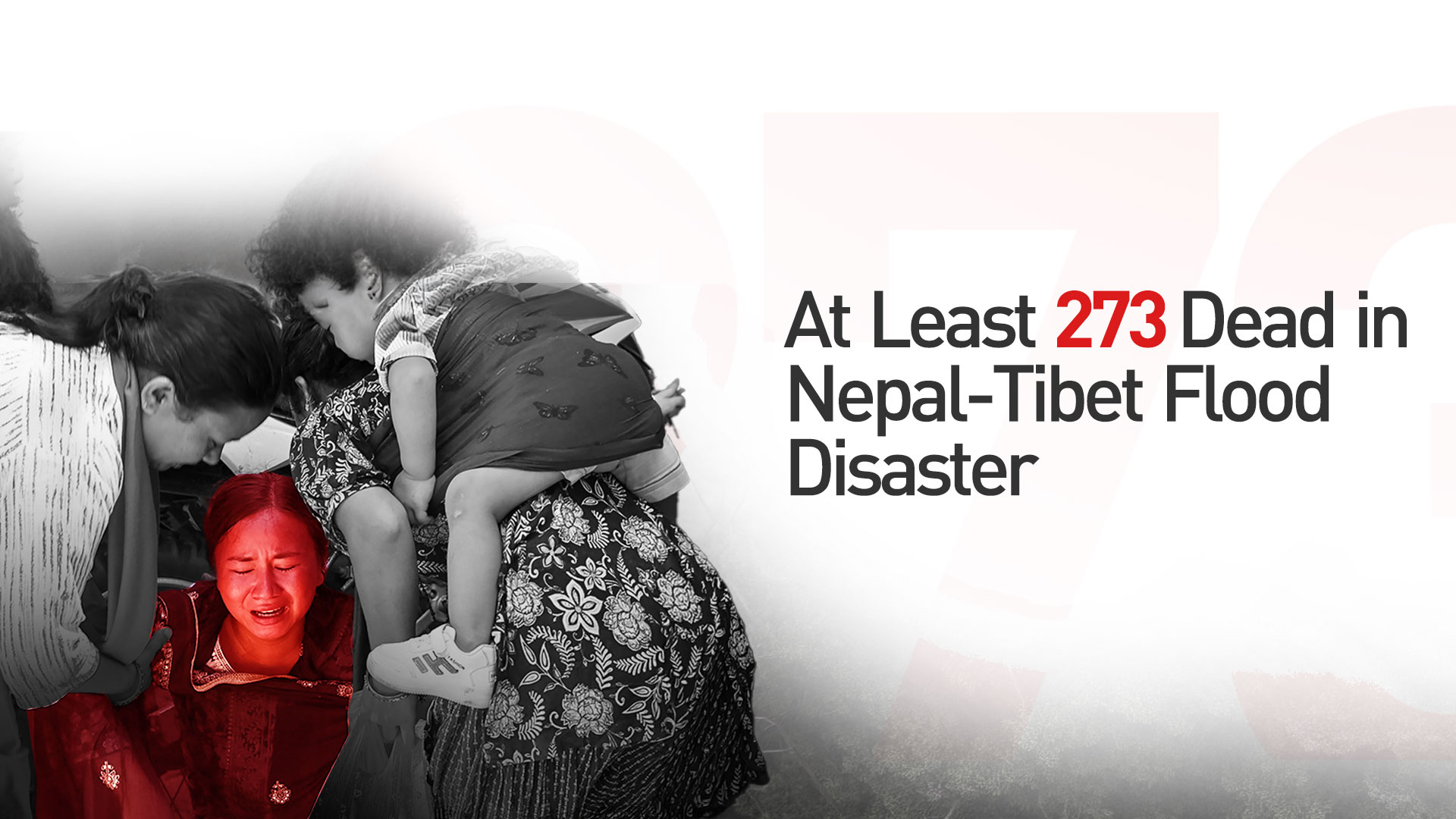
ERBIL (Kurdistan24) - The death toll from catastrophic floods in Nepal has risen to at least 270, police said Thursday, pushing the confirmed number of dead across the Nepal-Tibet border disaster to at least 273 as rescuers continued searching for more than 1,300 missing people.
Chinese state media has reported three deaths from the mudslide disaster around Gyirong Port in Tibet, while hundreds remain unaccounted for on both sides of the Himalayan frontier.
The revised toll marks a dramatic increase from earlier figures reported Thursday as rescue teams gain access to communities devastated by the sudden surge of water, mud and debris that swept south through steep mountain valleys Wednesday morning.
The Associated Press reported that 826 people remained missing in Nepal, while Chinese authorities said 558 were missing in Tibet. The figures have been changing as emergency teams identify bodies, restore communications and reconcile lists of people previously reported unreachable.
Hundreds of those still missing are foreign tourists and religious pilgrims.
Nepal's Tourism Board said 517 foreign nationals were among those unaccounted for in the country, including visitors from India, the United States, Australia, Britain, Malaysia, South Korea and other countries.
Chinese authorities said 260 foreigners were among those missing in Tibet.
Villages swept away
The disaster struck communities along the Bhote Koshi and Trishuli river systems with little warning, carrying enormous quantities of water and debris through towns and villages.
Residents and witnesses described a torrent powerful enough to destroy buildings, tear down bridges and carry vehicles downstream.
Drone footage showed buildings buried in thick mud, vehicles submerged in debris and entire areas transformed by the flood.
The small village of Soley in Nepal's Nuwakot district, which contained about 25 homes, was virtually wiped out, according to a local journalist whose relatives lived there.
Deaths have been reported across seven districts in Nepal, with some bodies recovered hundreds of kilometers downstream from the initial disaster zone.
Nearly 40 kilometers of roads and dozens of bridges were damaged, complicating rescue operations and isolating communities.
The Nepalese army deployed helicopters and said more than 100 people had been rescued from affected areas by Thursday morning. Foreign nationals were among those airlifted to Kathmandu, while people trapped at facilities connected to the Trishuli hydropower project were also evacuated.
The Nepal Red Cross Society has begun shifting toward large-scale relief operations as well, with about 1,200 people displaced from at least three villages.
China has mobilized hundreds of emergency personnel, sniffer dogs and boats in Tibet. Premier Li Qiang traveled to Gyirong on Thursday to oversee rescue efforts.
Glacier collapse triggered disaster
The US Geological Survey said the catastrophe was caused by a glacier collapse rather than an earthquake, revising its initial assessment after analyzing seismic data and satellite imagery.
The collapse produced an enormous debris flow that raced downstream with catastrophic consequences in Tibet and Nepal.
Environmental historian Ruth Gamble of La Trobe University described the rush of water and mud as an "inland tsunami," saying it traveled nearly 170 kilometers south into Nepal.
Climate researchers at the Kathmandu-based International Centre for Integrated Mountain Development said hydrological measurements demonstrated the exceptional speed of the flood wave.
At one point, water levels on the Trishuli River rose by as much as nine meters in approximately 30 minutes, according to the center.
The disaster highlights growing concern about instability across the Himalayan cryosphere.
Glaciers across the Hindu Kush Himalaya region are melting at an accelerating rate as temperatures rise, increasing the danger of glacial collapses, avalanches and glacial lake outburst floods.
Research published earlier this year found that rates of ice loss across the region have doubled since 2000.
Risk has not passed
Authorities warned Thursday that the danger was not necessarily over.
Large quantities of debris have blocked sections of the river system near the Nepal-China border, trapping water upstream and creating fears that another sudden release could produce a second flood.
A Nepalese government technical assessment said additional water flows could not immediately be ruled out.
Chinese authorities have also warned about an unstable barrier lake near the confluence of rivers in Tibet that is overflowing and could potentially burst.
Continued rainfall and unstable slopes have added to the difficulty facing rescue teams.
Meanwhile, families across Nepal and abroad are waiting for information about missing relatives.
Many foreign nationals were traveling toward or returning from Mount Kailash in Tibet, one of Hinduism's most sacred pilgrimage destinations, when the flood struck the border region.
The disaster has drawn international offers of assistance, with the International Federation of Red Cross and Red Crescent Societies sending emergency equipment including blankets, first-aid supplies, stretchers and body bags.
With hundreds still unreachable and entire communities buried beneath mud and debris, authorities cautioned that casualty and missing-person figures could continue changing.
The latest confirmed toll, 270 dead in Nepal and three in Tibet, already makes the disaster one of the most devastating Himalayan flood events in recent years, while the search for more than 1,300 missing people continues.