Iran's Supreme Leader Warns Internal Division Serves the Enemy
Iran's Supreme Leader Mojtaba Khamenei warned that sectarian, political and economic divisions serve Iran's adversaries as war and U.S. sanctions strain the country.
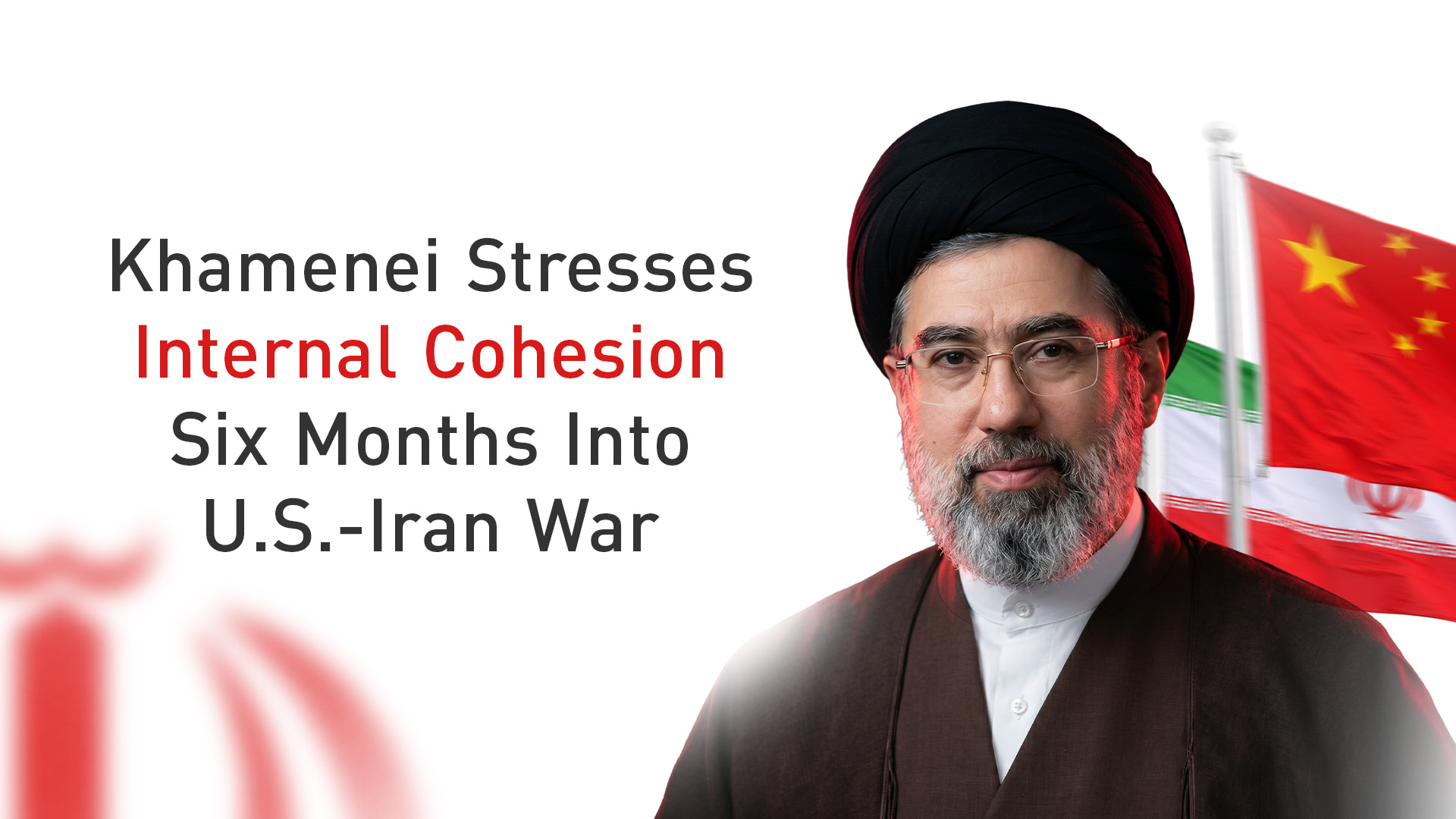
ERBIL (Kurdistan24) - Iran's Supreme Leader Ayatollah Seyyed Mojtaba Hosseini Khamenei has issued a sweeping warning against sectarian, ethnic, political and social divisions, saying any action that creates discord among Muslims ultimately advances the objectives of Iran's adversaries at a time when the country faces war, sanctions and growing economic pressure.
In a message marking Unity Week and the anniversaries of the births of the Prophet Muhammad and Imam Jaafar al-Sadiq, Khamenei called Muslim solidarity a strategic necessity rather than a ceremonial religious slogan.
The message was published by Iran's state-run IRNA, citing the website of the Office of the Leader of the Islamic Revolution.
Khamenei argued that Iran's adversaries seek to exploit much more than theological differences, pointing to racial, cultural, social, economic, political and geographic divisions as potential sources of fragmentation.
He warned that "anyone, in any position" who contributes to discord among Muslims serves the objectives of Islam's enemies, whether intentionally or otherwise.
The address comes amid an increasingly difficult domestic environment for Iran, six months into war with the United States and Israel and as Washington intensifies efforts to weaken Tehran economically.
Unity framed as strategic defense
The central theme of Khamenei's message was that Muslim societies become vulnerable when internal divisions override common political and religious interests.
He presented unity as requiring cooperation both within Iran and among Muslim-majority states, particularly across West Asia and the Persian Gulf.
Khamenei called on governments in the region to identify what he described as their true adversaries, explicitly naming the United States and Israel.
His language reflects the Iranian leadership's longstanding ideological framing of regional politics, but the renewed emphasis on internal cohesion carries additional weight under current wartime conditions.
Khamenei argued that ideological and religious disagreements are only one avenue through which hostile powers can weaken Muslim societies.
Economic inequality, political rivalry, ethnic differences and geographic disputes, he said, can similarly be transformed into instruments of conflict.
The Supreme Leader also held up Iran as an example of Muslim unity, maintaining that attempts to exploit divisions inside the country had achieved limited success.
That assertion comes as Iranian authorities are increasingly focused on the possibility that military pressure and economic hardship could translate into domestic unrest.
Economic pressure becomes harder to dismiss
Iranian President Masoud Pezeshkian acknowledged Friday that sanctions and wartime disruption are materially hurting the economy.
AFP reported Saturday that Pezeshkian rejected claims that sanctions have no impact, telling Iranian state television that the country must accept the reality of operating under wartime conditions.
According to the president, Iranian imports and exports have fallen by approximately 25% to 35% in recent months as the United States maintains a naval blockade around Iranian ports.
He also raised the politically sensitive possibility of increasing some gasoline prices as reduced trade makes it harder for Iran to cover domestic fuel shortages.
The comments were notable because Pezeshkian had only days earlier publicly insisted that the latest U.S. sanctions would fail to achieve their objectives.
Washington has intensified its pressure campaign under what the Trump administration calls "Operation Economic Outcast."
U.S. Treasury Secretary Scott Bessent has threatened further penalties against countries and companies continuing significant trade with Iran, while the naval blockade has constrained Tehran's access to maritime commerce.
The economic backdrop gives Khamenei's warnings about social and economic divisions a clear domestic dimension.
Iran's leadership is confronting the challenge of maintaining political cohesion while households face rising prices, reduced trade and uncertainty over how long the conflict will continue.
Hard-line leadership emphasizes cohesion
Associated Press journalists Lee Keath and David Rising reported Saturday that Iran's senior leadership has increasingly consolidated around veteran military commanders and hard-line clerics following the deaths of many senior figures during the U.S.-Israeli campaign that began in February.
Among the most consequential recent appointments has been former Revolutionary Guard commander Mohsen Rezaei as secretary of the Supreme National Security Council.
Hossein Taeb, a former intelligence chief with extensive experience in suppressing dissent, has meanwhile been placed at the head of the Basij, the Revolutionary Guard's nationwide volunteer organization.
AP's reporting described the appointments as evidence that Iran's leadership is focused simultaneously on confronting external threats and preventing internal instability.
Sascha Bruchmann of the International Institute for Strategic Studies told AP that the leadership appeared to be drawing experienced hard-line figures into its core in an effort to maintain cohesion.
The domestic significance of Khamenei's Unity Week message is therefore difficult to separate from the government's broader security posture.
His appeal to avoid division extends beyond Sunni-Shiite relations and explicitly encompasses political, economic and social fractures — precisely the areas in which wartime pressure could produce internal dissatisfaction.
Different approaches within Iran
The emphasis on unity does not mean Iran's ruling establishment is free of disagreement.
Pezeshkian has remained one of the strongest senior voices favoring a negotiated end to the war, arguing that prolonged confrontation carries mounting economic costs.
Harder-line figures have advocated a more confrontational approach toward Washington and warned that continued U.S. pressure could trigger renewed Iranian escalation.
AP's Keath and Rising cited Tehran-based political analyst Ahmad Zeidabadi as saying there are serious disagreements over Iran's future direction.
Those disagreements concern not only whether negotiations should resume but also the balance between economic necessity, military deterrence and ideological confrontation with the United States.
Khamenei's message did not address those internal policy differences directly.
Instead, it sought to establish a boundary between legitimate disagreement and what the leadership regards as politically dangerous fragmentation.
Regional unity directed against Washington and Israel
The message also contained an unmistakable regional dimension.
Khamenei urged rulers across Muslim-majority states, particularly in West Asia and around the Persian Gulf, to cooperate more closely and resist U.S. and Israeli influence.
He linked Muslim disunity to developments in Palestine and argued that greater coordination could strengthen regional states against external intervention.
The Supreme Leader described cooperation in security, economic affairs, knowledge and broader development as part of a longer-term vision for stronger Islamic societies.
Such language reflects Tehran's own geopolitical worldview and will not necessarily be shared by governments that maintain close security partnerships with Washington or diplomatic relations with Israel.
It also comes as Iran's relations with its neighbors are being tested by the war and the continuing dispute over the Strait of Hormuz.
Regional governments have been attempting to mediate between Tehran and Washington, while Gulf states remain deeply concerned about threats to shipping, energy exports and broader stability.
Unity as a wartime political message
The timing gives the religious message an unmistakably political character.
Iran faces direct military pressure, a U.S. naval blockade, tighter sanctions and growing evidence that the conflict is affecting ordinary economic life.
At the same time, the leadership has strengthened institutions responsible for domestic security and repeatedly warned against efforts it says are designed to exploit internal divisions.
Khamenei's Unity Week address brings those concerns together under a broader ideological framework.
For the Supreme Leader, unity is presented simultaneously as a religious obligation, a regional strategy and a form of national defense.
That message is likely to become increasingly important to Tehran if economic conditions deteriorate further.
Iran's leadership is publicly projecting confidence that the state can withstand external military and economic pressure. Yet Pezeshkian's acknowledgment of the sanctions' effects shows that the costs are becoming harder to minimize.
Against that backdrop, Khamenei's warning is directed as much inward as outward: external pressure, in Tehran's view, becomes most dangerous when it can be converted into internal division.