Iran Says It Struck U.S. Military Targets in Jordan and UAE
Iran says it struck U.S. military targets in Jordan and the UAE after Washington attacked Larak Island, reigniting direct fighting around the Strait of Hormuz.
ERBIL (Kurdistan24) - Iran said Monday that its armed forces had struck U.S. military targets in Jordan and the United Arab Emirates in retaliation for an American attack on Larak Island near the Strait of Hormuz, marking a sharp renewal of direct fighting after several weeks in which Washington had increasingly emphasized economic pressure over large-scale military action.
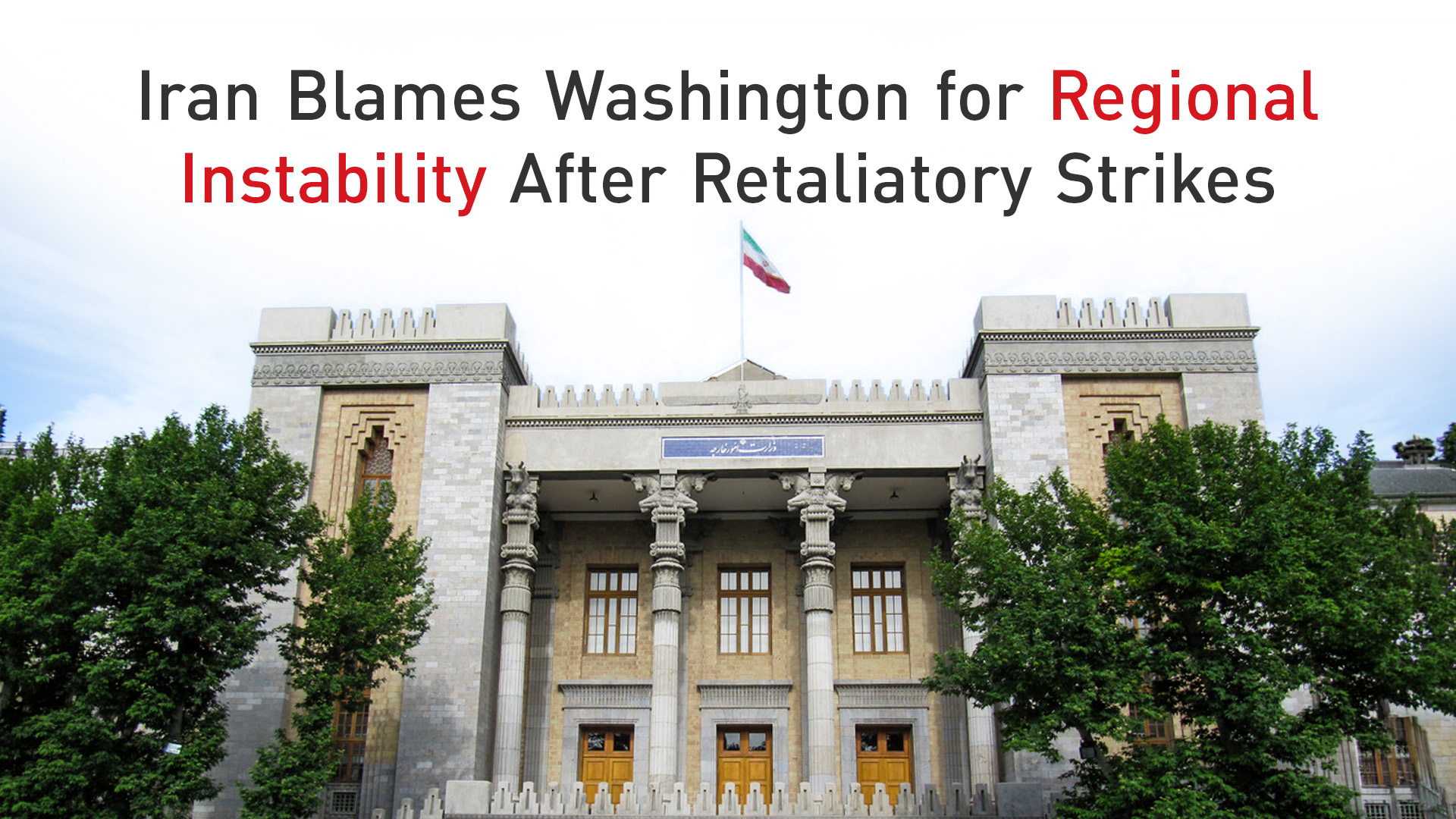
Iran's Foreign Ministry said the strikes were defensive responses to the U.S. operation on Larak Island, which Tehran described as a violation of Iranian sovereignty and territorial integrity.
The Iranian military separately announced that it had targeted Al Minhad Air Base in the UAE, while the Foreign Ministry confirmed strikes against U.S. military facilities in Jordan.
Tehran said the Jordanian facilities had been used as staging grounds for American attacks against Iranian territory.
The extent of any damage at the bases was not immediately independently established.
Jordan's armed forces said they intercepted eight missiles that entered the country's airspace early Monday, according to reporting by Agence France-Presse and The Associated Press. Jordan did not identify their origin in the statement cited by AFP.
Iran's Islamic Revolutionary Guard Corps, however, said its Aerospace Force had launched a combined missile and drone operation against what it described as U.S. facilities at King Hussein and Al-Azraq air bases.
The IRGC claimed ballistic missiles caused extensive damage to infrastructure and areas housing U.S. aircraft. No independent confirmation of those damage claims was immediately available.
Retaliation follows U.S. strike on Larak Island
The escalation began Sunday when U.S. forces attacked Iranian military positions on Larak Island, a small island near the Strait of Hormuz.
Washington said the operation targeted Iranian rocket launchers associated with an imminent attempt to lay additional mines in one of the world's most important maritime energy corridors.
U.S. Central Command described the operation as limited and precise, saying Iranian Revolutionary Guard personnel had been preparing rockets carrying sea mines for use in the strait.
"In essence, Iran created the threat and the U.S. military eliminated it to protect civilian mariners, commercial shipping, and the free flow of global commerce," CENTCOM said in a statement reported by The Associated Press.
AP journalists Konstantin Toropin, Cara Anna and Ben Finley reported that Sunday's operation was the first confirmed U.S. military strike on Iran in about a month, ending a relative lull in a conflict that has now lasted more than six months.
The IRGC said the U.S. attack caused deaths and injuries among Iranian personnel and civilians.
Iranian President Masoud Pezeshkian said Tehran had not sought renewed warfare but would respond to attacks against the country.
"We are not seeking war, but we will deliver a decisive response to the aggressors," Pezeshkian said, according to Iranian state television as cited by AFP.
Iran expands retaliation across region
By Monday, Tehran's response had spread well beyond Larak Island.
Alongside the attacks Iran said it carried out against facilities in Jordan and the UAE, Iranian state media reported missiles launched toward U.S. targets elsewhere in the region and toward American military vessels operating around the Strait of Hormuz.
Iran also claimed to have shot down a U.S. drone over the strategic waterway.
AFP bureaux in the Middle East and Washington reported that Tehran said it had targeted U.S. personnel at an air base in the UAE in addition to firing ballistic missiles at two facilities in Jordan.
The Iranian Foreign Ministry accused Washington and Israel of bearing responsibility for the deteriorating security environment, arguing that their military actions had destabilized maritime routes across the region.
That characterization reflects Tehran's position. Washington says Iran's mining operations, missile attacks and threats against commercial shipping are themselves the principal cause of insecurity in the Strait of Hormuz.
The Foreign Ministry warned that Iranian forces would respond forcefully to further attacks and said countries or parties assisting U.S. operations would share responsibility for the consequences.
The statement raises the stakes for regional governments hosting American military personnel or facilities, many of which have sought to contain the six-month conflict while maintaining longstanding security relationships with Washington.
Hormuz again at center of confrontation
The latest exchange is closely tied to the battle over the Strait of Hormuz, which has become one of the defining fronts of the war.
Before fighting began on Feb. 28, roughly one-fifth of global oil supplies passed through the waterway.
Iran has used mines, missile threats and attacks on vessels to restrict shipping, while the United States has conducted extensive mine-clearing operations, escorted commercial traffic and imposed a naval blockade on Iranian ports.
U.S. officials announced last week that recognized international shipping routes had been cleared of Iranian sea mines.
Navy Capt. Tim Hawkins, a CENTCOM spokesman, said U.S. forces were continuing to monitor the area and protect maritime commerce.
The military said Sunday that it had redirected 83 commercial vessels and disabled three under the blockade of Iranian ports, according to AP.
But the strait remains far from normal.
AP's Toropin, Anna and Finley reported that a multinational maritime coalition overseen by the U.S. Navy described commercial traffic as remaining at reduced levels.
President Donald Trump has repeatedly asserted that Hormuz is open and recently pointed to 24 vessels passing through the waterway.
That remains well below the roughly 130 ships that crossed the strait each day before the war.
A tanker was also struck Saturday by an unidentified projectile north of Khasab, Oman, according to the United Kingdom Maritime Trade Operations center. No casualties or environmental damage were reported, and responsibility for that incident remained unclear.
Renewed fighting challenges economic-pressure strategy
The exchange of attacks is particularly significant because the Trump administration had recently shifted much of its emphasis from sustained airstrikes toward economic pressure.
Washington has tightened sanctions, maintained its blockade and threatened governments and businesses that continue substantial commercial activity with Tehran.
Trump defended that strategy during an interview aired by Fox News, describing the blockade and financial pressure on Iran as highly effective.
He argued that Iran should never be allowed to acquire nuclear weapons and portrayed the campaign as necessary to prevent Tehran from threatening Israel and the wider Middle East.
Trump also claimed that Iran's conventional military capabilities and senior leadership had been severely degraded, adding that Iran is a "a failing nation right now. And at the right point, we'll either win or they'll do something."
Iran, meanwhile, has been presenting an opposite narrative.
Its Defense Ministry said over the weekend that weapons output had expanded significantly and claimed the country now produces more than 1,000 types of weapons and ammunition, with defense self-sufficiency exceeding 90%.
Iranian military officials have also adopted increasingly confrontational rhetoric, including an unusually explicit recent statement by a Khatam al-Anbiya Central Headquarters spokesman arguing that Iran needed nuclear weapons to deter Israeli attacks.
Tehran has not formally announced a decision to build a nuclear weapon, and Iranian authorities have historically maintained that the country's nuclear program is peaceful.
Economic and market consequences return
The latest military escalation immediately affected energy markets.
AFP reported that both major crude benchmarks rose at least 2% Monday.
AP reported that U.S. crude had risen 1.8% to $84.94 a barrel following the U.S. strike, while Brent crude gained 1.9% to $89.79.
The reaction reflects continuing uncertainty over whether shipping through Hormuz can return to normal while U.S. and Iranian forces remain engaged in direct attacks around the waterway.
Iran's restrictions on shipping have already contributed to higher energy and fertilizer prices internationally, while the U.S. blockade is placing growing pressure on Iran's own economy.
President Pezeshkian acknowledged last week that sanctions and wartime restrictions were affecting Iranian trade, saying imports and exports had fallen sharply in recent months.
The war is also generating political pressure in the United States as November midterm elections approach.
AFP cited Democratic Sen. Jack Reed, the ranking member of the Senate Armed Services Committee, as criticizing the administration's conduct of the conflict and arguing that its objectives had not been achieved after six months.
Trump, by contrast, has maintained that U.S. pressure is steadily weakening Tehran and has said he does not necessarily require a negotiated document to define victory.
Diplomacy pushed further into uncertainty
Monday's fighting comes after weeks of intensive mediation by Pakistan, Qatar and Oman aimed at preventing another major escalation.
A ceasefire reached in April reduced the most intense fighting, while Iran and the United States signed a memorandum in June intended to create a framework for ending the conflict.
Neither arrangement produced a lasting settlement.
Tehran continues to insist that Washington must return to the commitments it says were contained in the June memorandum, including provisions concerning sanctions, Iranian assets and navigation through Hormuz.
The United States has increasingly acted as though the military and economic balance has changed enough to justify a different negotiating framework.
That disagreement was already making diplomacy difficult before the latest exchange of fire.
The strikes on Larak Island and Iran's subsequent attacks in Jordan and the UAE now threaten to push those efforts further into the background.
The immediate question is whether Monday's attacks remain another contained exchange in an intermittent six-month conflict or open a new period of sustained military escalation.
Iran says any further U.S. attack will be answered.
Washington maintains that it will continue acting against Iranian forces it considers an imminent threat to commercial navigation.
With American military facilities spread across the region, Iranian missile and drone capabilities still intact, and the Strait of Hormuz remaining a central point of confrontation, the latest exchange again demonstrates how quickly the conflict can expand beyond Iranian territory and place neighboring states directly in its path.