Trump Says Iran Would Use Nuclear Weapon if It Had One
President Donald Trump called Iran a "failing nation" and argued Tehran would use a nuclear weapon if it possessed one, while defending the U.S. blockade and pressure campaign.
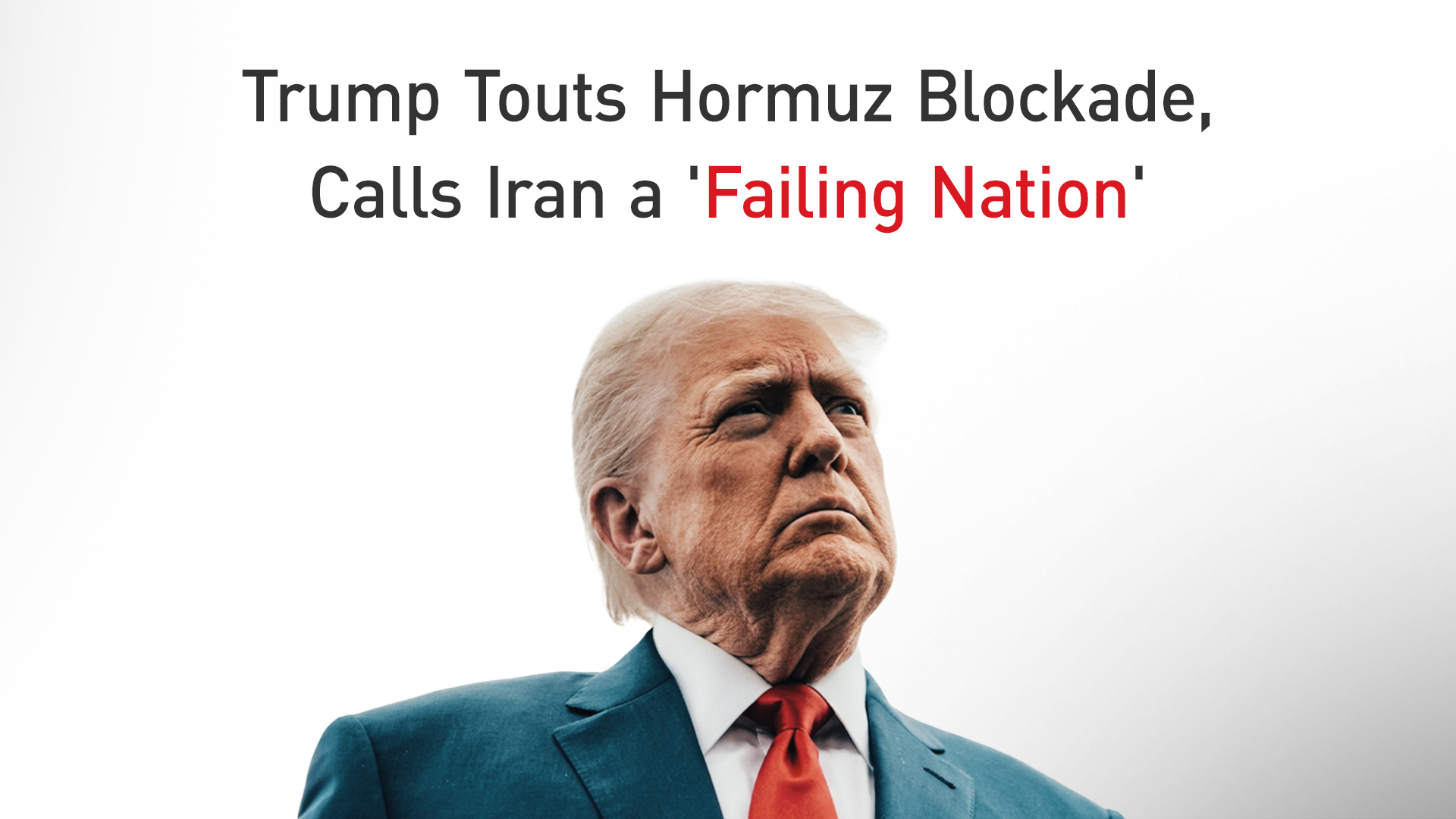
ERBIL (Kurdistan24) - U.S. President Donald Trump described Iran as a "failing nation" and argued that Tehran would use a nuclear weapon if it ever acquired one, defending the six-month U.S. campaign against the Islamic Republic as fresh military exchanges again spread across the Middle East.
Speaking on Fox News' Sunday Night in America with host Trey Gowdy, Trump portrayed preventing an Iranian nuclear weapon as the overriding justification for the conflict and said Washington's naval blockade and financial pressure were severely weakening Tehran.
"They cannot have a nuclear weapon," Trump said.
He later added: "They're a failing nation right now."
Trump's remarks aired as Iran launched missile and drone attacks against U.S. military targets in Jordan and the United Arab Emirates following an American strike on Larak Island near the Strait of Hormuz.
The renewed exchange has complicated Washington's recent effort to shift the focus of the war toward sanctions, a maritime blockade and economic pressure rather than sustained airstrikes.
Trump says Iran would use nuclear weapon
Pressed by Gowdy to explain to undecided U.S. voters why the Iran campaign was in America's interests, Trump repeatedly returned to Tehran's nuclear program.
He argued that allowing Iran to obtain an atomic weapon would pose an existential threat to Israel and potentially much of the wider region.
"If they had a nuclear weapon, Israel would be gone," Trump said.
Trump then went further, asserting that Iran's wartime attacks against several Gulf states demonstrated that Tehran would be prepared to use such a weapon if it possessed one.
"That means that if they would have had a nuclear weapon, they would have fired it," he said.
That is Trump's assessment of Iranian intent and cannot be independently established.
Iran has historically insisted that its nuclear program is peaceful and has not formally announced a decision to build a nuclear weapon.
However, rhetoric inside Iran has hardened sharply during the war. Kurdistan24 reported Saturday that Ebrahim Zolfaghari, spokesperson for Iran's Khatam al-Anbiya Central Headquarters, publicly argued that the country needed nuclear weapons to deter Israel.
That statement represented an unusually explicit departure from Tehran's traditional public rhetoric, but it was not accompanied by a formal change in Iranian nuclear doctrine.
Trump calls blockade 'unbelievable'
Trump also strongly defended the U.S. blockade of Iranian ports and the broader campaign to constrain Tehran economically.
"The blockade has been unbelievable," Trump told Fox News, adding that Washington was inflicting heavy financial pressure.
The president suggested he did not necessarily require a negotiated agreement to define success.
"I don't need a signature on a piece of paper," he said.
His comments reflect an increasingly confrontational U.S. position toward diplomacy after months of unsuccessful mediation.
Washington and Tehran agreed to a ceasefire in April and signed a memorandum in June intended to create a pathway toward ending the conflict. Both arrangements ultimately failed to produce a durable settlement.
Iran continues to insist that Washington must implement commitments it says were contained in the June memorandum before Tehran fully reopens the Strait of Hormuz.
The Trump administration increasingly argues that U.S. military and economic pressure has changed the balance of leverage enough that Washington does not need to return to the earlier framework on Iranian terms.
Renewed fighting tests Trump's strategy
Trump's comments come as military confrontation has again intensified around Hormuz.
Kurdistan24 reported Monday that Iran said it struck U.S. military targets in Jordan and the UAE in retaliation for the American attack on Larak Island.
Iran said its forces targeted Al Minhad Air Base in the UAE and U.S.-linked facilities at King Hussein and Al-Azraq air bases in Jordan.
Jordan's military confirmed intercepting eight missiles that entered its airspace, although Tehran's claims of extensive damage to U.S. facilities have not been independently verified.
The retaliation followed a U.S. strike Sunday on Iranian military positions at Larak Island.
Washington said Revolutionary Guard forces had been preparing rockets carrying sea mines for deployment in the Strait of Hormuz.
The U.S. military characterized the attack as a limited action intended to eliminate an imminent threat to shipping.
Associated Press journalists Konstantin Toropin, Cara Anna and Ben Finley reported that it was the first confirmed American military action against Iran in roughly a month, breaking a relative lull in direct attacks.
Hormuz remains far from normal
Trump has repeatedly presented the campaign around the Strait of Hormuz as a major American success.
U.S. Central Command says international shipping lanes have been cleared of Iranian sea mines and American forces continue protecting commercial traffic.
But maritime activity remains substantially below prewar levels.
AP's Toropin, Anna and Finley reported that a U.S.-led multinational maritime coalition described commercial traffic through the strait as still reduced.
Trump recently cited 24 vessels passing through Hormuz as evidence that the route was open.
Before the war, however, around 130 vessels crossed the waterway daily.
The distinction is critical because the conflict over Hormuz is no longer solely a question of whether ships can physically pass.
Commercial shipping companies and insurers must also be confident that vessels can transit without a significant risk of missile, drone or mine attacks.
A tanker was struck by an unidentified projectile north of Khasab, Oman, over the weekend, underscoring the continuing danger. No casualties were reported and responsibility remained unclear.
Competing narratives of Iranian strength
Trump used the Fox News interview to offer a sweeping assessment of Iran's military condition, claiming that Tehran's naval, air and air-defense capabilities had been devastated and much of its senior leadership eliminated.
Those claims broadly reflect the administration's assessment of the war, although the precise remaining strength of Iran's military is difficult to independently determine.
Tehran is advancing the opposite narrative.
Iran's Defense Ministry said over the weekend that weapons output has more than doubled since its 12-day war with Israel in 2025 and claimed the country produces more than 1,000 types of weapons and ammunition.
Iranian officials have also said the defense industry has achieved more than 90% self-sufficiency and is preparing additional weapons for future battlefield use.
Monday's missile and drone attacks themselves demonstrate that Iran retains the ability to strike targets beyond its borders even after months of U.S. and Israeli military operations.
War moves toward U.S. midterms
Trump's Fox appearance also placed the Iran conflict directly in the context of the November 2026 U.S. midterm elections.
Asked to make the case for the war to undecided voters, Trump framed the issue primarily around nuclear proliferation, Israel's security and the wider threat he says Iran poses to regional states.
His political argument is straightforward: whatever questions voters may have about the cost or length of the war, they should first decide whether Iran can be allowed to acquire a nuclear weapon.
For Trump, the answer determines the justification for the wider campaign.
"No, you cannot let them have a nuclear weapon," he said. "And they won't have a nuclear weapon."
Whether the administration can translate its military and economic pressure into a stable end to the conflict remains unresolved.
Iran has shown no sign of accepting Washington's current terms, while its renewed attacks in Jordan and the UAE have demonstrated the continuing capacity for regional escalation.
Six months into the war, Trump is nevertheless presenting Iran's economic difficulties and military losses as evidence that his strategy is working, and arguing that stopping Tehran from ever possessing a nuclear weapon remains the central measure by which that strategy should ultimately be judged.