How Kurdish Families Turn Wheat into Living Tradition
Discover how Kurdish families in Western Kurdistan turn wheat into bulgur through a centuries-old ritual of harvest, boiling, sun-drying and hand-milling passed down for generations.
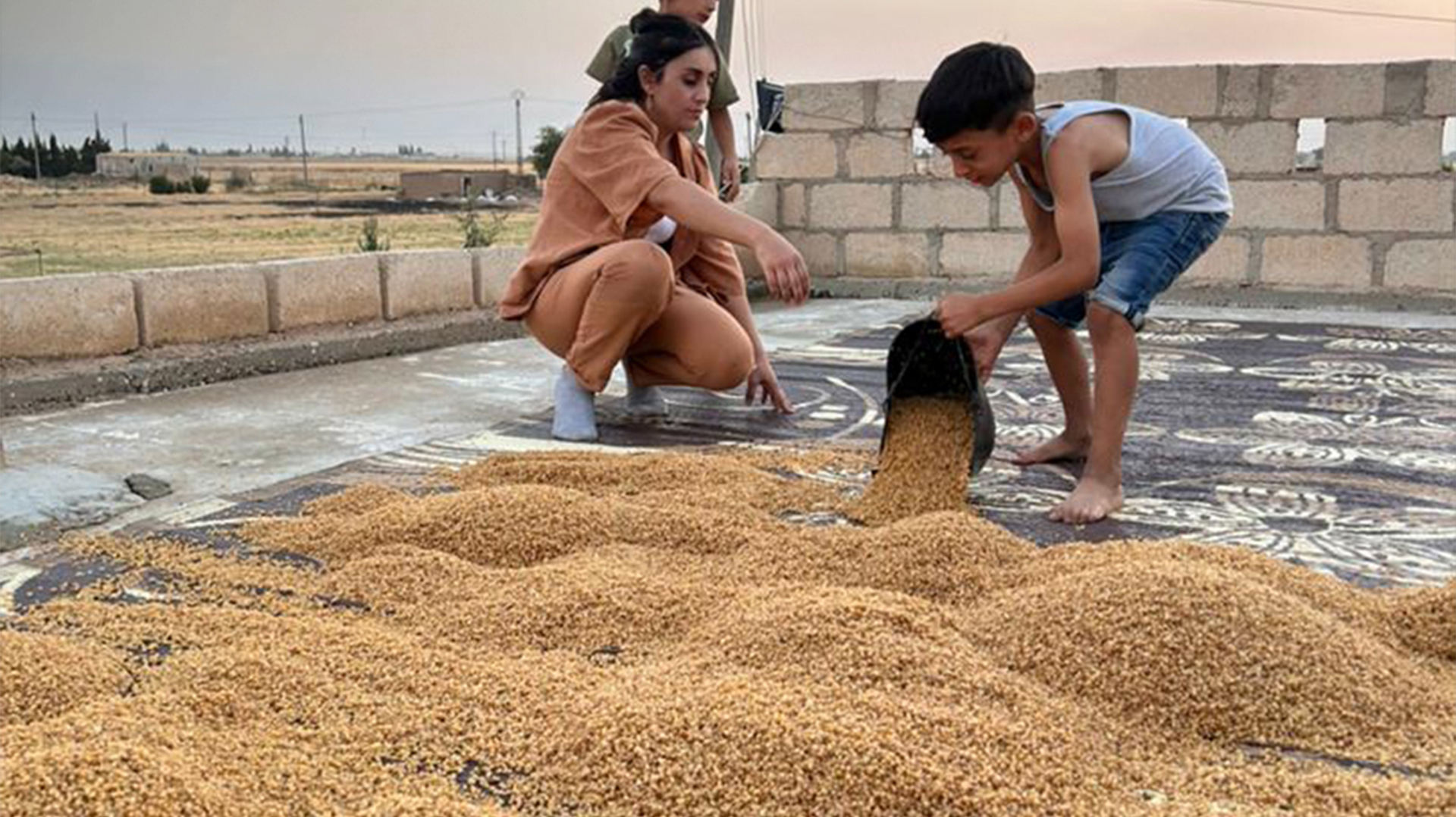
ERBIL (Kurdistan24) - Long before wheat reaches a dinner plate in Western Kurdistan (Northern Syria) — the Kurdish-populated Al-Jazira region — it passes through the hands of an entire village. Neighbors haul it up onto rooftops, women spin it through hand-carved stone mills, and children wait eagerly for the moment the grain is finally ready to eat.
The result is bulgur, a cracked-wheat staple that has fed Kurdish families here for generations and, for many, still tastes better than anything a factory can produce.
For outsiders, bulgur may look like a simple pantry item. In Western Kurdistan, it is something closer to a shared inheritance — a food whose preparation has, for centuries, bound families and neighbors together through harvest, fire, water and sun.
The process begins in the wheat fields themselves, where the harvest has traditionally been a communal affair known among Kurds by the terms Kar or. Men and women work the fields side by side, a division of labor that reflects a long-standing spirit of equality and cooperation within Kurdish households and communities.
Once harvested, the wheat does not go straight to the pantry. Generations of Kurdish families developed a method of boiling the grain as a means of preserving it and protecting it from spoilage, ensuring that households would have enough stored food, to last through the harsh winter months.

The boiling itself is done in a large communal pot called a Mêzer, and it is far from a solitary chore: neighbors gather around it in what amounts to a small local celebration.
After boiling, the wheat — now called Dan — is spread out across the flat rooftops of traditional Kurdish clay homes, left to dry and harden under the sun. It is deliberately turned over the following days so it dries evenly without scorching.
Before mechanized mills arrived in the region, no Kurdish household was complete without a Destar — a traditional hand-turned stone mill used to grind the dried wheat. Kurdish mothers and grandmothers ground the grain by hand at the Destar, often accompanied by folk songs and chants passed down specifically for the task. Once ground, the wheat is carefully sorted into two main types: coarse bulgur, known as Savar, long considered a staple of the Kurdish table and a historic alternative to rice, and fine bulgur, known as Gırar or Kofta, used to prepare kibbeh and other popular Kurdish dishes.
A Craft Passed Down: One Farmer's Story

Suad Nassan, a Kurdish woman originally from Afrin who now lives in the town of Amuda and owns farmland in the area, has watched this tradition unfold across her own fields for years. Nassan described the Jazira region as widely known for its agriculture, particularly wheat farming, which local families rely on both to feed themselves and to earn a living.
In an interview with Kurdistan24, Nassan said most of a household's wheat crop today is sent to the mills and factories for sale, with families setting aside only one or two large sacks of Dan, the boiled wheat, for their own household consumption. This year, her own land produced 60 large sacks of Dan. Of that harvest, Nassan kept one sack for herself and set aside several additional sacks for her children.
She was candid about the pressures farmers face season after season. "Among the difficulties farmers deal with are the lack of rainfall, the high cost of fertilizer and pesticides, and rising prices generally," Nassan said. "This affects everything, especially the rain."
Nassan walked through the agricultural calendar in detail. Farmers plant their fields in October and November, scattering seed and fertilizer before waiting for the rains to fall. By the following May and June, stretching into early July, the wheat is ready for harvest. It is gathered by combine, bagged, and taken to the local grain silo, with each household setting aside what it needs at home to prepare saliqa later in the year.
"Whatever a household needs, they bring it home to make saliqa, and they keep it stored until September, when they finally prepare it," Nassan explained.

She also described how the process was once done entirely without machinery. "Before mills existed, they would boil the wheat properly, and then women would grind it by hand using the traditional stone mill," Nassan said, referring to the Destar. Even today, with mechanized mills widely available, many families continue milling by hand out of habit and preference rather than necessity. "This custom has remained as a tradition, not as a necessity, because now people can simply buy ready-made bulgur," she said. "But bulgur made by hand still tastes better than what comes from the factories."
Nassan also recalled the physically demanding side of the process — carrying the boiled wheat up to the rooftops for drying, a task traditionally left to the men of the household because of the strength required. Women, meanwhile, handled the delicate work of separating the grains once boiled, dampening them slightly with water so they would not stick together before spreading them out to dry on carpets laid across the rooftops.
Sharing the Harvest: The Tradition of Zakat
Alongside the wheat set aside for household use, Nassan said families also set apart a portion of their harvest as zakat, a religious tithe amounting to 10 percent of the crop.
"Whoever does not give zakat is stingy, and there will be no blessing left in their harvest," Nassan said. "Zakat goes to people who do not own land, so they too can make saliqa and are not deprived of bulgur. This is both a religious and a social custom."

September Ritual: When Neighbors Share the Harvest
Nassan described the wheat-boiling season as a fixed date on the community calendar, typically falling around September 15 or in the early days of that month. On that day, families across the region prepare their wheat together, regardless of whether they farmed it themselves.
"Everyone who has wheat — whether they grew it or not — takes part," Nassan said. "Those who did not farm buy the wheat, and those who cannot afford to buy it are given wheat by their neighbors, who share what they have. Every year, people boil it together to make bulgur."
She described the full sequence in vivid detail: cleaning and sifting the wheat, boiling it in a large pot of heated water for roughly an hour and a half to two hours over a wood or dung fire, then distributing portions among neighbors and children before spreading it across rooftop carpets to dry.
"After it's boiled, the neighbors and everyone helps one another," Nassan said. "The neighbors and children come by, we share it out, and it makes the children happy — it brings joy into their hearts." Over the following two days, families climb back up to the rooftops daily to turn the drying wheat, ensuring it dries evenly without being scorched by the sun. Once fully dry, it is taken to the mill and sorted into fine bulgur for dishes like tabbouleh and kibbeh, and a coarser variety used in other traditional meals.

Yellow Gold: Wheat's Place Alongside Cotton and Oil
For Nassan and many others in the region, wheat sits alongside two other resources that have long defined Jazira's economy. "As you may know, the Jazira region is famous for white gold, black gold and yellow gold," she said. "White gold is cotton, black gold is petroleum, and yellow gold is wheat."
That description reflects wheat's deep economic and cultural weight across Western Kurdistan. A few years ago, Nassan noted, many families had begun relying more heavily on factory-made bulgur as mechanized production expanded. Even so, she said, the homemade version made through the traditional method remains, in her view, simply better.
The tradition's roots run deep into the region's history. According to the historical and geographic heritage of Mesopotamia, Kurds are counted among the peoples of the Zagros Mountains and the Jazira who played a foundational role in humanity's historic shift from a pastoral, herding way of life to settled agriculture — a transition that included the development of grain-processing tools such as the Destar.
For decades, bulgur has served as a pillar of economic and food resilience for Kurdish families, providing a measure of self-sufficiency that reduced dependence on imports or outside markets. That resilience is mirrored at the regional level: the plains of Jazira, with their Kurdish majority, form a vital artery and food basket for wheat production across Syria. Kurdish farmers continue to invest in and develop their land to safeguard this strategic crop, contributing alongside other communities to more than half of the country's total wheat output — a share that makes Kurdish farming a cornerstone of bread and bulgur production for the wider country.
Despite the rise of factory production, the ritual Nassan describes — the shared boiling pot, the rooftop drying, the turn of the stone mill, and the sacks of zakat set aside for neighbors without land — has not disappeared. It persists not out of necessity, but because, as she put it, nothing from a factory quite matches the taste of bulgur made by hand.