Baghdad Highlights Challenges of Bringing Weapons Under State Control
Iraqi Foreign Minister Fuad Hussein discussed bringing weapons under state control, U.S.-Iran de-escalation and Iraq-U.S. relations with Atlantic Council Iraq Initiative director Victoria Taylor.
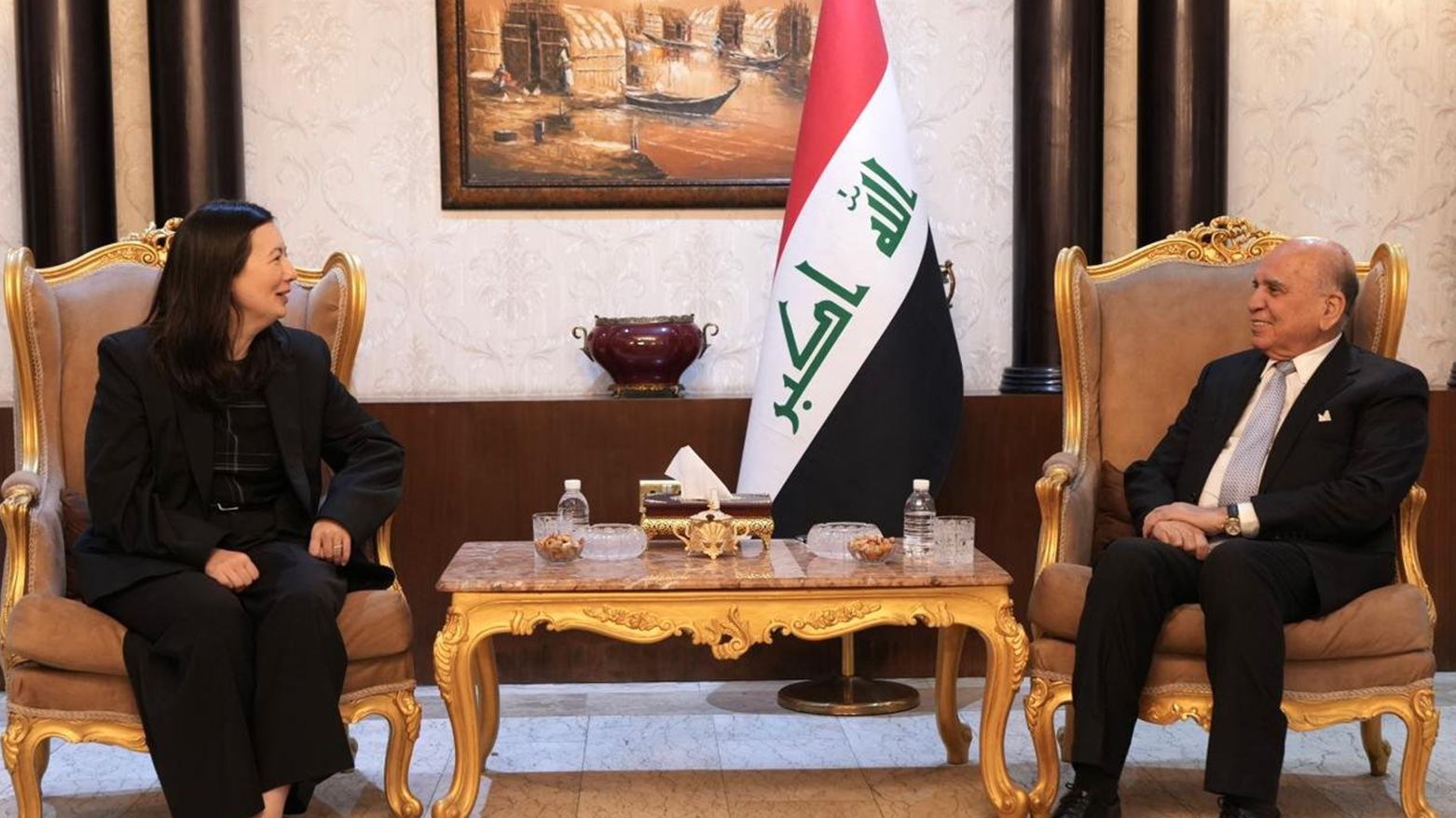
ERBIL (Kurdistan24) - Iraqi Foreign Minister Fuad Hussein discussed Baghdad's efforts to bring weapons under state control and the challenges facing that policy during a meeting Friday with Victoria Taylor, director of the Atlantic Council's Iraq Initiative, as Iraq seeks to reinforce state authority while navigating renewed tensions between the United States and Iran.
According to a statement from Iraq's Foreign Ministry, Hussein received Taylor in Baghdad for talks covering regional developments, Iraq-U.S. relations and initiatives aimed at reducing tensions between Washington and Tehran.
A central part of the discussion concerned the Iraqi government's effort to regulate weapons and ensure that armed force remains under state authority.
The two sides reviewed both the government's measures and the obstacles facing implementation, the ministry said.
The meeting comes as the government of Prime Minister Ali al-Zaidi has made control of weapons one of its principal security priorities.
Baghdad has repeatedly said decisions on war and peace must remain with constitutional institutions and that armed formations operating independently of the recognized security structure cannot be permitted to determine national security policy.
The issue has gained particular importance ahead of the Sept. 30 deadline for the conclusion of the international coalition's mission in Iraq.
Government spokesman Haider al-Aboudi said earlier that the Constitution prohibits the formation of armed groups outside official security institutions and described bringing weapons under state control as a return to normal constitutional procedures.
Read More: Iraq Says Formation of New Armed Groups Is Constitutionally Prohibited
The government has increasingly linked the end of the coalition mission with a broader assertion of Iraqi sovereignty: foreign forces withdraw, Iraqi security institutions assume full responsibility and armed authority is concentrated within the state.
Several armed factions, however, have attached conditions to disarmament or resisted the idea of surrendering their weapons entirely, creating one of the most sensitive security challenges facing the Zaidi government.
Deputy Parliament Speaker Farhad Amin Atrushi has backed the government's approach while stressing that the Kurdistan Region's Peshmerga forces should not be included in the same category as armed groups operating outside constitutional structures.
Atrushi has argued that the Peshmerga's status derives from Article 121 of Iraq's Constitution.
Hussein and Taylor also reviewed regional developments, particularly initiatives aimed at easing tensions between the United States and Iran.
The subject has become increasingly urgent after renewed U.S.-Iran military exchanges this week, including Iranian attacks against U.S. military targets in several regional states and fresh American strikes on Iranian positions.
Iraq has sought to avoid becoming a theater for those confrontations and has repeatedly emphasized that its territory should not be used to launch attacks against neighboring countries.
Baghdad is also economically exposed to escalation between Washington and Tehran.
During a separate meeting Thursday with U.S. Chargé d'Affaires Steven Fagin, Hussein warned that Iraq remains particularly vulnerable to disruption in the Strait of Hormuz because of its heavy dependence on oil exports and revenues.
Read More: Iraqi FM, U.S. Chargé d’Affaires Discuss Political and Security Developments in Baghdad
That meeting also covered U.S. sanctions against Iran, Iraq's political and security situation and Baghdad's efforts to bring weapons under state control.
Friday's talks with Taylor also addressed Iraq's relationship with the United States and ways to expand bilateral cooperation following the Iraqi prime minister's recent visit to Washington.
Baghdad is seeking to redefine its relationship with Washington as the formal coalition mission winds down, shifting toward direct bilateral cooperation in security, economic and diplomatic affairs.
That transition includes continued U.S. military sales and training even as coalition forces prepare to leave.
Washington recently approved a possible $800 million Foreign Military Sale of helicopters and related equipment to Iraq, part of Baghdad's broader effort to strengthen its independent defense capabilities.
For Hussein, the weapons-control issue therefore sits at the intersection of domestic security, Iraqi sovereignty and foreign policy.
As the Sept. 30 coalition deadline approaches and regional tensions remain high, Baghdad faces the challenge of demonstrating that it can consolidate armed authority inside the state while maintaining balanced relations with Washington, Tehran and its other regional partners.