Iraq's 2027 Budget Draft Cuts Kurdistan Region Allocation
Iraq's 2027 draft budget raises federal spending to 217.2 trillion dinars but cuts the Kurdistan Region's listed allocation by 19.3%, with investment falling sharply.
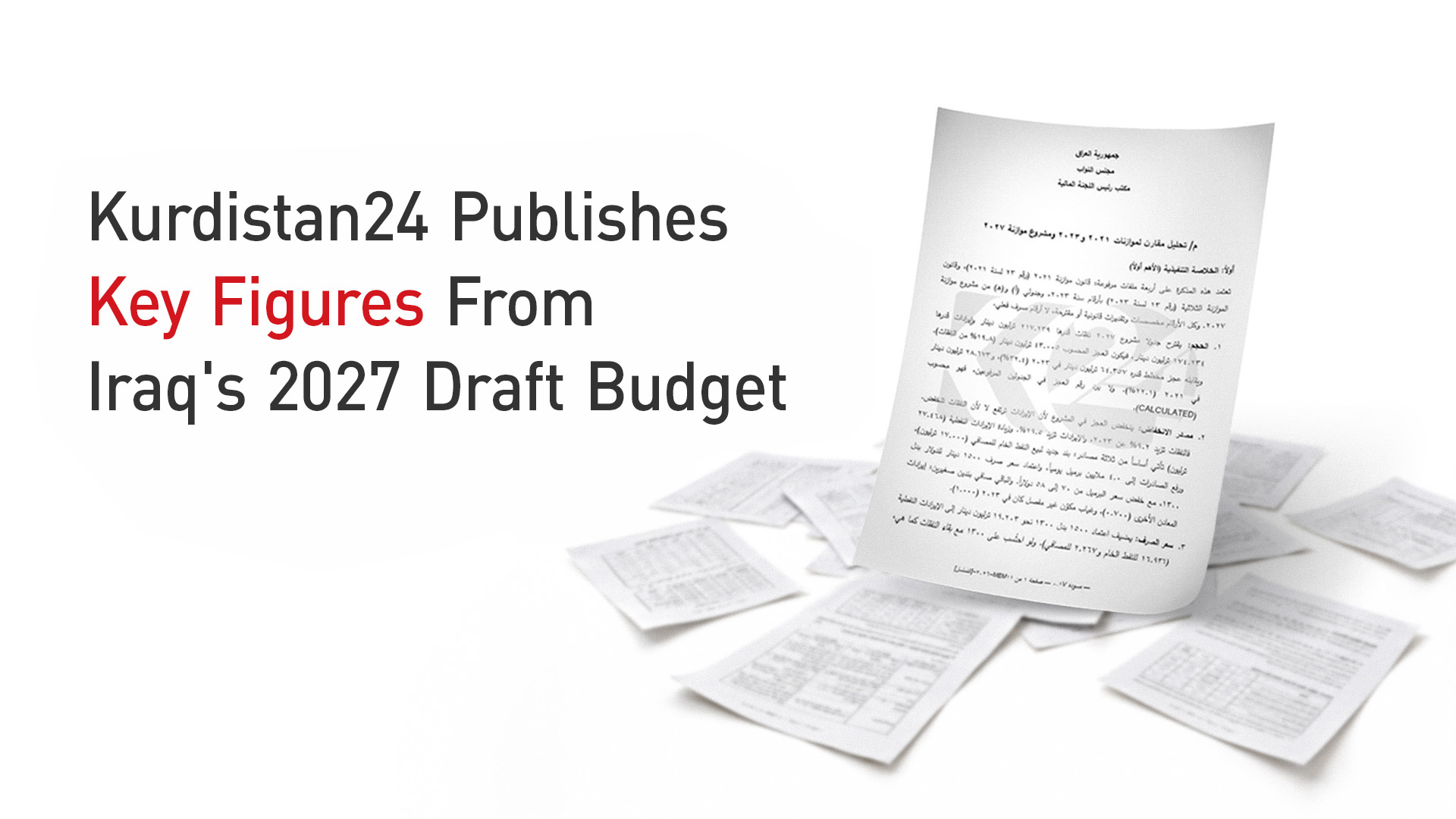
ERBIL (Kurdistan24) - Iraq's 2027 draft budget proposes higher overall spending and substantially stronger revenues than in 2023, but the allocation listed for the Kurdistan Region moves in the opposite direction, falling by nearly one-fifth while its investment component drops particularly sharply.
A comparative memorandum from the Office of the Chairman of the Iraqi Parliament's Finance Committee, examining the 2021 and 2023 budgets alongside Tables A and E of the 2027 draft, puts the Kurdistan Region's proposed allocation at 13.308 trillion dinars.
That compares with 16.498 trillion dinars in 2023, a decline of 19.3%. The equivalent figure in 2021 was 11.482 trillion dinars.
The Region's listed item amounts to 6.1% of total proposed expenditures, compared with 8.3% in 2023 and 8.8% in 2021.
The memorandum, however, makes an important distinction: that percentage should not be treated as the Kurdistan Region's legal “share” of the federal budget.
The 6.1% figure simply compares the Region's listed budget item with total federal expenditures. Under the previous budget laws, the Region's legal share was calculated from actual expenditure after excluding sovereign expenditures.
The memorandum says the corresponding 2027 table establishing that calculation was not among the documents examined.
Investment Takes the Sharpest Hit
The clearest reduction for the Kurdistan Region is in investment.
The draft allocates just 499 billion dinars in investment expenditure to the Region, down from 2.784 trillion dinars in 2023.
That means the proposed investment allocation is less than one-fifth of its previous level.
The memorandum also lists employee compensation for the Kurdistan Region at 10.210 trillion dinars, compared with 9.300 trillion in 2023, while social welfare rises from 1.158 trillion dinars to 2 trillion dinars.
The combination suggests that while some operating components increase, the overall regional allocation still declines because of the severe contraction in investment and other components.
The Kurdistan Region is not alone in facing weaker investment spending.
Federal investment expenditure as a whole falls from 54.253 trillion dinars in 2023 to 47.897 trillion dinars in 2027, a reduction of 11.7%.
Once investment for the Ministry of Oil and the new aggregated “Program and Performance Entities” category is removed, investment for the remaining entities drops even more sharply, from 33.533 trillion dinars to 20.396 trillion dinars, a decline of 39.2%.
Bigger Budget, Smaller Deficit
The reduction in the Kurdistan Region's allocation comes despite an increase in Iraq's overall proposed budget.
Total expenditures reach 217.239 trillion dinars, 9.2% above the 2023 figure of 198.910 trillion.
Projected revenues rise much faster, climbing by 29.5% to 174.234 trillion dinars.
That produces a calculated deficit of 43.005 trillion dinars, equivalent to 19.8% of expenditures.
The memorandum stresses that this deficit does not appear directly in the two 2027 tables examined but is calculated by subtracting revenues from expenditures.
The deficit is smaller than the 64.357 trillion dinars planned for 2023 and, as a share of expenditure, below both the 2023 and 2021 levels.
The reason is not austerity.
Iraq plans to spend more, but it also expects to collect much more.
Oil, Exchange Rate Drive Revenue Increase
Oil remains central to that calculation, accounting for 83.1% of total revenues.
Published oil revenues rise from 117.253 trillion dinars in 2023 to 144.720 trillion dinars in the draft.
The increase relies on several major changes.
The draft assumes exports of 4 million barrels per day, compared with 3.5 million barrels in 2023, while lowering the assumed oil price from $70 to $58 per barrel.
It also uses an exchange rate of 1,500 dinars per U.S. dollar, rather than the 1,300 rate used in the 2023 budget.
According to the memorandum's calculations, the exchange-rate change alone adds approximately 19.203 trillion dinars to projected oil revenues.
If the exchange rate remained at 1,300 dinars while expenditure stayed unchanged, projected revenues would fall to 155.031 trillion dinars and the deficit would rise to 62.208 trillion dinars, or 28.6% of expenditures.
The draft also introduces a major new revenue line: 17 trillion dinars from the sale of crude oil to refineries.
The memorandum calculates that this corresponds to approximately 776,256 barrels per day at $40 per barrel and an exchange rate of 1,500 dinars.
But it also flags the item for clarification because no separate equivalent appeared in the 2021 or 2023 tables.
Among the questions raised is whether the 17 trillion dinars represents an actual cash inflow into the Treasury or an accounting transfer between state entities.
More Revenue Outside Oil - But Oil Still Dominates
Non-oil revenue is projected to rise sharply to 29.514 trillion dinars, 70.6% higher than in 2023.
The main increases come from public-sector profits, other revenues and commodity taxes.
Public-sector profit transfers rise from 3.300 trillion dinars in 2023 to 7.524 trillion, while other revenues increase from 2.166 trillion to 5.904 trillion.
Commodity taxes and production fees more than double to 5.917 trillion dinars.
Income and wealth taxes, however, decline to 5.703 trillion dinars, 10.3% below 2023 and 38.9% below 2021.
The Finance Committee memorandum notes that the draft tables do not explain the basis used for estimating several of these higher non-oil revenue items.
More Spending Locked Into Salaries and Welfare
A large portion of the proposed budget is also tied to relatively inflexible expenditure.
Employee compensation rises by 8.951 trillion dinars, reaching 68.125 trillion.
Social welfare climbs to 33.032 trillion dinars, an increase of 8.329 trillion, while debt service rises to 17.015 trillion dinars.
Together, employee compensation, social welfare and debt service account for roughly 118.2 trillion dinars, or 54.4% of total expenditure.
Commodity spending also more than doubles, rising from 12.344 trillion dinars to 26.437 trillion dinars.
Part of that increase appears inside a new aggregated category called Program and Performance Entities, valued at 41.931 trillion dinars.
The memorandum says the category lacks a detailed breakdown in the attached tables, making direct comparison difficult.
Some entities that had individual allocations in 2023 no longer appear separately in 2027. The memorandum says Electricity, Diwaniyah and Salah al-Din are reported to fall within the aggregated category, while the inclusion of Higher Education is inferred and still requires verification.
Kurdistan Oil Assumption Unchanged
The draft continues to include 400,000 barrels per day from the Kurdistan Region in its revenue assumptions, the same quantity used in the 2023 budget.
The Finance Committee memorandum notes that this figure remains part of the revenue calculation even as the Region's listed expenditure allocation falls.
Under the 2023 law, the Kurdistan Region was required to deliver at least 400,000 barrels per day to Iraq's State Organization for Marketing of Oil, SOMO, at Ceyhan, or to the federal Oil Ministry when exports were not possible, subject to provisions covering production and transportation costs.
The full legal text of the 2027 draft was not included among the files examined, meaning the memorandum cannot establish whether those obligations have been changed, retained or rewritten for the coming year.
That absence is important because the budget tables alone do not reveal all of the legal conditions that could ultimately govern transfers between Baghdad and Erbil.
A More Revenue-Dependent Budget
The draft's fiscal position is therefore stronger on paper than in 2023, but that improvement rests heavily on revenue assumptions.
The memorandum calculates that every $1 change in the oil price affects revenues by about 2.190 trillion dinars, while every 100,000-barrel change in daily exports is worth approximately 3.176 trillion dinars.
Every 100-dinar movement in the exchange rate changes projected revenue by about 9.601 trillion dinars.
At the draft's assumptions, the calculated break-even oil price is $77.64 per barrel at an exchange rate of 1,500 dinars.
The budget itself assumes only $58.
For the Kurdistan Region, however, the immediate issue is more direct.
Iraq's overall proposed spending rises by 9.2%, yet the Region's listed allocation falls 19.3%. Its investment allocation drops from 2.784 trillion dinars to only 499 billion.
At the same time, the Finance Committee analysis cautions against describing the Region's 6.1% of total expenditures as its legally determined federal budget share, since the table required to establish that calculation is not included.
The figures therefore show a clear reduction in the allocation currently listed for the Kurdistan Region.
Whether that figure becomes the Region's final entitlement, and under what financial, oil and revenue conditions, cannot be determined from the attached draft tables alone.
This report was updated on Tuesday, Oct. 6, 2026, at 01:37pm.