CRS Says 81 US Military Aircraft Lost or Damaged in Iran War, Nearly Double May Count
Iranian Foreign Minister Abbas Araghchi cites the revised Congressional Research Service assessment as evidence of higher US military losses
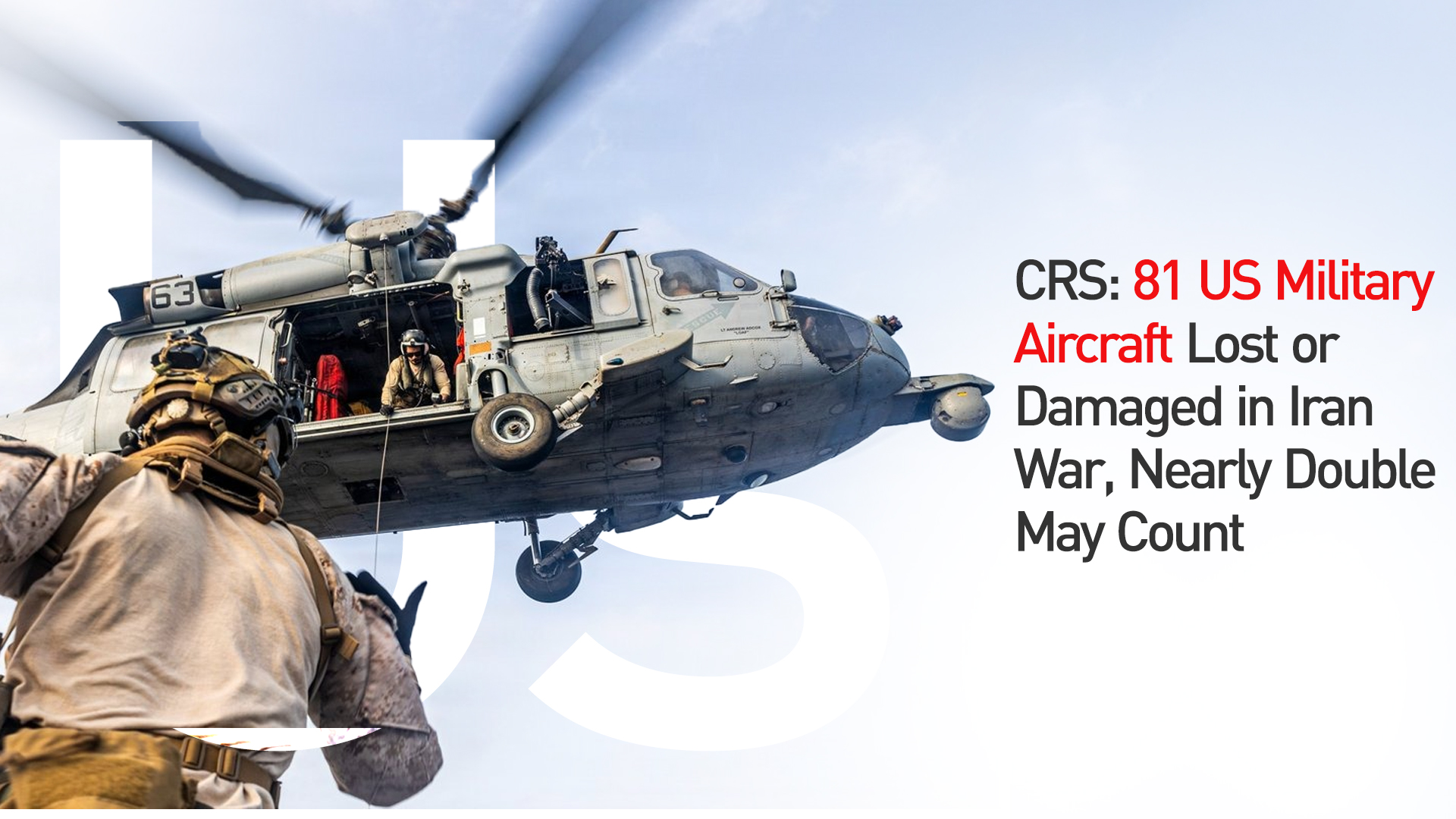
ERBIL (Kurdistan24) — A revised Congressional Research Service (CRS) report has listed 81 US military aircraft as lost or damaged since Washington launched Operation Epic Fury against Iran on Feb. 28, nearly doubling the 42 aircraft counted in an earlier CRS assessment in May.
Iranian Foreign Minister Seyed Abbas Araghchi cited the revised figure on Thursday, claiming that the actual US military losses were significantly higher and questioning the US military’s transparency over the damage sustained during the war.
“In May, the Congressional Research Service admitted that Iran’s Armed Forces had taken out 42 U.S. military aircraft. Now: 81. Real toll is far higher,” Araghchi wrote on X. He also questioned why US Central Command would not allow a sitting senator to inspect military bases that Washington says remain operational.
In May, the Congressional Research Service admitted that Iran’s Armed Forces had taken out 42 U.S. military aircraft. Now: 81. Real toll is far higher. Proof? CENTCOM won’t let a sitting Senator inspect bases it claims are fine. You can fool all the people some of the time... https://t.co/eB3fRrJFt4
— Seyed Abbas Araghchi (@araghchi) October 8, 2026
The updated CRS report, revised on Oct. 5, includes aircraft losses and damage identified through public information, including Defense Department and US Central Command statements, news reports and a Sept. 14 Pentagon inspector general report.
However, CRS cautioned that its figure should not be interpreted as a tally of aircraft destroyed. “Some damaged aircraft may have been returned to active service,” the research service said, adding that the count could still change because of classification, continuing combat activity and questions over attribution.
The revised assessment includes aircraft damaged during an Iranian strike on Muwaffaq Salti Air Base in Jordan in September, helicopter losses identified through the Pentagon inspector general’s report and a substantially higher number of MQ-9 Reaper drones.
The MQ-9 Reaper accounts for more than half of the aircraft included in the CRS tally. The drone is used by the US military for intelligence, surveillance and reconnaissance, close air support and combat search and rescue missions.
The list also includes some of the US military’s most advanced aircraft, including an F-35A fighter jet and an E-3 Sentry airborne early warning and control aircraft equipped with a large radar dome for tracking targets and managing airspace.
The deadliest incident identified in the report remains the March 12 crash of a KC-135 Stratotanker in western Iraq, which killed all six crew members aboard. US Central Command said at the time that the aircraft’s loss was not caused by hostile or friendly fire.
Another KC-135 in the report was forced to make an emergency landing at Ben Gurion Airport in Israel.
The revised tally also includes the loss of an MH-60S Sea Hawk helicopter from the aircraft carrier USS George H.W. Bush in the Arabian Sea on July 1. Three of the four crew members were recovered, while the Navy later suspended its search for Cmdr. Gabriel Edwards, the commanding officer of Helicopter Sea Combat Squadron 5. The Navy said there was no indication that hostile action caused the incident.
According to figures cited by the Congressional Budget Office, the estimated value of the aircraft lost or damaged ranges from $1.9 billion to $3.3 billion, depending on whether the Defense Department replaces or repairs the affected aircraft.
The aircraft losses represent only part of the broader financial cost of the conflict. US war costs have been estimated at at least $45 billion, according to figures cited by CNN, excluding damage to US military infrastructure in the region.
The CRS report also highlights questions for Congress over the Pentagon’s reporting of US military losses and whether lawmakers are receiving sufficient information to assess the impact of the aircraft losses and determine the need for repairs, replacements and additional funding.
The report raises broader concerns about the impact of the war on US military readiness and its ability to maintain forces outside the Middle East. It also questions whether the US defense industrial base has sufficient capacity to replace damaged or destroyed aircraft while maintaining military sales commitments to foreign partners.
The growing number of MQ-9 losses has drawn particular attention. Air Force Chief of Staff Gen. Kenneth Wilsbach previously described the Reaper as the military’s “most valuable player” in the war with Iran, while an Atlantic Council assessment in September said 45 MQ-9s had been lost in the Middle East during 2026.
The Atlantic Council report described the rate of Reaper losses as alarming and said the Air Force had lost about 35 percent of its MQ-9 fleet since the aircraft entered service in 2004.
The revised CRS assessment does not establish that all 81 aircraft were destroyed by Iranian attacks. Rather, it provides a publicly sourced tally of US military aircraft that have been lost or damaged during the conflict, with some damaged aircraft potentially already returned to service.
The sharp increase from the 42 aircraft identified in May nevertheless provides a new indication of the scale of US military equipment losses during the conflict and is likely to fuel further scrutiny in Congress over the Pentagon’s reporting and the longer-term impact of the war on US military capabilities.