IRGC Spokesman: Iran Has Defeated The World's Biggest Superpower
Speaking in Tehran, Mohebbi says Iranian resistance forced the US to abandon regime-change and partition goals, claims US oil reserves have fallen, and mocks American threats as increasingly unserious.
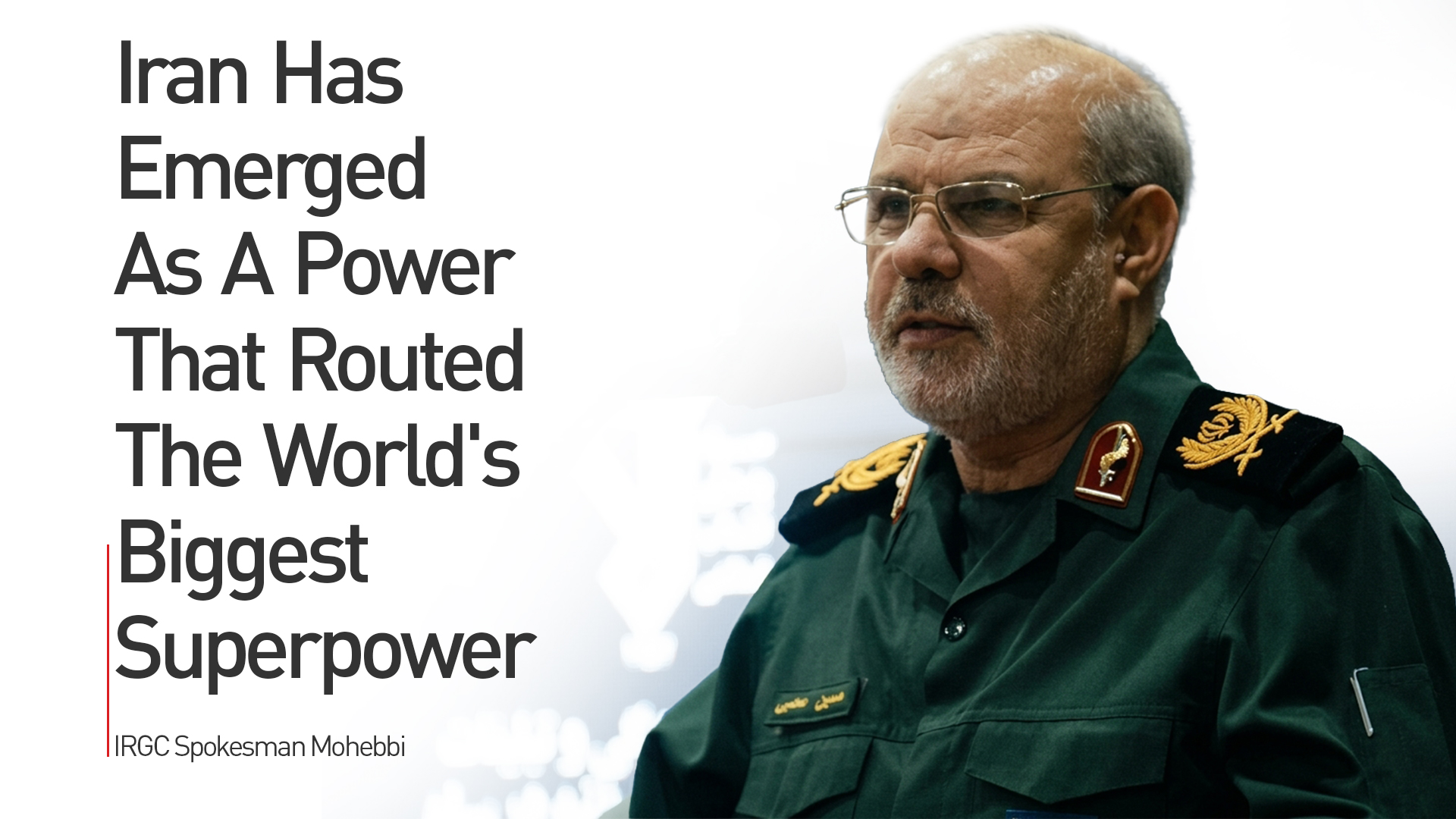
ERBIL (Kurdistan 24) - Islamic Revolutionary Guard Corps spokesman Sardar Hussein Mohebbi declared on Monday that Iran has emerged as a power that routed the world's biggest superpower, that the United States failed in all three phases of the war and was forced to abandon its original goals, that President Trump is a criminal without any doubt, and that American threats are now more amusing than serious, in one of the most sweeping single Iranian military assessments of the conflict to date.
Speaking at a ceremony marking the unveiling of new publications by the 27th Ba'ath Publishing House at the Sacred Defense Garden Museum in Tehran, Mohebbi said: "Today Iran has emerged as a power that has routed the greatest superpower in the world, and this great honor belongs to Iran today. This event, this phenomenon, and this great achievement makes the duty of each and every one of us heavier than before."
Three Phases of the War
Mohebbi outlined a three-phase framework for the conflict. In the first phase, he said, the enemy had two main objectives: first, to change the Islamic Republic system, and second, to partition Iran into smaller countries and multiple pieces. "The enemy gradually retreated from its objectives when it witnessed the resistance of the Iranian people, which arose from the rich culture of this nation, and ultimately arrived at the issue of reopening the Strait of Hormuz, in which it also failed," he said.
He said the enemy initially believed it could force Iran to surrender within a few days, but what happened in practice was contrary to its assumptions and calculations. After 25 days, he said, the enemy began scrambling to identify mediators and intermediaries to end the war through a memorandum of understanding. "With the entry of mediators into the field, this process continued until the thirty-ninth day, and ultimately the enemy signed the memorandum out of desperation and inability," Mohebbi said.
The MOU Collapse
Mohebbi provided Iran's account of why the June memorandum of understanding collapsed. "We all acknowledged that the enemy was a covenant-breaker and knew it would not remain committed to its obligations," he said. "At the very time negotiations were underway, we declared that our finger is on the trigger and if the enemy commits the slightest breach of promise, we will pull the trigger."
He said the enemy again broke its covenant by pressuring Oman to redirect ship traffic routes southward, thereby violating Article Five of the memorandum. "We pulled the trigger as we had previously warned," Mohebbi said, in the first specific Iranian official identification of the Omani routing pressure as the mechanism that triggered the MOU's collapse.
America's Weakened Position
Mohebbi argued that American power is now weaker than at the start of the conflict while Iranian power has grown stronger. "If the enemy had the ability to do this, it would certainly have done it earlier," he said. "Today the enemy's power is weaker and ours is stronger. When they could not achieve their objectives at the peak of their power, they certainly will not be able to do so today with weakened power. Therefore, the statements and threats of the enemy are more amusing to us than something we would take seriously as a reality."
He claimed that America's strategic petroleum reserve has fallen from 415 million barrels to 263 million barrels, of which 150 million are not extractable, and said America today cannot fuel its own vehicles and has become dependent on others for aluminium and microchips. He said the war produced an economic inversion that undermined the American claim to economic supremacy and the dollar's status as a tool of dominance.
On Trump
Mohebbi was direct about his assessment of the American president. "Trump is a criminal person and there is no doubt about his being a criminal. He has committed numerous crimes in this short period and it is not unlikely that he will commit crimes again," he said. He added that the very nature of America is built on crime and that listing American crimes across the world would produce a very long list.
He also contrasted Iranian consistency with what he described as American contradictions. "When we say something, we act on it. We are not like the American president who says one thing in the morning, says something else in the afternoon, says something contradictory at night, and then the next morning rejects everything he said the day before," Mohebbi said. "No, we stand by what we say and act on it. Because we believe in our goals and our principles and we believe in the righteousness of ourselves and the things we say."
On Hormuz
Mohebbi returned to the Hormuz file directly. "The enemy had defined the basis and philosophy of its presence as ensuring the security of energy flows and freedom of navigation," he said. "We made the enemy lose this. After several decades of presence in the region, America could not open the Strait of Hormuz and could not even guarantee the transit of energy through a single channel."