‘No Peace Without Us’: Ukraine’s Envoy to Iraq Confronts Regional Fallout
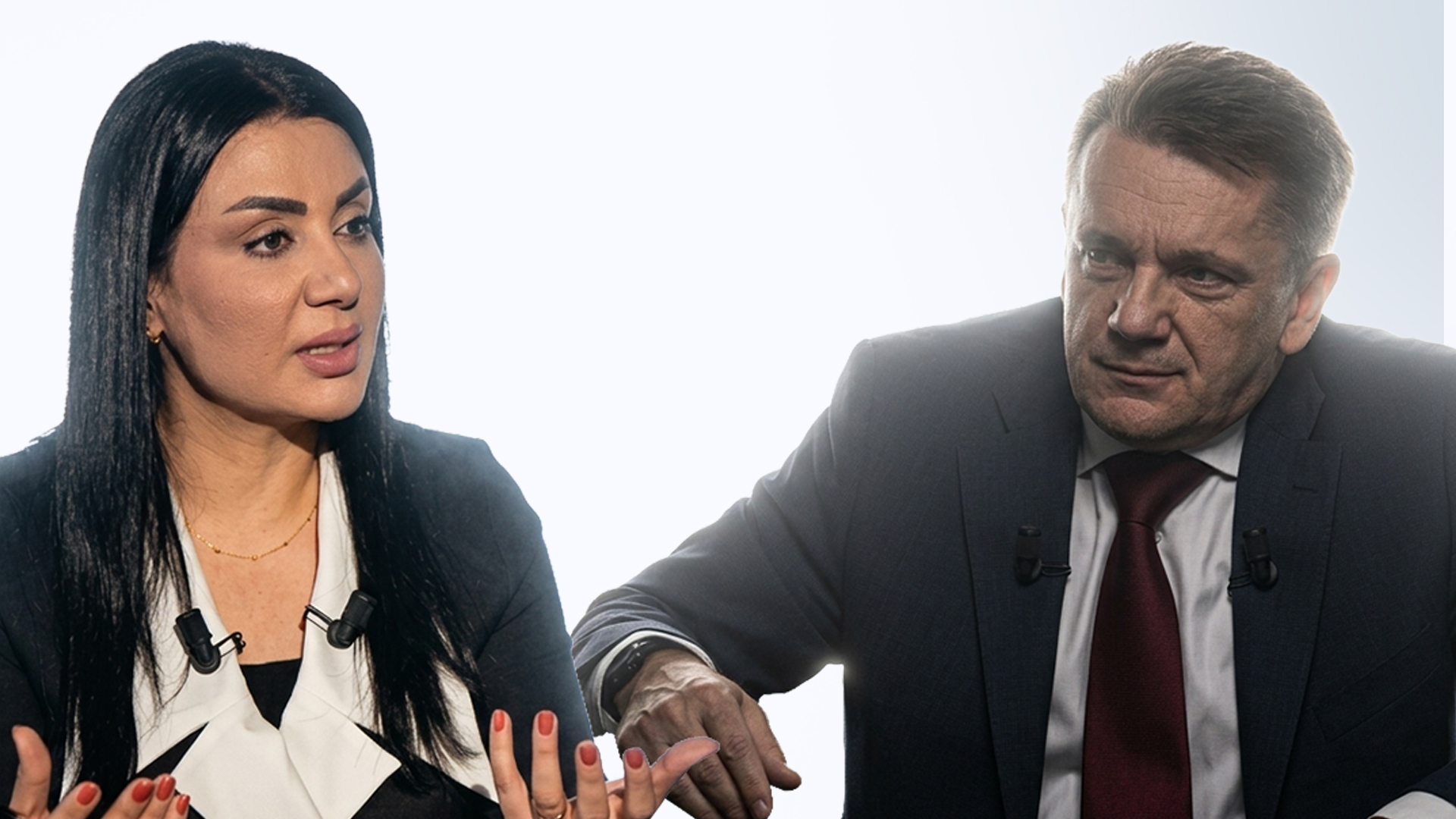
ERBIL (Kurdistan24) - In a wide-ranging and candid interview on Kurdistan24’s flagship current affairs program Basi Roj, hosted by Zhino Muhammad on Tuesday, Ukrainian Ambassador to the Republic of Iraq Ivan Dovhanych laid bare Kyiv’s resolve amid protracted conflict, touching on geopolitics, military technology, and bilateral relations.
From firmly rejecting diplomatic solutions negotiated without Ukrainian representation to addressing reports of Iraqis recruited into Russia's ranks, the ambassador underscored that genuine peace cannot be achieved through territorial concession.Dovhanych also offered deeply personal reflections on the human toll of the war—including his own son serving on the front lines—while discussing consular challenges, shared cultural parallels with the Kurdish people, and the future of Ukrainian–Iraqi relations.
Zhino Mohammed:
Good day, distinguished viewers. The war between Russia and Ukraine has now been ongoing for five years, leaving a significant impact on the entire world and our region, particularly the Middle East.
This is one dimension of our discussion today. The other focuses on Ukraine’s ties with Iraq, the nature of Ukraine’s relations with the Kurdistan Region, and what the future holds for Ukraine. Will this war come to an end? Will diplomacy and peace prevail, or will drones and warfare win the day?
Today, I will discuss these topics—along with several other questions—with His Excellency Ivan Dovganych,, the Ukrainian Ambassador to Iraq, who has graciously joined us here in the Kurdistan 24 studio.
Mr. Ambassador, welcome to Kurdistan 24, and thank you very much for this opportunity.
To begin, I would like our conversation to start with the Kurdistan Region, and then we will gradually delve into the other topics. First, how do you assess the current state of relations between Kyiv and the Kurdistan Region, and how can these ties be further developed?"
Ivan Dovganych:
Um our relations are very important for Ukraine. First of all I would like to say that the traditionally uh Kurds and Ukrainians have a very warm, friendly relations and uh via going to go further to increase the level of our relations. Uh for example the importance for my country for relations with the region reflects the decision of the government of Ukraine need uh recently to open consulate general in Erbil. And now we apply to the government of federal government in Baghdad for the official approval because it needs the decision of the Baghdad to open our consulate general, so we are waiting for that approval and since that approval will be made we are ready to uh move very very fast.
Zhino Mohammed:
Is it possible, then, that you will be opening your consulate in Erbil anytime soon? Because for years, there has been talk of Ukraine opening a consulate in Erbil—could this finally become a reality this year?
Ivan Dovganych:
I don't know it because this question does not depend on me unfortunately, uh frankly speaking this on my idea I am I am with this idea for 20 years. First time I initiated the openness of consulate general 20 years ago in 2006 when I was chargé d'affaires of Ukraine in Baghdad. At that time I understood that it's impossible to to develop our relations with all Iraq including Kurdish region without having our separate diplomatic mission in in in Erbil and I initiated this to open consulate uh which would be at the same time the trade mission uh in Erbil, but unfortunately at that time the decision was not made. Now uh our government estimated the perspective of relations with the Kurdish region and uh decided to to to have that Ukraine have to has our consulate general in in in in this city.
Zhino Mohammed:
Could you elaborate on this vision? Beyond the opening of the consulate, what else does Ukraine’s political vision toward the Kurdistan Region entail?
Ivan Dovganych:
Um okay it's very important because you know being in Baghdad it's sometimes very difficult for us to um to to deal with the visas, so to give to give services for citizens Iraqi uh citizens and Ukrainian citizens living in Iraq uh in in I mean in a region. We organize monthly so called mobile consular days. Our consul is traveling to Erbil once a month for few days uh but it's not enough for our level of our relations that uh the task of the uh consulate general will be also of course visas uh issues at at the same time it will be trade mission so called uh the hub uh uh uh good for so acceptable for Kurdish business circles and uh it allows us to have a direct relations between business communities in Ukraine and in Kurdistan because there are if you perhaps know a lot of so called middleman who uh helps to to develop the trade between two two two countries between Iraq and and Ukraine, but at the same time the customers the buyer is pays more because uh uh every middleman gives to price.
Zhino Mohammed:
Yes, you have mentioned the trade and commercial ties between Ukraine and the Kurdistan Region several times. As we speak, are there any private-sector joint ventures or direct Ukrainian investments currently underway in the Kurdistan Region?
Ivan Dovganych:
Yes it is and we also we have a Ukrainian International Chamber of Commerce branch here in in in in Erbil uh in which represent represents the interest of Ukrainian Ukrainian come companies here, but I think that when we have a diplomatic mission it will be much easier.
Zhino Mohammed:
"Indeed. While we are on the subject of trade and the economy, let us not forget that—despite the fallout of the war—Ukraine remains one of the world's leading producers of wheat and agricultural goods; that much is clear. At present, could you tell us what volume of Ukrainian commodities, such as wheat, flour, and sunflower oil, is being exported? And has this ongoing war not taken a heavy toll on your agricultural sector?
Ivan Dovganych:
Um for your understanding Ukraine really is one of the biggest world uh exporter of sunflower oil and other same agricultural products. Uh even during the war the importance is growing and growing because you know not the situation with the instability is not just in Ukraine and a lot of regions in the world depending on Ukrainian uh Ukrainian products. Uh Iraq is not depend depending from Ukrainian grain, but uh it's one of the biggest world buyer of Ukrainian sunflower oil. And as far as I understood the majority of our export goes through Kurdistan. That is why important to be present here constantly and I hope that uh after I we open our consulate general the amount general amount of our trade will grow not not not by growing the amount of just sunflower oil, but other goods will also easily uh go to to to not just to Kurdistan, but uh our business communities as far as I know consider Kurdish region as a stable region in a very unstable neighborhood which opens a possibility and will play as the role of some gateway for the much more wider uh region.
Zhino Mohammed:
You mentioned your desire to expand the volume of trade and further advance commercial ties in the Kurdistan Region. What I would like to know, however, is how has the Kurdistan Regional Government received these proposals of yours? How have your companies been received here in the Kurdistan Region?
Ivan Dovganych:
Which government?
Zhino Mohammed:
Kurdistan Regional Government
Ivan Dovganych:
Uh you know I didn't discuss with the government yet this, but I am absolutely sure that they will support this attitude uh since my contacts yesterday and today show me that they uh accept this with with with very very good estimation, so we have we are we are welcomed in in in Kurdistan and they support.
Zhino Mohammed:
Very well. Setting aside the topic of Ukraine’s relations with Iraq and the Kurdistan Regional Government for a moment, let us turn to the Russia-Ukraine war. It has now been ongoing for five years, leaving a profound impact across the globe—particularly on European nations, as well as the Middle East.
Mr. Ambassador, to start: what has this war given you, and what has it taken away from you?
Ivan Dovganych:
Sorry um I didn't didn't catch. There is no positive sides in the war uh uh we know we are suffering we are suffering from the war and I know that Kurdish having such a difficult history uh they understand Ukrainians much much better than other nations in in the world. So for us uh uh it is really um very very difficult and terrible years of war. No one in in in the world wants peace more than Ukrainians want.
Zhino Mohammed:
We will address the subject of peace shortly, as a year ago right here on Kurdistan 24, you spoke about Ukraine's desire for peace. I certainly intend to ask about peace, but first: you noted that war is never good—and indeed, nobody wants war. Yet, looking at the direct impact on Ukraine, in which sector have you suffered the heaviest toll and sustained the greatest damage: healthcare, the economy, society, or the military?
Ivan Dovganych:
Wartime is a very challenging time for uh for for for any country uh would connected Ukraine for example uh it is examination of all parts of the mechanism state mechanism uh uh country. Uh for example local self government uh 10 years ago 12 years ago we started administrative reform in our country which gives uh new power to the local self government for example it's it's an example and the uh significant part of taxes collected uh in the villages or in in small cities are staying with with them and the mayor elected by by population is responsible for using this. So what does it mean during the war? When war started there was no mayor escaped from his position. All system of self government, state and uh ensured the stability of uh of of of of of of of few Ukraine. People, population seeing that the authorities are uh uh acting they are they are they are they not turn to the panic.
Zhino Mohammed:
Throughout five years of war, has Ukraine not lost its stability? Do you truly believe you still remain stable?
Ivan Dovganych:
Everything is functioning in Ukraine uh of course not like in a time of peace, but we even during the most difficult time uh we are uh uh our universities are working, our schools are working, uh students are studying uh and what mean regarding foreign foreign students for for foreign. We issued for them all possibilities to study uh personally, online or combining these possibilities.
Zhino Mohammed:
You spoke about peace: is Ukraine ready for a definitive peace, or perhaps a long-term ceasefire? And if you are open to either option, what are your terms and conditions?
Ivan Dovganych:
So peace peace is our of course in our demand and our desire and our dream because no one wants peace more than the Ukrainians, but it should be peace not ceasefire uh ceasefire and and uh break before new invasion giving time. We have to to see a peace which guarantees us that it's a long term peace. Uh but what can we do? We are we are we appreciate the efforts of the United States and we are grateful personally to President Trump for his for his um attempts to to establish peace or even even proclaim ceasefires, but last last example when President Trump proclaimed uh so called energy uh ceasefire and the and the President Zelensky supported this idea at that very night Russia uh responded by sending 200 drones and 16 missiles against Ukraine. And the uh on the morning half million of Ukrainian uh families uh stayed without power. This was most support, if you asking me when the peace will be established it is nobody knows and it is the answer is not in Kyiv or in Washington, the answer is in Moscow.
Zhino Mohammed:
Are you prepared to cede the territory currently under your control for the sake of peace, or do you insist on holding onto it?
Ivan Dovganych:
No we we we we we we we we we we we we never going to agree with that because you know it dose not even depend on the president the territory of Ukraine internationally is protected by the constitutional of ukraine its absolutely impossible this territory’s destiny without the opinion of all Ukrainian people, so you need at least a Referendum for that, but it is impossible to have referendum or elections during the War.
Zhino Mohammed:
He was discussing the elections and addressed the role of the United States. The U.S. President remarked, saying:
'The time has come for a new president to be designated in Ukraine. What do the Ukrainians have to say about this?
Ivan Dovganych:
no problem with that this Idea to have election in Ukraine, was first sounded by the Russian, and because they seek instead of Zelenskyy, the Ukrainian will have some new leader who will capitulate but another thing is, it is impossible from the legal point to have elections in Ukraine because according to our legislation there is no election possible in the War time, as in the majority of the European countries, recently our president said, ok we are ready to change our legislation and to have elections in Ukraine if we have at least 60 days of sees-fire, but I can add that in this time even if some one hope that some one will came instead of Zelenskyy, Ukraine will see some other leader who will be softer with Russian, its a great mistake, its very high likely that Zelenskyy will be reelected or another leader will come and he will be even tougher with Russia.
Zhino Mohammed:
Ukrainians have confidence in Zelenskyy for another presidential term?
Ivan Dovganych:
It Dose not matter who is the person Ukrainian trust the strong Policies made with the government, so our strong position , the majority of the population is in favor of the government, and Zelenskyy is popular because he is reflecting the over half the majority of Ukrainian, Ukraine will never surrender.
Zhino Mohammed:
Yes, understood. A trilateral meeting between the United States, Russia, and China is scheduled to be held regarding an end to the Russia–Ukraine war. However, Ukraine is not a participant. If any decision is reached at this meeting, will Ukraine accept it? Or should Ukraine really be excluded from such a meeting?
Ivan Dovganych:
I don't know what— So, we will see what kind of decisions they will make. If it will be acceptable for Ukraine, Ukraine will... So, it is not a matter— I would like to speak about concrete decisions. All leaders can meet at any other— at any time, at any place, but finally, everything will be decided and solved by the Ukrainian nation. Not even— not by the Ukrainian president. The Ukrainian nation is the main actor in this war.
Zhino Mohammed:
Yes. Before I forget—the Russia–Ukraine war is unfolding in an era defined by technology and advancement. Could Mr. Ambassador tell us what role artificial intelligence has played in this war on the Ukrainian side?
Ivan Dovganych:
It's a very complicated issue, because you know, of course, we developed our technologies very, very well. It helps us to fight with the much more strong and bigger enemy. But for people in the world, it seems that we have some wonder weapon, some counter-drone systems able to shoot down any drone.
But the secret of success is a bit another. Ukraine really has unique experience, but the experience is lying very often in a very easy things—in civil life, for example. If you have the best developed weapon, it does not guarantee that your population will be in a safe.
The task of the authorities starts from the, for example, warning system. The population has to know where to go during the missile attack. Then, you have to protect your main strategic targets. Sometimes it's very, very easy and cheap: covering by nets, surrounding by T-walls will help to protect that objects—for example, power plants, or water supplies, or data centers, or something like that.
Then, everything depends on people. Well-trained crews able to fix very fast any damaged object are vitally important. In Ukraine, we have really very well-trained crews.
So, in this connection, of course, Ukraine developed unique experience, and we are ready to share with other countries.
Zhino Mohammed:
Right, you mentioned diverse experiences and knowledge-sharing. At the outset—one might say around the outbreak of the Iran–[Israel]–U.S. conflict—President Zelenskyy visited the Gulf states and pledged support. Could you tell us: is that support still ongoing? Within what framework did this assistance take place? How exactly did you support the Gulf states? And have you shared these wartime technological advancements with them?
Ivan Dovganych:
As far as I know, yes, but I don't know details because I'm not involved in a process. For your understanding, military cooperation is also the matter of negotiations between governments, but not through the media, so I am not able to give you much more.
But as far as I know, our people working with Gulf governments also started from very practical steps that should be made: to protect by nets, protect main objects by T-walls, to develop warning systems, and so on and so on. So it's a complex question, because the war of the 21st century is not a war just between drones; it anyway it is war between people.
Zhino Mohammed:
As you know, European nations have borne the lion’s share of the economic fallout from the Russia–Ukraine war. Similarly, when it comes to Iran and the United States, Europe—alongside the Middle East—has carried the brunt of the economic burden. But focusing on the European countries, there is a recurring argument, particularly raised by U.S. President Donald Trump, where we often hear:
'European nations are paying the price for aiding Ukraine, and that is why they find themselves in this situation.'
Is that truly the case? Are European countries really paying the price for supporting you?
Ivan Dovganych:
I don't see the logic in this statement, frankly speaking. You know, if we will see who is benefiter from this telling that Europe is suffering supporting Ukraine, that's Russia dreaming that Ukraine will stay alone without any support. And in this connection, they hope that Ukraine will be defeated.
I don't believe that there is some logic in this statement that the problems in Europe because they are supporting Ukraine. No, vice versa: the problems of Europe because Russia attacked Ukraine.
Zhino Mohammed:
Let me remind you of a statement you once made. You said: 'Those who know what they are fighting for never lose', meaning you define them as victors. Does Ukraine know what it is fighting for?
Ivan Dovganych:
Ukraine is fighting, and Ukraine will never surrender, I told you. Because, you know why? It don't depend just from the weapon. A people—soldier is a fighter. When I was on the front line, I was a machine gunner. And after I was wounded, another soldier went, because without me, the machine gun could not shoot.
But we have our soldiers, and now my son is fighting on the front line. For your understanding, we Ukrainians will never give up. And we are grateful to any who helps Ukraine. Our partners are helping Ukraine, and it is a very important contribution to the stability of the European continent.
Zhino Mohammed:
You mentioned earlier, saying: 'I personally took part in the war and was wounded.' Now, may I ask: are any members of your family currently fighting in the war in Ukraine?
Ivan Dovganych:
You know, I was never served in an army. But when you woke up in the morning and see Russian helicopters flying towards Kyiv, you have one choice: to protect your family and to go to the army. What I did, because I am first of all a man and a father.
And of course, it was really very, very black days in our lives, but on the very first day, I found myself in the trenches with machine gun. But anyway, I did as many, many thousands of Ukrainians did, and any normal man is acting the same.
Now, in five years of this full-scale war, we have a lot of Ukrainians ready to fight and to protect our country. Because we understand that the consequences of capitulation will be much, much terrible than this war—even this war is.
Zhino Mohammed:
Right, I understand that, but I didn’t quite get an answer to my question: is any member of your family—your son, a relative, or someone close to you—currently fighting in the war as a soldier?
Ivan Dovganych:
In my family?
Zhino Mohammed:
Yes Yes.
Ivan Dovganych:
Phew. On the front line, yes, we have few men who are fighting on the front line, but there are a lot of people. Even our wives and women, they are working with different foundations, somehow helping our army. So, all nation is working—working hard on the victory.
Zhino Mohammed:
Well, could you tell us: which is closer—a continuation of the war, or peace? Which one is it? How do you see it?
Ivan Dovganych:
Nobody knows. I told you that the answer is in Moscow. When Putin decides that, "Okay, the war is too expensive for me and no result," he'll stop the war in a day. It's absolutely. Because the decision and the answer is not in Kyiv, or in Paris, or in London, or in Washington. The answer and decision is in Moscow.
Zhino Mohammed:
Well, why do you think it is often said—and I have come across this statement quite a lot: 'A harsh winter awaits Ukraine.' Why does a harsh winter lie ahead for you? Are they referring to the weather conditions, or to the war intensifying once again?
Ivan Dovganych:
It is because of Putin. You know, for your understanding, I told you once more: huge Russia with a huge army is not able to break through the front line for five years. It means that our defense system is very efficient.
This opens for Putin just one new solution: to hit the civil infrastructure and to make Ukraine the territory impossible for living, with hope that during the election, tired Ukrainians elect the president who is ready to capitulate.
So, and his plan is very clear: spring, he will celebrate victory because Ukraine will give up. But I will stress you once more: Ukraine will never surrender.
The Ukrainian nation knows very well that the winters will be terrible. We are preparing, and we will survive. And moreover, the army is fighting, and the nation is supporting the army.
Zhino Mohammed:
Could Mr. Ambassador tell me—turning now to the subject of Iraq—how many Iraqi fighters are serving in the Russian army, and how many have been taken prisoner? Do you have any statistics, data, or information on this?
And conversely, could you tell me if there are any Iraqis within the Ukrainian army?
Ivan Dovganych:
No, no. In Ukraine, no. We are not recruiting Iraqis to our army.
But this question is really very painful and sensitive for me personally. Because, yes, there are, according to the Western sources, some 5,000 Iraqi citizens recruited to the Russian army since 2022 or '23. Quite a huge amount: 5,000.
But they are victims. Frankly speaking, they are victims. Why they were recruited? Because Russia is in a short of soldiers. Can you imagine that Russia does not have enough soldiers for this war?
In the 20th century, there was a war the USA conducted against Vietnam, which was tsunami and earthquake for American policy. America, for 20 years, lost their 58,000 of soldiers.
Zhino Mohammed:
Yes.
Ivan Dovganych:
And the political consequences were terrible for the American administration. Russia, in Ukraine, lost more than 1 million soldiers. And there are no consequences for Putin at all.
But anyway, they need new and new soldiers because they are trying to break through this front line. That's why they are recruiting in Africa and even in Iraq. But I would like to stay, if you allow me, because it's very important even for the Iraq issue.
Zhino Mohammed:
go ahead.
Ivan Dovganych:
Yes. So, a lot of Iraqi young people went to the Russian army, being sure that they are going to Russia for jobs or to study. Some of them were promised money, citizenship, or something like that.
Other part of Iraqis, they were in Russia before the war—studying, or working, or having even mixed families, being married on Russian women. But doing something wrong, breaking administrative law, some traffic rules or something like that, they have a choice as the police tells them: four years of contract with the army, or 10 years of prison.
So, collecting in this way young Iraqis to the Russian army, then began for them terrible days. It's very difficult to survive in this modern war. Russian commanders and Russian officers are sending them to the mortal attacks without any mercy.
Zhino Mohammed:
However, Mr. Ambassador, you mentioned a decline in Russian troop numbers, but it is reported that Ukraine is also facing a troop shortage. There is even talk of forced conscription currently taking place in Ukraine. Can you confirm this for me?
Ivan Dovganych:
Yes, we have mobilizations, of course, because we need soldiers. But at the same time, we have very sophisticated technologies giving us possibility to defend our soldiers. Another thing, Russia is trying all times to attack. And in offensive operations, you have much more losses than when you are defending. That is the rate of losses between two armies are enormous. So, if I'm not mistaken, in 2022 there was around one to three, so three Russian soldiers and one Ukrainian. Then the rate was five to one. And now, according to my son, who is informing me about the situations in front line, sometimes on his sector, ten to one. So, they are sending new and new troops without any mercy because they need result, for example, to the birthday of Putin.
Zhino Mohammed:
Mr. Ambassador, as a father, how does it feel knowing your son is on the front lines?
Ivan Dovganych:
I am worrying all time, I am worrying. I'm... No, of course, I am father, you can understand me. Of course, I am proud of him. But I would like to to have him back alive.
Zhino Mohammed:
May God protect him for you. But I would also like to ask: as an ambassador, and among Ukrainian officials in general—do they send their sons and families to the front lines to send a message to Ukrainian citizens that 'we make no exceptions', or is it purely their love and devotion to the land that drives them?
For example, in sending your own son to the front lines, are you looking to show Ukrainians: 'The reason I sent my son is that in this war, my son is no different from yours'? Or is it simply your patriotism, sense of duty, and deep love for your homeland that compels you to go to the front lines?
Ivan Dovganych:
No, you know, in Ukraine nobody knows that that I, as an ambassador, was... was a soldier, private soldier on a front line, because I'm not... It's first time I am speaking about this in in with media. And my my my aim is not to... to to speak to Ukrainian, but to to show Kurdish people that we Ukrainians are not sending soldiers from other countries or poor people. It's it's our domestic war, and we are we are defending of our country with with a weapon because we are protecting our families. And I know and I know even millionaires who were fighting like like a single private soldiers. So, we are defending our our families and our motherland. It's absolutely understandable for any people. It's just war. But for Ukrainians, I I don't think that it's necessary to explain to them. They see everything, and they understand that Ukrainian officials and Ukrainian Ukrainian government also is involved to the war and we are under the same risk.
Zhino Mohammed:
Well, that was a valuable point you shared with us—thank you. Let me turn to Iraq’s position: how does Ukraine view, or assess, Iraq’s diplomatic stance—for instance, at the United Nations General Assembly regarding Ukraine’s territorial integrity?
Ivan Dovganych:
I am grateful to the Iraqi government because of their balanced position and balanced policy. For your understanding, during the voting in the UN, usually Iraq abstained because it want to keep balance between Russia and and Ukraine, and at the same time to support principles of UN. But being dedicated supporter of UN principles and country founder, one of the founders of the UN, Iraq few times voted for the resolutions supporting Ukraine and Ukrainian territorial integrity. So, it's very clear position. I respect it, and, of course, I am grateful to the Iraqi government. Otherwise, I would like to stress that we understand difficulties in Iraq, because trying to be not involved into the instabilities, and not... Iraqi people suffered from the wars for 40 or even more years. And we understand that the main task for the government is to avoid of involving of Iraq to any regional or global global war, and, of course, Ukraine supports this policy. So, in this connection, we have a full understanding with Baghdad and with my colleagues in in in Iraq government.
Zhino Mohammed:
You raised an important point: Iraq wants to maintain its neutrality in this situation. Naturally, you are primarily referring to the conflicts engulfing the region—especially between Iran and the United States. Indeed, the Iraqis themselves—the Iraqi government—admit that striking a balance between Iran and the U.S. is difficult. But what is Ukraine’s stance? What is your position? What message and support do you offer Iraq in these circumstances, and what have you told them?
Ivan Dovganych:
We are supporting all positions supporting peace. Any any conflict, any crisis could be solved by negotiations. I diplomat, and I support this point of view. And Iraq, as far as I know, and I am sure that it's here, they also stated that all any problematic questions, problematic issues could be and should be solved by the by negotiations, by peaceful means, not not not with the war.
Zhino Mohammed:
Well, we have discussed many important topics, but let us turn to the Ukrainian community: how many Ukrainian citizens are there in Iraq and the Kurdistan Region? What do they do here, and what sectors or professions are they engaged in?
Ivan Dovganych:
Sorry, what the Ukrainians doing?
Zhino Mohammed:
Yes, exactly—how many Ukrainians are there in Iraq and the Kurdistan Region?
Ivan Dovganych:
Okay. There are, yes, yes, according to our data in embassy, not not full, but I see that about more than 700 Ukrainians are permanently living in on the territory of Iraq. And more than a half of them, more than 400 Ukrainians, are living in region, in of Kurdistan, in Erbil mostly and Sulaimani.
So, yesterday evening I met with some of representatives of our Ukrainian community, and I can tell you that I'm really satisfied with them, and would like to express our great, my personal as an ambassador gratitude to the government of Kurdistan, made, created conditions which gives our Ukrainians feel here as a as a second home.
I know how difficult is to to create these conditions when you are in a in a very unstable unstable neighborhood. I know that Kurdish Kurdistan Region become a second home for a lot of a lot of refugees from Syria, from other regions of Iraq during this ISIS war against ISIS. So, it's this really very, very respectful position of the government and the Kurdish population of of of this region, and I... Of course, Ukrainians are not refugees here, but anyway they feel here comfortably, and I am grateful to to Kurdish friends and to the government of of the region.
Zhino Mohammed:
From what you have observed and understood, what are the commonalities between the Kurdish people and Ukrainians?
Ivan Dovganych:
You know, I was surprised when some, my good friends told me that foreigners are considering Kurds as a victim of a lot of tragic events. So, that Kurdish just were suffering from different, different black and tragic disasters. In Ukraine, vice versa, we are we in in common imagination Kurds first of all are perfect soldiers, perfect warriors, the nation able to fight against any enemy, even much, much stronger than you are. So, for us this is... And at the same time, for your understanding, all Ukrainians absolutely sure that in world we are known because of our history, very difficult history, when Ukraine were divided between several empires, and so there was a lot of losses and black days in our history. But vice versa, in modern world Ukrainians are almost accepted as a as a good fighters and warriors able to to fight with any any enemy. So, in this connection for us we are we are we are very similar one to other.
Other thing I would like to mention, Kurdish and Ukrainians are very sincere and ready to to become a real friend. One of the documents I have read about the region when explaining why to open diplomatic mission, or to have some negotiations and agreements with Kurdish, is that the agreement made with Kurdish businessman will be kept. So, in our modern world, when deficit of trust, this is a huge capital when you are trusted. And Kurdish business community, I know that they reach capital in this because they are really trusted. So, I hope that Ukrainian business community also is the same.
Zhino Mohammed:
Thank you for those kind words describing the Kurds—that is indeed who the Kurds truly are. But there is another side to us that I would like to ask about, Mr. Ambassador, to see if you have experienced it here in the Kurdistan Region: while we are formidable warriors and fierce fighters against our enemies, we are also deeply hospitable. Have you experienced this hospitality firsthand in the Kurdistan Region?
Ivan Dovganych:
Yeah, yeah. Hospitality is also a Ukrainian and Kurdish feature, but I am first time in Kurdistan, unfortunately, my first visit. Third day here, I didn't enjoy your hospitality at the moment . Why? Because I had a lot of back-to-back meetings, and to the evening, I'm really tired and frustrated . So, I have no no no forces to to to continue evening with a good on on the good table. But I know that being hospitable, Kurdish has this tradition of common eating, having tables and so on, with the famous famous and beautiful Kurdish dishes.
Zhino Mohammed:
Wonderful and delicious food, indeed. This might be a question you hear all the time as a guest, but most people who visit Kurdistan speak so fondly of our cuisine, saying: 'You have such delicious food.' Which of our dishes do you find most delicious? Genuinely speaking, what has been your favorite?
Ivan Dovganych:
No. No. Because when I told you that I am too too busy here, because I not cancelled any any meeting, and I have a lot of a lot of meetings from the morning to the evening, and to the end of the day I have the possibility just to have a private dinner in the hotel. So, I didn't taste any Kurdish so... But it reflects why I am so busy, because Kurdistan weighs Ukrainian presence more and more. So, I believe that when we open our consulate general here, I will be not so busy and I will have much more possibility to enjoy hospitality, cuisines, and so on and so on and so on.
And you know, I can tell you, I am historian according to my first diploma, and and I was dreaming to to to visit Citadel. Being here in Erbil, in one of the oldest cities in the world, I would like to see this miracle. But, you know, three days in Erbil, I didn't see Citadel . Because because my first obligation is to speak to people, is to have a meeting with the politicians, with the journalists, with with business community, with Ukrainians, of course
Zhino Mohammed:
Mr. Ambassador, I hope you will have the time and opportunity in the future, as Kurdistan is rich in historical heritage, tourist destinations, and scenic, peaceful landscapes. I hope you get the chance to sample more of its delicious cuisine as well—perhaps we can explore that in another conversation.
However, I have two questions that are genuinely important to address, and I would appreciate brief answers to both:
First: A number of Ukrainian women married in Erbil and the Kurdistan Region—speaking specifically of those in Erbil, though this likely applies to Sulaimani and other areas as well—are unable to bring their husbands with them even for a visit to Ukraine. Their grievance is that their spouses are reportedly denied visas, even when presenting an official invitation letter. How are you addressing this issue for them? If you could answer this first, I will move on to my second question.
Ivan Dovganych:
You know, it's a question to to our consul, because I am not dealing with concrete cases. Frankly speaking, I am not ready to answer you immediately, because it's very sensitive and very important. Give me possibility to to ask my consul first, and then I will prepare you the the full answer on this. But but really, we we we are also in contact with our citizens in in Erbil and trying to help them in any case.
Zhino Mohammed:
So, requiring an official invitation letter is a strict condition.
Ivan Dovganych:
You know, traditionally or historically Iraq belongs unfortunately to the region with high risk of illegal migration. It's a it's a common European demand to have much more strict visa demands and strict visa rules for citizens of such countries, not just Iraq, but there is a number of countries. When Ukraine became a visa, when Ukrainian citizens received the visa-free regime with European Union, if I'm not mistaken, that was one of the conditions from European Union to strengthen our demands to the to the number of countries. So, our rules, this mostly the same like like European Union. So, we have to to tolerate, perhaps...
Zhino Mohammed:
For my final question: Ukraine is at war, the Middle East has felt the fallout of the U.S.–Iran conflict, and Iraq and the Kurdistan Region are grappling with tough economic conditions. When it comes to marriage—or what we traditionally refer to as courtship and matrimony—times are difficult. Could you tell us: is this life milestone still taking place in Ukraine today? Does it continue? And if so, how do people manage to get married in the midst of war?
Ivan Dovganych:
Yes. No, no, no, it's not demanding, because Ukraine has other traditions. And, for example, our children get married without not our agreement, but even knowledge. Sometimes parents does not know that they get married . No, I'm joking, of course.
In our country now, during the war, we have a very developed system of digital services. So, you are being, not it's not necessary for you to go to some authorities, to to the capital, to to... It you it's enough to have your mobile in your hands with the internet and access to the governmental services portal. And you can declare everything: open business, close business if you want, pay taxes. So, everything. It's not necessary to go to... I don't remember... to see the risk, danger of the rocket, missile attack or something like that. You can even change your status, marriage status. Divorce, if you are divorced and you... or marry.
For example, my daughter has informed me recently, last year, that she was she's getting married with with her boyfriend. I know him, very good guy, and they were friends for years. But they decided, and when they, he was sent to the front line and become a soldier, she they they agreed that she she will be, they'll create a family, a couples of officially. And of course, I am a man of old formation, I was asking: "Where is a wedding party? I would like to to celebrate this event." "Okay, don't worry, we are we get married officially by, through internet." So, it is possible to... Of course, they will celebrate their wedding. Of course, they will have a honeymoon, normal honeymoon. Everything will be made, but it seems to me that after war. But it's our it's our hope too.
Zhino Mohammed:
Thank you very much, Mr. Ambassador. Thank you for joining us and answering our questions. Thank you very much.
Well, dear viewers, that brings us to the end of Basi Rozh. Until next time, stay well.