Brussels Shopkeepers Board Up Stores as Europe Braces for Protests
Brussels shopkeepers are boarding up stores amid fears of looting as demonstrations continue across Europe following violence during protests last weekend.
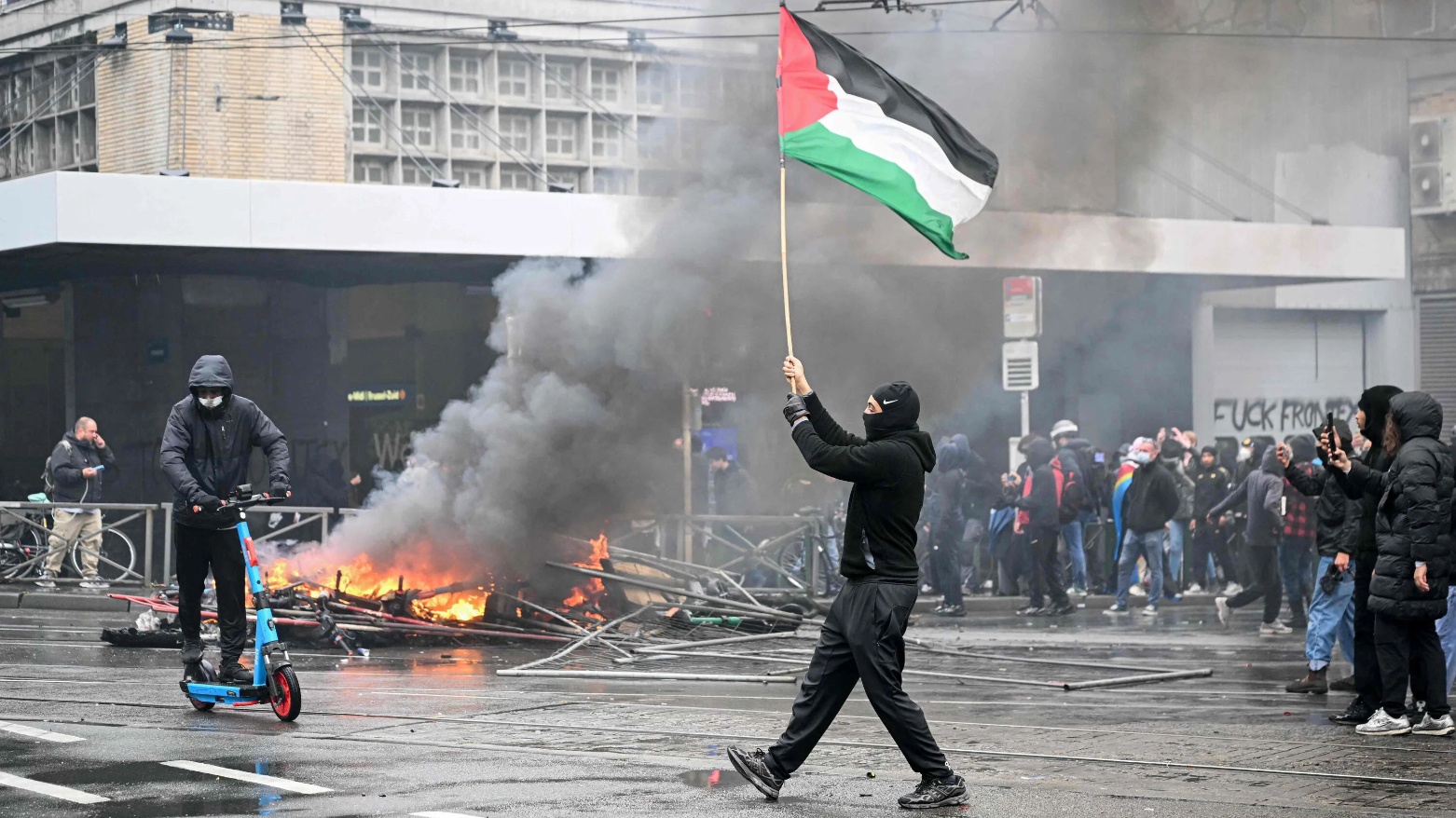
ERBIL (Kurdistan24) - Shopkeepers across Brussels were boarding up storefronts on Saturday as businesses took precautions against possible looting or damage, following a week in which protests in Belgium, France and other European countries were accompanied in some cities by violence targeting shops and public property.
Kurdistan24 correspondent Barzan Hassan, reporting from the Belgian capital on Oct. 24, said large numbers of businesses were covering their storefronts in an effort to protect property from any potential attacks.
The measures reflect anxiety generated by unrest during demonstrations over the previous weekend, when some businesses suffered material losses.
Boarding up shops is a precaution, however, and does not in itself mean that new demonstrations in Brussels will turn violent.
Similar scenes could be seen elsewhere in Europe on Saturday as authorities and business owners prepared for another weekend of demonstrations driven by a range of economic, social and political grievances.
France has been at the center of the recent unrest.
Agence France-Presse journalists reported wooden barriers covering windows at shops and restaurants in Paris, Bordeaux and Lyon, following widespread looting and property damage during demonstrations a week earlier.
Near Paris' Bastille district, one clothing retailer had removed merchandise from its shelves, while a restaurant covered its frontage with boards but posted signs telling customers it remained open.
Some business owners were uncertain about whether they would be able to operate normally.
Bookseller Armelle Gueganton told AFP that her business had taken as many precautions as possible and would likely close early while employees remained nearby to monitor the situation.
In Bordeaux, the financial cost of such precautions was itself becoming a concern.
Margaux Rey, manager of the Altermundi shop, told AFP that securing five storefronts could cost almost 5,000 euros.
The concern follows serious disorder around last weekend's demonstrations in France, where shops were looted, vehicles burned and public buildings attacked.
The Associated Press, in reporting by Thomas Adamson, Samuel Petrequin and Sylvie Corbet, said around 3,000 shops across France were damaged or looted during the previous weekend.
French authorities responded by heavily reinforcing security for Saturday's demonstrations.
Up to 70,000 officers were expected to be deployed nationwide, along with helicopters, armored vehicles and water cannons.
The planned Paris march was moved away from the center of the capital to its southeastern edge, while demonstrations in some other cities were prohibited.
Major cultural institutions, including the Louvre and Orsay museums, were also closed.
The precautions have prompted debate over how authorities should balance the right to protest with protecting businesses and public spaces.
Trade unions have criticized some demonstration bans as restrictions on freedom of expression, while the French government argues that tighter measures are needed after the scale of the previous violence.
The demonstrations themselves involve broader grievances than the disorder that has attracted international attention.
French students have demanded more teachers, improvements to school and university buildings and greater access to higher education. Trade unions and other participants have also focused on wages, pensions and the rising cost of living.
The Yellow Vest movement, which has participated in the latest demonstrations, announced on Saturday that it was calling for another round of protests on Oct. 31.
Organizers said the next demonstrations would focus partly on what they described as restrictions on public freedoms and the right to protest.
Italy has also tightened security following clashes and looting.
The Associated Press, in reporting by Colleen Barry, said an additional 500 soldiers were deployed to Milan ahead of Saturday's demonstrations, reinforcing thousands of police and other law-enforcement personnel.
Last weekend, rioters broke into stores near Milan's central Duomo area, targeting retailers selling sportswear, footwear and other goods.
Italian authorities said many of those detained following the disturbances were young people.
Prime Minister Giorgia Meloni's government has responded with additional security measures and tougher penalties, while officials have also acknowledged that social and economic pressures affecting young people require attention.
Milan welfare councilor Lamberto Bertolé told AP that more work was needed to understand why some young people became involved in the looting, pointing to social inequality, limited opportunities and feelings of exclusion.
Demonstrations are not confined to France, Belgium and Italy.
Protests have also been taking place or planned in countries including Spain, Portugal and Albania, although the issues motivating participants differ considerably from country to country.
Thousands marched peacefully in Madrid on Saturday over pensions, while housing affordability has driven other demonstrations in Spain.
In Lisbon, protesters have focused on housing costs and government measures concerning rents and evictions.
Albania has seen more confrontational demonstrations, with students demanding lower tuition fees, greater investment in education and action against corruption while joining a wider movement opposed to Prime Minister Edi Rama's government.
The wave of demonstrations also comes as Serbia's student-led movement prepares for Sunday's parliamentary election following nearly two years of anti-corruption protests.
Those movements should not be treated as a single coordinated campaign. Their origins, demands and political environments are different, ranging from education and housing to corruption, pensions and living costs.
What they share is the unusually visible presence of young people and the economic pressure underlying many of the demonstrations.
The challenge for governments has increasingly become how to respond to those grievances while separating peaceful protesters from groups responsible for vandalism, arson and looting.
For businesses, the distinction offers limited comfort when storefronts are exposed to damage.
That concern is now visible in Brussels, where wooden boards across shops provide a physical reminder of the effect last weekend's unrest has had beyond the cities where the most serious violence occurred.
The precautions taken Saturday are intended to prevent a repeat of earlier losses, not a prediction that such violence is inevitable.
But from Brussels to Paris and Milan, shopkeepers are preparing for the possibility nonetheless, as another weekend of demonstrations tests both European security measures and governments' ability to address the grievances bringing people into the streets.
Kurdistan24 correspondent in Brussels Barzan Hasan contributed to this report.