Slavoj Žižek Backs Öcalan's Peace Initiative in Türkiye
Slavoj Žižek writes to Abdullah Öcalan backing his role in Türkiye's peace process and arguing that a successful settlement could benefit Kurds and Turks.
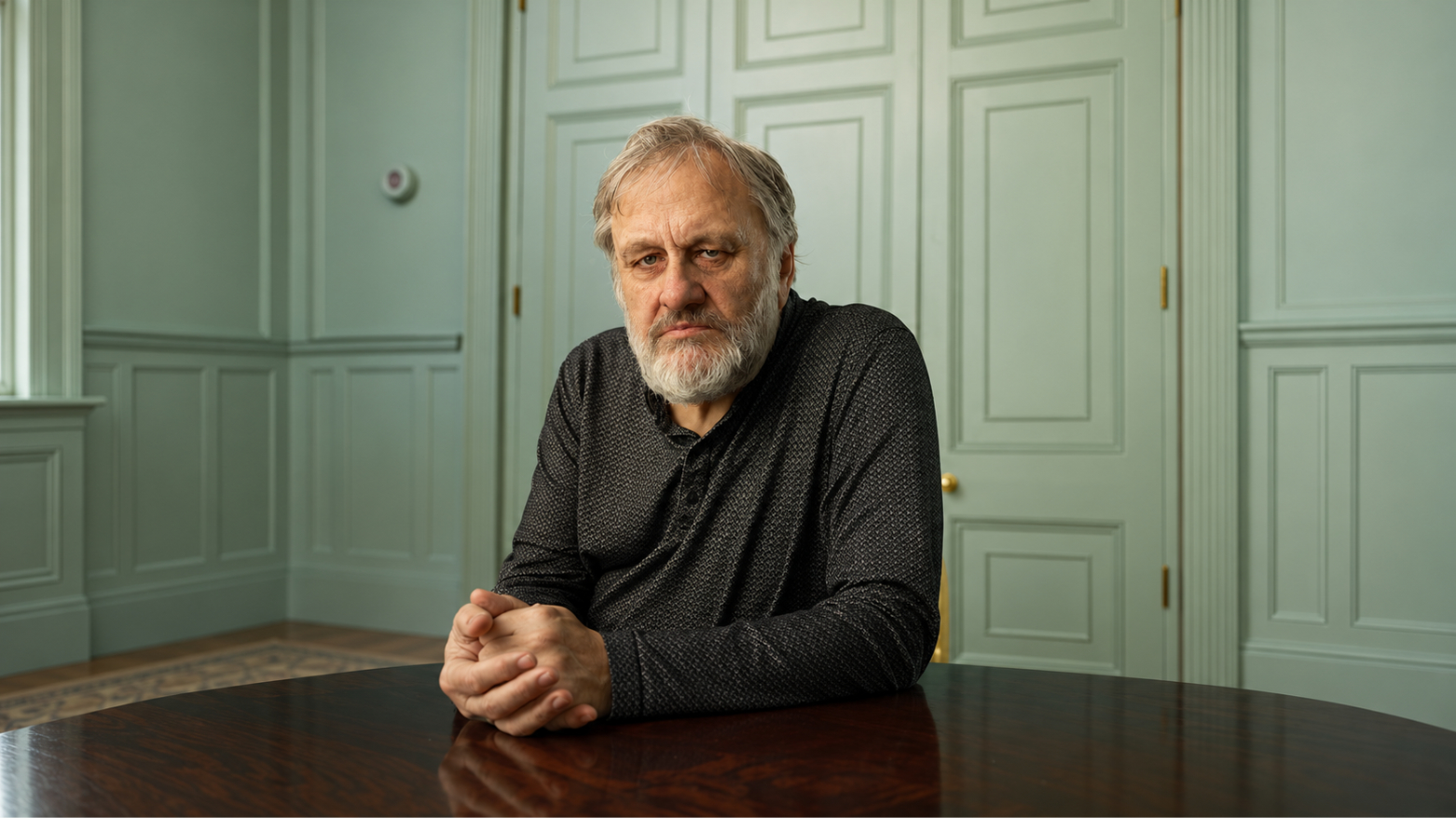
ERBIL (Kurdistan24) - Slovenian philosopher and cultural critic Slavoj Žižek has sent a letter to imprisoned PKK founder Abdullah Öcalan expressing unusually strong support for his role in Türkiye's renewed peace process and arguing that a successful political settlement could benefit both Kurds and Turks.
In the letter, published on Oct. 24 by Mezopotamya Ajansi (MA), Žižek described Öcalan as one of the few contemporary political leaders he believed could be supported without reservation.
"You are one of the very few leaders whom one can and should support unconditionally," Žižek wrote, praising what he described as a combination of political principle, theoretical depth and pragmatism.
His central argument was that the Kurdish struggle, as he understood Öcalan's current position, should not be framed as a struggle against Turks.
"If you succeed, both sides will win," Žižek wrote, adding that Turkish citizens as a whole could benefit through greater freedom, peace and welfare.
The intervention comes at a sensitive stage in a nearly two-year political process that began with an unexpected opening from Devlet Bahçeli, leader of the Nationalist Movement Party (MHP) and an ally of Turkish President Recep Tayyip Erdoğan.
On Oct. 22, 2024, Bahçeli proposed that Öcalan, who has been imprisoned on İmralı Island since 1999, address parliament and call on the Kurdistan Workers' Party (PKK) to dissolve.
Öcalan subsequently issued a public appeal on Feb. 27, 2025, urging the PKK to convene a congress, lay down its weapons and end its organizational structure.
The PKK declared a ceasefire on March 1 and, after holding its 12th Congress from May 5 to 7, announced on May 12 that it had decided to dissolve its organizational structure and end armed operations.
The PKK, founded in 1978, launched an insurgency against the Turkish state in 1984. The decades-long conflict has killed tens of thousands of people and displaced communities across Türkiye and neighboring areas. The organization is designated as a terrorist organization by Türkiye, the United States and the European Union.
A symbolic disarmament ceremony followed on July 11, 2025, when 30 PKK members, including senior figures, burned weapons at Jasana Cave in the Kurdistan Region's Sulaimani province.
The organization later announced in October 2025 that it was withdrawing fighters from Turkish territory.
Those steps moved the process beyond political declarations, but they did not establish that all PKK weapons had been surrendered or that disarmament had been independently verified.
That distinction remains central to the current stage.
Türkiye's parliament approved a 12-article framework law on Aug. 10, 2026, providing conditional legal measures for certain PKK-linked prosecutions and sentences. The law, published in the Official Gazette on Aug. 18, is not a general amnesty and excludes senior figures and people convicted of specified serious crimes. Öcalan himself is also outside its scope.
Turkish security agencies must verify that the PKK and affiliated organizations have ceased operations and surrendered their weapons before later measures can proceed.
Ankara has continued to describe the process through the framework of a "terror-free Türkiye." Turkish Foreign Minister Hakan Fidan said in September that the initiative could have wider regional benefits but argued that the PKK had still not taken sufficient concrete steps to remove the armed threat.
The DEM Party, PKK and Kurdistan Communities Union (KCK), by contrast, have called for a broader political settlement covering legal guarantees, democratic freedoms, reintegration and Öcalan's prison conditions.
This unresolved gap between security verification and demands for political and legal reform is the backdrop against which Žižek's letter arrives.
Žižek, born in Ljubljana in 1949, is one of the most widely known contemporary European philosophers and public intellectuals. His work combines the influence of German philosopher G. W. F. Hegel, Karl Marx and French psychoanalyst Jacques Lacan.
He became internationally prominent after the publication of The Sublime Object of Ideology in 1989 and is particularly associated with analyses of ideology, capitalism, political conflict and the role of unconscious beliefs and desires in sustaining social systems.
His political interventions have often been controversial, and scholars have disputed both his philosophical interpretations and some of his positions on contemporary political questions.
That makes the directness of his letter notable. Rather than offering a general endorsement of negotiations or dialogue, Žižek attaches his support specifically to Öcalan's political approach and to the argument that Kurdish rights and Turkish interests do not have to be treated as mutually exclusive.
The current initiative is not Türkiye's first attempt at ending the conflict. A previous peace process between 2013 and 2015 collapsed amid renewed violence, leaving significant distrust among the parties.
Kurdistan Region leaders have consistently supported dialogue in the current process. Kurdistan Region President Nechirvan Barzani said on Oct. 12 that, although progress had been slow, the initiative had at least brought direct military confrontation to a halt.
The remaining questions are more difficult: whether disarmament can be independently verified, how former fighters will be reintegrated, what legal and political reforms will accompany the security process, and whether the parties can turn the current framework into a lasting political settlement.
Žižek's letter does not resolve those disputes. It instead adds the voice of a prominent international philosopher to those arguing that the process should be understood not as a victory for one community over another, but as a potential political settlement from which both could benefit.