US welcomes return of remains of ISIS Yezidi victims
The US has hailed the return of some 100 Yezidi (Ezidi) victims of ISIS, who were massacred by the terrorist group, following its assault on their ancestral homeland in northwest Iraq in 2014.
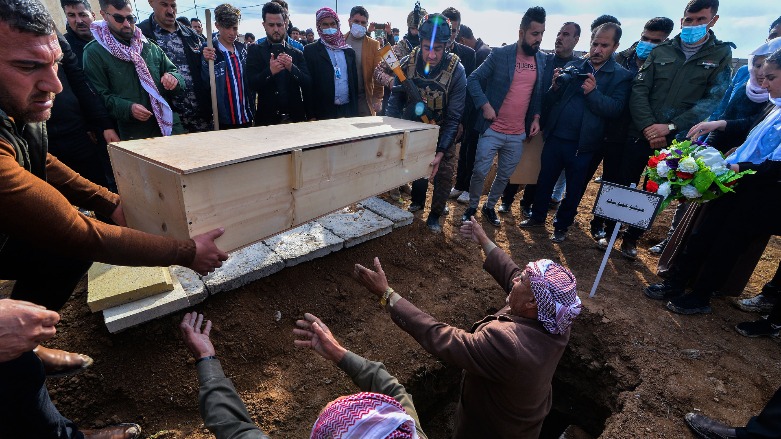
WASHINGTON DC (Kurdistan 24) – The US hailed the return of some 100 Yezidi (Ezidi) victims of ISIS, who were massacred by the terrorist group, following its assault on their ancestral homeland in northwest Iraq in 2014.
“Today, the UN Investigative Team to Promote Accountability for Crimes Committed by Da’esh/ISIL (UNITAD) worked with the Government of Iraq to return the remains of 104 Yezidis to Kocho, Sinjar to be laid to rest by their loved ones,” State Department Spokesperson, Ned Price, said Saturday in a written statement.
READ MORE: Sinjar re-buries the remains of more than 100 Yazidi "Kocho victims"
A memorial service was held earlier this week in Baghdad, before the remains were transferred to the Ezidi village, where the official burial site is located.
The Baghdad service was attended by delegations from the Kurdistan Regional Government (KRG) and the federal government, as well as the United Nations envoy in Iraq, Jeanine Hennis-Plasschaert, along with the head of UNITAD.
UNITAD was established by the UN Security Council in 2017, at the request of the Iraqi government. Its mandate is “to support domestic efforts to hold [ISIS] accountable by collecting, preserving and storing evidence in Iraq of acts that might amount to war crimes, crimes against humanity and genocide committed in Iraq,” as its website explains.
“The evidence that UNITAD gathered,” Price’s statement continued, “will help achieve justice for those who suffered from the horrors of ISIS.”
“Since UNITAD’s creation,” the “US government has provided almost $9 million to its budget in order to collect, preserve, and store evidence of ISIS atrocities,” Price concluded.
KRG Prime Minister Masrour Barzani met on Sunday with Nobel Peace Prize laureate Nadia Murad, an Ezidi woman, held as a sex slave by ISIS, who managed to escape and then earned the distinguished award through her courageous calls against human trafficking and for justice for the victims of the terrorist group.
READ MORE: KRG 'stands' with Yezidi community, Kurdistan PM says in meeting with activist
Following his meeting with Murad, the Kurdish Prime Minister, in a statement, tweeted “We reflected on yesterday’s reburial of 104 Yazidi victims of ISIS in Kocho and I emphasized that we’re all wounded by the losses.”
“We also reviewed ways to collectively accelerate justice through @UNITAD_Iraq,” he added.
UNITAD’s mandate is far-reaching: to investigate all aspects of ISIS crimes and hold all those responsible who committed them. In December, for example, UNITAD announced that it was beginning the second phase of its investigation into the financial aspects of ISIS crimes, which UNITAD described as “a complex and lucrative financial system” that enabled ISIS activities and helped to “push revenue to its command structure and its fighters.”
Saddam’s Mass Graves
For Kurds, ISIS’ crimes against the Ezidis recall their own suffering at the hands of Saddam Hussein’s former regime, which murdered over 180,000 Kurds in what it called “the Anfal campaign” (in Arabic, “anfal means “spoils”—as if the genocide were part of the legitimate spoils of war.)
Since the overthrow of that regime in 2003, the mass graves of Kurds and Shiites have been discovered throughout Iraq.
Most recently, such a site, containing the remains of Kurdish victims, was discovered in 2019 in the desert in southern Iraq, 200 kilometers west of the city of Samawa, the capital of Muthanna province.
READ MORE: Mass grave in southern Iraq believed to contain remains of Kurdish Anfal victims
The remains of some 80 victims, mostly women and children, were found. They appeared, from their clothing, to be from the Garmiyan district.
Around the same time, in roughly the same area, investigators also discovered a mass grave with the remains of Kuwaitis killed by Saddam’s regime, following its attack on the small Gulf state in the summer of 1990.
READ MORE: Iraq transfers remains of 48 people missing for decades to Kuwait
Nearly 50 victims were found, and the Baghdad government returned their remains to the Kuwaiti government in August 2019.
The most definitive article on ISIS, based on a leak from German intelligence and published by the highly regarded news magazine, Der Spiegel, explains that ISIS, is, at its core, the former Iraqi regime, and their professed ideology—extremist Islam—serves as a cover and recruiting tool.