Canada concerned with IS chemical weapon
Chief of the Defense Staff Gen. Jonathan Vance stated that IS has chemical weapons, and it is a “huge concern.”
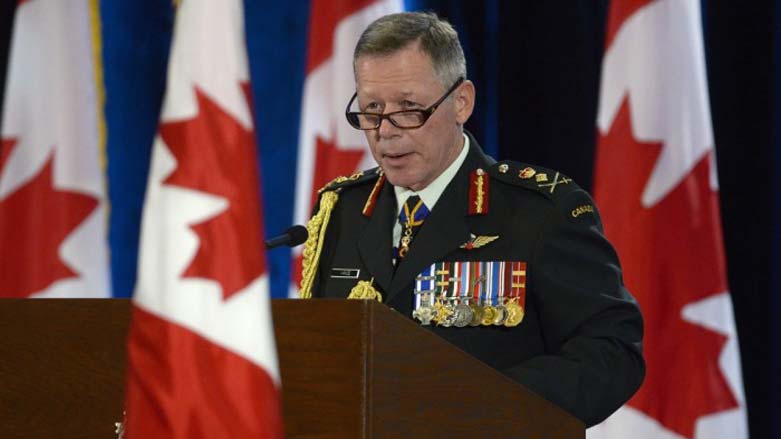
ERBIL, Kurdistan Region (Kurdistan24) – The Canadian armed forces will train and equip Kurdish Peshmerga forces as part of their efforts to combat the Islamic State (IS), a top Canadian general said on Monday.
Chief of the Defense Staff Gen. Jonathan Vance stated that IS has chemical weapons, and it is a “huge concern.”
Last month, the Ottawa government announced that Canada would increase the number of military personnel working alongside Peshmerga forces in the Kurdistan Region to 200, and provide “lethal aid” to the Kurds.
Vance mentioned that Canada does not know the exact number of Peshmerga fighters they will train in the coming year, but most of the Peshmerga are those who volunteer to fight against IS extremists in northern Iraq.
“We’re not building an army. We’re building an effect that will last as long as it needs to last,” he said.
“One of the programs will be to try and take conventional forces and give them a bit more focused training,” Vance continued. “That is where we’re going to equip people. So try to take roughly…300 to 400 [Kurds], give them training for months [and] equip them, so they have a stronger core of more professional fighters.”
His speech followed the recent debate about the Mosul operation, the second largest city located in northern Iraq that IS has been in control of since June 2014.
Moreover, Vance confirmed that IS has access to some chemical weapons. He described the mustard and chlorine gas weapons as “rudimentary” and “small-scale,” and noted Canadian troops on the ground are well protected against such attacks.
“We don’t have [an] indication of that right now, but it is a huge concern. It’s also, if you can imagine, a concern because of the impact it could have on a civilian populace,” he added.
On March 3, the US State Department stated that IS was believed to have used deadly chemical weapons in an attack near the town of Makhmour last August. Approximately 35 Kurdish Peshmerga were affected by the gas, which causes severe burns to the skin, eyes and respiratory tract.
Makhmour is about 100 km south of Mosul and the Kurdish capital, Erbil. Canadian Special Forces have been training and accompanying Kurdish forces around those two cities, and to the north of them, since September 2014.
Additionally, on Feb. 28, IS attacked Peshmerga front lines with chemical weapons in the city of Sinjar for the third time. Many Peshmerga fighters were injured.
On December 2015, Canada's Defense Minister Harjit Singh Sajjan and his accompanied delegation visited the Kurdistan Region and met with Kurdish officials where they visited Peshmerga front lines in Makhmour.
Reporting by Mewan Dolamari
Editing by Karzan Sulaivany and Ava Homa