Kirkuk council head to appeal six-month prison sentence
”I am ready to personally attend court only if it is held in the Kurdistan Region.”
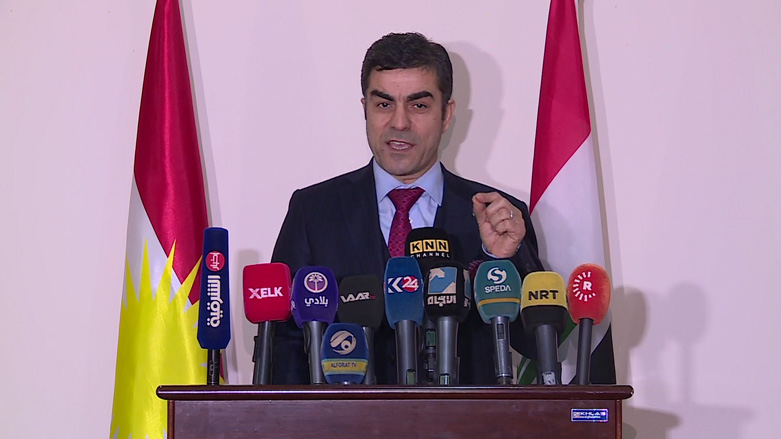
ERBIL (Kurdistan 24) – Head of Kirkuk Provincial Council Rebwar Talabani announced on Thursday that he will appeal a six-month prison sentence handed to him in absentia the day before and urged Iraq's Supreme Judicial Council to investigate local judges for ruling as a result of political pressure.
A court in Kirkuk on Wednesday found Talabani guilty of “illegally” spending Iraqi funds.
The court’s ruling states that Talabani had spent 76 million Iraqi dinars ($63,567) “outside of [the] legal framework” and issued an arrest warrant for the Kurdish official.
In a press conference held in Erbil, Talabani denied the allegation and stated that he will appeal and take additional legal measures against the ruling.
Following the attack and military takeover of Kirkuk by Iraqi forces and Shia militias on Oct. 16 of last year, Talabani, along with many other council members, fled to the Kurdistan Region. Since then, the body has been unable to convene due to “the current militarized situation” in the disputed province of Kirkuk.
Since Oct. 2017, several complaints have been issued against Talabani for raising the Kurdistan national flag in Kirkuk alongside the Iraqi flag as well as deciding to hold the Kurdistan Region’s independence referendum in the disputed province.
The council's decision to take part in the referendum wasn't made by Talabani alone, but rather decided by a council vote, with a majority of the members agreeing to it. Of those who later participated in the referendum in Kirkuk, 86 percent favored secession from Iraq.
“The court’s ruling is retaliation and politically-oriented against me… I will appeal and take legal steps against the decision,” he told reporters.
The council chief charged that judges in Kirkuk have been unduly pressured by officials and political parties in the province and publicly called on the Supreme Judicial Council of Iraq to investigate the matter.
“I am taking legal steps through my lawyer to reverse the ruling… I am ready to personally attend court only if it is held in the Kurdistan Region,” Talabani said, refusing to attend any hearing held in Kirkuk or other parts of Iraq outside the semi-autonomous region.
He accused Kirkuk's acting governor Rakan Saeed of illegally and unilaterally making decisions and replacing over 30 Kurdish directors in the province without the approval of the council.
“It is a clear violation of Iraqi law and the constitution. Iraqi law clearly mentions that only the provincial council has the authority to remove or replace any directors, including the governor.”
Talabani noted that he, as council chief, had refused to accept or recognize the present political situation in Kirkuk and had therefore become the main obstacle and target for the current local administration.
On Wednesday, President of the Kurdistan Democratic Party (KDP) Masoud Barzani objected to the court’s ruling, labeling it a "purely political" decision, adding his voice to earlier condemnations that day by members of Talabani's party, the Kurdistan Islamic Union (KIU).
Talabani concluded by calling on the Kurdistan Regional Government (KRG) and the federal government of Iraq to peacefully resolve their issues, namely in Kirkuk.
The oil-rich and ethnically diverse province remains territory disputed by Erbil and Baghdad, and the source of much ongoing political tension between the two.
Editing by John J. Catherine