US withdraws some troops as coronavirus reduces tensions with Iran
The United States has withdrawn some of the forces it deployed to the Middle East, as tensions escalated with Iran in late December and early January.
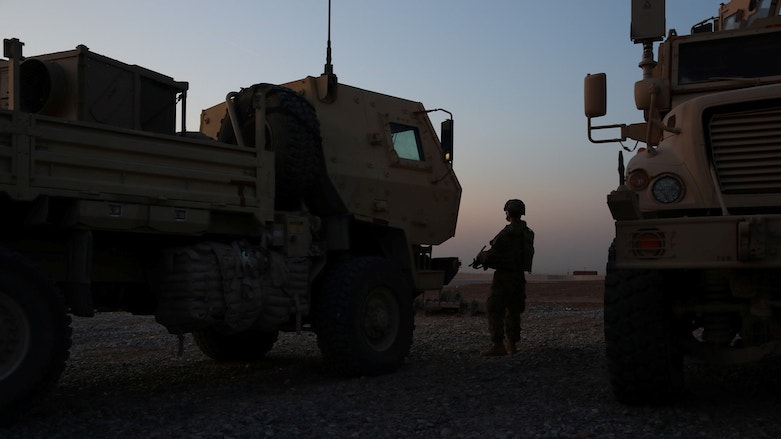
WASHINGTON DC (Kurdistan 24) – The United States has withdrawn some of the forces it deployed to the Middle East, as tensions escalated with Iran in late December and early January.
After Iranian-backed militias attacked the US embassy in Baghdad, Washington announced on Dec. 31 that it was sending to Kuwait 4,000 troops from the 82nd Airborne Division—which is based at Ft. Bragg, North Carolina and designed for rapid deployment.
Indeed, following Saddam Hussein’s Aug. 2, 1990, invasion of Kuwait, it was the 82nd Airborne that was first dispatched to Saudi Arabia to block any further forward movement of Iraqi troops.
Read More: US sending as many as 4,000 paratroopers to Kuwait, with siege of Baghdad embassy
Following the attack on the US embassy in late December, on Jan. 3, the US assassinated Qasim Soleimani, head of the Quds Force of Iran’s Islamic Revolutionary Guard Corps, further dramatically escalating tensions between Washington and Tehran.
Yet 1,000 of the US troops deployed then have left Kuwait over the past two weeks, The Wall Street Journal reported on Tuesday, and another 2,000 forces are slated to depart in the coming weeks.
Although Iran retaliated on Jan. 8 with two ballistic missile attacks aimed primarily at Al Assad airbase in Iraq’s Anbar province, which hosts a large number of US forces, no further major assaults have followed.
The Impact of the Coronavirus
“The coronavirus has affected Iran’s ability to respond to the January strike, some Pentagon officials have concluded,” the Journal reported. As one official told the paper, “Their focus is internal.”
The Pentagon’s conclusion may also help alleviate concerns in Erbil, which was a secondary target of Iran’s Jan. 8 retaliatory strike.
Iran has officially reported the third largest number of coronavirus cases in the world—over 8,000, behind China and Italy, and the third largest number of coronavirus deaths: 291.
Delayed and ineffectual Iranian Response
Iran was slow to respond to the outbreak of the virus. Its first deaths occurred on Feb. 19. National elections took place two days later, and the regime, keen on securing a respectable voter turn-out, said little about the disease.
Moreover, coronavirus first appeared in the Shia holy city of Qom, and Iranian officials resisted isolating the city, as other governments in other countries, including China, Italy, and even the US have done with coronavirus epicenters. To this day, Iran has imposed no quarantine.
Read More: Coronavirus appears to be spreading among Iranian elite: report
The result has been the widespread of the virus, including within the Iranian elite, while travelers from Iran have carried the disease to numerous other areas of the Middle East. They include at least nine countries, according to the BBC: Afghanistan, Bahrain, Iraq, Kuwait, Lebanon, Pakistan, Qatar, Saudi Arabia, and the UAE.
On Tuesday, Iran reported its largest daily increase in coronavirus deaths—54. That number is likely to increase in the coming days because instances of the disease tend to rise dramatically until appropriate measures are taken to bring the epidemic under control.
A parliamentarian from the hard-hit province of Gilan, Gholam Ali Jafarzadeh, warned that coronavirus cases would rise “exponentially,” and “we will witness a humanitarian crisis if serious measures are not taken.”
According to official Iranian statistics, coronavirus cases are concentrated in a north-south corridor in the center of the country that includes Tehran province with 1,945 cases and Qom with 712.
But there are strong suspicions that Iran is underreporting its coronavirus cases. The Atlantic Monthly suggested that the number of coronavirus cases in Iran could actually be in the millions. The New York Times reported that trenches were being dug in Qom to serve as mass graves.
Health facilities in stricken provinces are overstretched. “Six of 14 Tehran hospitals contacted by Bloomberg News on March 6 said either that they were full and new patients would have to wait or that they wouldn’t be admitted at all,” it reported.
There is some desperation in the response of Iranians. On Tuesday, the state-run news agency, IRNA, reported that 44 Iranians had died from drinking bootleg alcohol, in the mistaken belief that it would prevent the coronavirus.
The death toll from such alcohol poisoning was highest in the southwestern province of Khuzestan, where fatalities from the illicit liquor surpassed those from the virus, according to IRNA.
Editing by Karzan Sulaivany