Iran claims 25 million COVID-19 cases since outbreak
The number of fatalities from the disease, as cited by the Iranian president, is the same as the official data: i.e. 14,000.
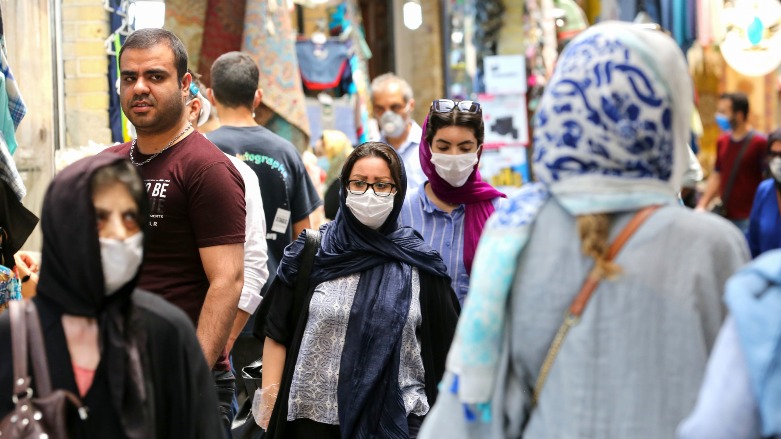
ERBIL (Kurdistan 24) – Iranian President Hassan Rouhani, citing a federal health ministry report, announced in televised remarks on Saturday that some 25 million people around the country had been infected with COVID-19, since the outbreak of the disease in Iran.
That number is almost 100 times larger than Iran’s official statistics, which state that there have been around 270,000 cases of coronavirus, of which about 22,000 remain active, while nearly 14,000 Iranians have died.
Rouhani's statement came, as the government announced the re-imposition of certain lockdown measures. New restrictions were imposed in Tehran for a week, including the banning of cultural—and, most significantly—religious functions.
New restrictions are also being imposed in the southwestern province of Khuzestan—which borders Iraq and which has already seen protests over Iran’s economic hardships.
It is likely that Rouhani made his dramatic announcement to encourage people to abide by the new restrictions.
The number of coronavirus cases has been climbing in Iran since mid-May, when the government eased limited lockdown measures which had been imposed in March. Iranian health authorities now regularly declare close to or over 2,000 daily infections.
The number of fatalities from the disease, as cited by Rouhani, is the same as the official data: i.e. 14,000. The difference is in Rouhani’s much larger estimate of the number of those who have already been infected—25 million—and his statement that another “30 to 35 million more people will be infected in the coming months."
Iran’s total population is about 81 million, so those figures mean that close to 31 percent of Iranians have caught the virus and another 40 percent will be infected in the coming months, if Rouhani’s statistics are accurate. Notably, however, the Associated Press reported that he gave those figures “without citing the basis for his estimate.”
The Iranian president also said that the rate of hospitalizations will likely grow to double that of the previous five months.
Iran was the original epicenter of the coronavirus in the Middle East, and it now has the worst outbreak in the region. The basic reason was Iran’s close ties with China, where the highly contagious virus was first detected in late 2019.
Related Article: WHO: 'Breach' of health regulations, trade with Iran behind new COVID-19 spike in Iraq, Kurdistan
Iranian authorities were slow to respond, when the disease first emerged in their country in mid-February. They then proceeded to downplay its significance. Indeed, in many countries both government authorities and the people have acted similarly, as the coronavirus is a rare event, representing a once-in-a century health crisis.
In Iran’s case, this problem was exacerbated by a religious factor. Social distancing is an important part of countering the virus. But it is also at odds with many religious rituals, which bring people together in communal activities.
In addition, when the virus appeared in Iran, parliamentary elections were underway, and the government did not want to interfere with them.
Finally, Iran suffers from poor economic conditions, due, in significant part, to crippling US sanctions.
From Iran, the disease spread to neighboring areas, including Iraq and the Kurdistan Region, which are now regularly experiencing record numbers of cases.
Related Article: COVID-19 spikes again in Iran, with regional implications
Like Iran, Iraq regularly reports some 2,000 new infections a day. Nonetheless, Iraqi authorities announced on Thursday that they were easing lockdown measures, including reopening the country’s airports next week.
Related Article: Iraq to reduce curfew measures, reopen airports on July 23
If Iran’s experience is any guide, there is a significant chance that the Iraqi decision to relax its coronavirus measures, under present circumstances, will lead to an even further acceleration of the spread of the disease within the country.
Editing by Laurie Mylroie