Local officials report 17 new cases of COVID-19 in northeast Syria
A representative for the Autonomous Administration of North and East of Syria (AANES) announced on Thursday that health workers had identified 17 new cases of the coronavirus in northeast Syria.
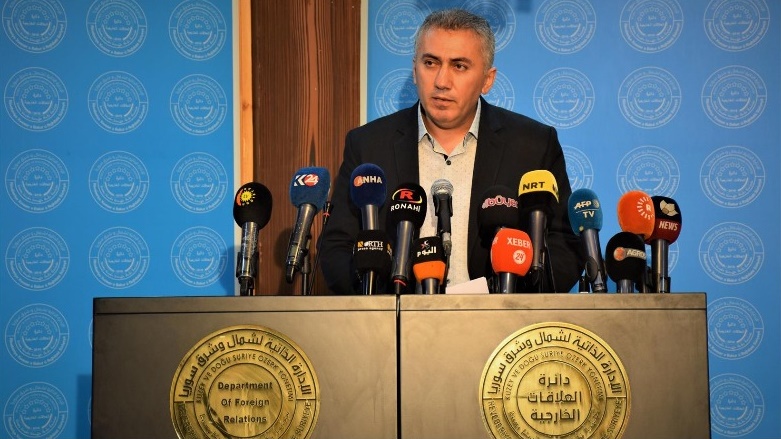
ERBIL (Kurdistan 24) – A representative of the Autonomous Administration of North and East of Syria (AANES) announced on Thursday that health workers had identified 17 new cases of the coronavirus in northeast Syria.
International experts have long warned that millions of displaced and otherwise vulnerable civilians in the area, so far relatively unaffected by the global pandemic, are at great risk if significant outbreaks of the highly-contagious disease begin to occur.
“There are 17 new cases of coronavirus in North and East Syria, Ciwan Mustafa of the AANES Health Bureau confirms,” the Syria-based Rojava Information Centre (RIC) wrote in a tweet. “With 11 cases in Jazira (Hasakah province), 3 in Deir-ez-Zor and 3 in Raqqa, there are now cases in all three regions of NES (Northeast Syria), as the disease spreads from Syrian government-held areas.”
Mark Lowcock, the UN’s Under-Secretary-General for Humanitarian Affairs and Emergency Relief Coordinator, said during a Security Council briefing on Wednesday that COVID-19 figures in Syria are still low when compared to other countries.
“The number of confirmed cases remains in the hundreds – so still a relatively low level,” he said, adding, “The true number of cases is certainly higher; limited testing capacity, compared to what is available in neighbouring countries, and a reluctance, among some people, to acknowledge an infection masks the real scale of the outbreak.”
He continued, explaining that UN agencies are “also helping tackle COVID-19 in Syria. The problem is now country-wide: cases have now been confirmed in all but one of Syria’s governorates. UN staff working in Syria are also struck by the disease.”
“The worry is that the virus will now continue to spread through closely tight communities full of internally displaced people (IDPs), or even into IDP camps or under detention facilities, or al-Hol Camp.”
On Saturday, a suspected first case was identified within the infamous al-Hol Camp, run by the SDF and presently holding roughly 65,000 individuals, mostly women and children. This includes nearly 11,000 foreign women with alleged ties to the so-called Islamic State.
Health workers then carried out a coronavirus test, which came back negative.
Editing by John J. Catherine