Danish-Kurdish writer wins top Danish literature award
Omar “gathers inspiration for her books, from her own life and through stories she has met, through her volunteer work with vulnerable children and women.”
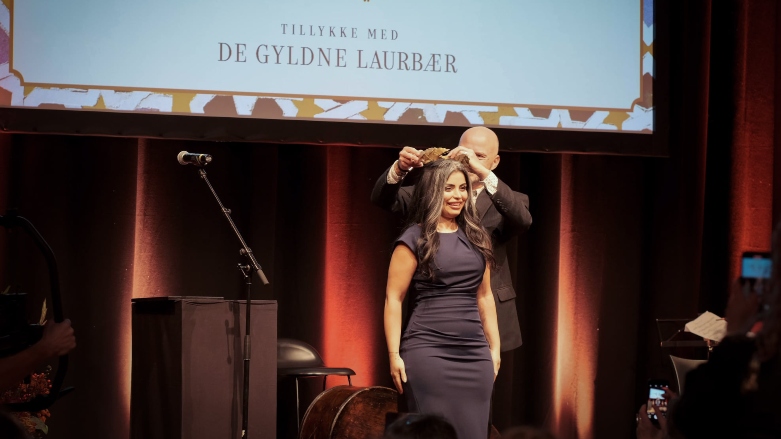
ERBIL (Kurdistan 24) – Last Wednesday, prominent Danish-Kurdish author Sara Omar was awarded the Golden Laurel, or De Gyldne Laurbær, Denmark’s top literature prize.
Omar, a women’s rights advocate, has won multiple awards for her literary works and is a best-selling author.
I have received the Golden Laurels. It’s a distinctive honor, I humbly accept. But the fight for women and children's rights does not end here. Consequently, @polforlag and I donated 250000dkk to @BornsVilkar. #HumanRights #Womensrights #equalrights
— Sara Omar ️ (@Saraoomarr) November 20, 2020
Foto: Flemming Bo Jensen pic.twitter.com/px1e1qausr
“I have received the Golden Laurels. It’s a distinctive honor, I humbly accept. But the fight for women and children’s rights does not end here,” Omar wrote in a tweet on Friday, adding that she donated the prize money, 250,000 kroner (about 40,000 USD), to a child welfare organization called Borns Vilkar.

This year, due to the cancelation of the traditional gala dinner amid the coronavirus pandemic, the winning author was given the option to donate the 250,000 kroner prize money to an organization of choice.
According to Omar’s biography from the LiteratureXchange, an international festival of literature held in Aarhus, Denmark, Omar “gathers inspiration for her books, from her own life and through stories she has met, through her volunteer work with vulnerable children and women.”
“She describes the notions of honour that can be difficult to understand for outsiders and takes a jab at the patriarchal society. Her first novel ‘Dead Washer’ (2017) is a strong and harsh book, which tells the story of the girl, Frmesk. She is born into a world that doesn’t want her, because of her sex. Her grandmother works as a dead washer and takes care of the women that no one wants to bury.”

Omar was born in 1986 in Sulaimani, in Iraqi Kurdistan. She grew up during the Iran-Iraq war in the 1980s during the Anfal campaign, the then Iraqi regime’s genocidal campaign against the Kurds, which serves as the backdrop for Omar’s novels.
She moved to Denmark in 2001 when she was fifteen and has lived in Denmark since. She is a board member in different women organizations in and outside Denmark, and in 2019 she won The Council of Human Rights Honorary Award for her significant fight for women’s and children’s rights.
Her latest novel, ‘The Shadow Dancer’ (2019), won The Golden Laurel 2020. It focuses on women’s rights and builds on the story of Frmesk, who lives in the male-dominated society that surrounds her in Kurdistan.
“My books indeed smell of blood, but whose blood?” Omer wrote on Facebook. “The blood of those women and girls who are killed daily on different accusations and, after their deaths, cannot find a grave.”
She added that, as an author, she is not afraid to express opinions that most of society does not want to hear and see.
“I hope this reward inspires hope in those women who, like me, were silenced… but found their voice through unyielding resistance and effort. A voice that the world can hear and acknowledge.”
“My literature is a call for an essential movement. A cry for oppressed women to stand united and fight for their rights without fear, shame, or remorse. It is a necessary critique of the patriarchal mentality, and oppression of any kind, as well as religious, cultural, and cruel acts against human rights justified by whatever norms the oppressor uses as excuse,” Omar told Kurdistan 24 on Monday.
“Furthermore, it is a rebellion against a tradition, a culture, and a set of life-destroying beliefs within the Muslim and non-Muslim community around the world. Oppression is a universal cause and we can no longer deny it, because we never know who is going to be the next victim tomorrow.”
Through a life filled with danger and adversity, I have realized that spreading knowledge through words, through literature, is the key to understanding and change,” she concluded.
Editing by Khrush Najari