‘A Sign of Complete Commitment’: Peshmerga Vote in Orderly Fashion, Zeravani Command Reports
The Zeravani Forces Command spokesperson confirms the voting process for Peshmerga forces is proceeding in an orderly, scheduled manner from their trenches.
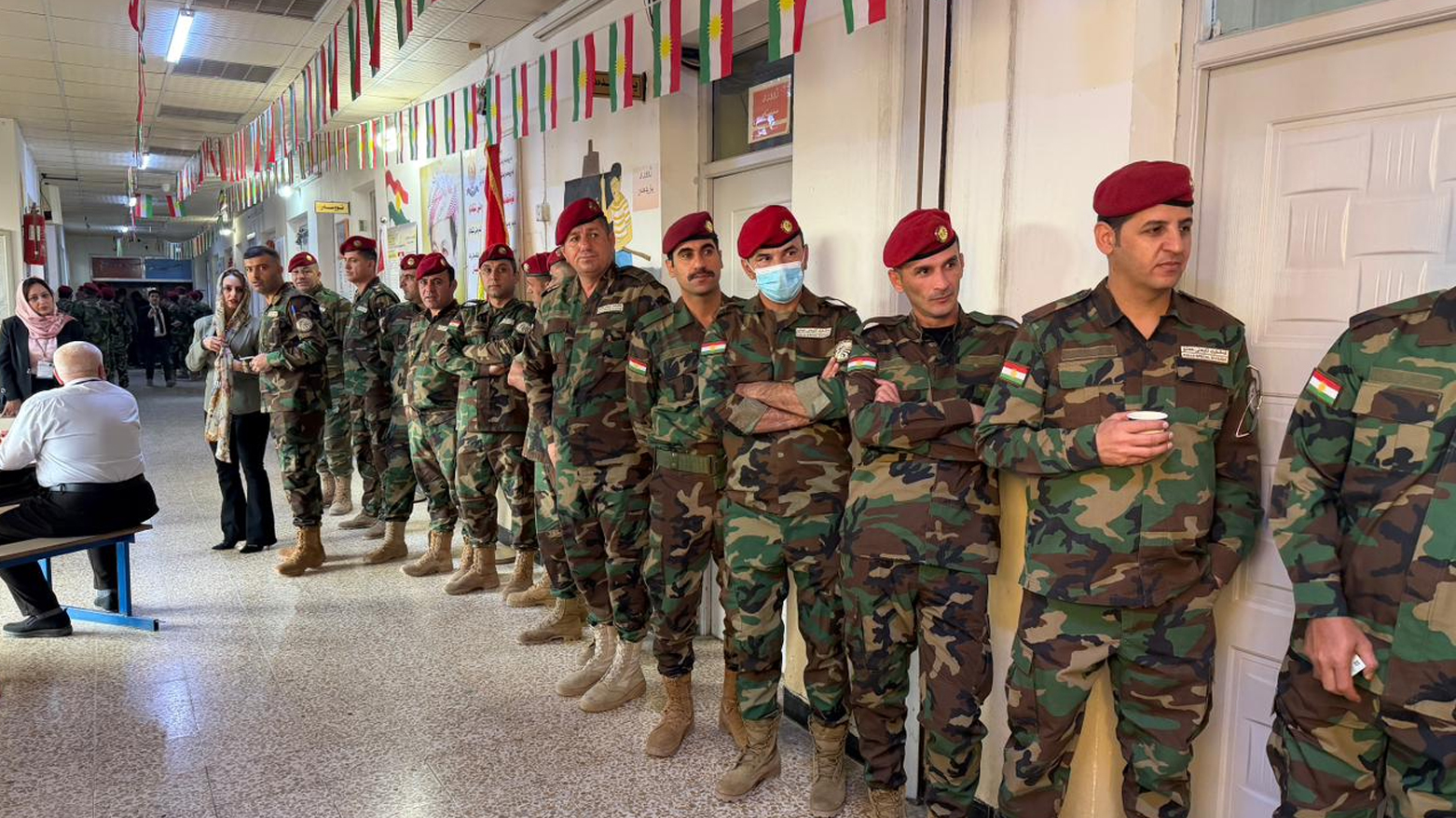
ERBIL (Kurdistan24) – In a powerful display of civic duty and disciplined organization, the Peshmerga forces of the Kurdistan Region are participating in today’s special voting for the Iraqi parliamentary elections in a remarkably orderly fashion, with commanders and soldiers casting their ballots from their defensive trenches according to a meticulous schedule.
The spokesperson for the Zeravani Forces Command confirmed on Sunday that the process, which began at the crack of dawn, is proceeding smoothly and without incident, a testament to the forces' "complete commitment" to the democratic process they are sworn to protect.
Didawan Khurshid, the spokesperson for the Zeravani Forces Command, provided details of the Peshmerga's participation in a statement to Kurdistan24 on Sunday morning, as the first crucial phase of Iraq's sixth national election got underway.
He confirmed that the voting process began promptly at 7:00 AM and is adhering strictly to a pre-arranged schedule. "This schedule has been set for all forces so that they can vote at their designated times," Khurshid explained, "thus ensuring adherence to queuing and preventing the creation of any kind of crowding or problems at the polling stations."
This methodical approach highlights a level of organization designed to ensure that every member of the force can exercise their right to vote without compromising their security duties.
Painting a vivid picture of democracy in action on the frontlines, Khurshid described how "the commanders and Peshmerga are present in an orderly manner in their trenches to vote." He emphasized that this disciplined turnout "is a sign of the complete commitment of the forces to the process."
As of his statement, the voting was proceeding as planned. "So far, the process has generally proceeded without any problems," he noted, while adding a note of caution typical of a large-scale technical operation: "but because it is still early, it is expected to be seen whether any technical issues will arise."
One of the most common technical glitches in past Iraqi elections has been the voter verification technology, particularly the fingerprint scanners. Khurshid acknowledged this as a potential concern but indicated that election authorities had prepared a contingency plan.
"One of the potential problems is the issue of fingerprints," he said. "However, a promise has been made that the 'Face ID' system will be used as an assistant to solve this problem. We hope that no such problem will occur."
The disciplined participation of the Peshmerga is a key component of a massive nationwide special voting day. Across all of Iraq and the Kurdistan Region, polling stations opened at 7:00 AM for more than 1.3 million eligible voters.
This group is primarily composed of one million, 313 thousand members of the various security forces and employees of the Ministry of Interior, who are casting their ballots today due to their deployment on the main election day.
They are joined by more than 26,000 internally displaced persons, a significant majority of whom are located in camps within the borders of Duhok province, who are also being given the opportunity to vote today.
To manage this large and geographically dispersed electorate, the Independent High Electoral Commission of Iraq (IHEC) has established 809 dedicated centers across the country. The voting is scheduled to conclude at 6:00 PM, at which point, according to the commission's strict instructions, the ballot boxes will be electronically sealed.
The commission has made it clear that this deadline is firm and the voting period cannot be extended. This special vote serves as a vital prelude to the general election, when the rest of the country's eligible voters will head to the polls on Tuesday, November 11, 2025.
This election is a monumental democratic exercise, with thousands of candidates vying for seats in the Iraqi Council of Representatives. According to IHEC spokesperson Jumana al-Ghalay, the initial number of registered candidates was a staggering 7,744.
A rigorous vetting process has since disqualified 848 contenders, but the field remains crowded and the competition fierce across all 18 of the country's provinces.
The capital, Baghdad, is the election's largest and most significant battleground, with 71 parliamentary seats available. The race there is incredibly intense, with 2,299 candidates competing for the votes of the province's 4.5 million eligible voters. Of this total, 274,636 are members of the security forces who are voting today.
In the Kurdistan Region, the electoral process is being watched with keen interest. Erbil Province is competing for 16 seats, with 108 candidates on the ballot. Today, 85,793 members of the security forces in Erbil are casting their votes.
Sulaimani Province, which holds 18 seats, has 136 candidates in the running, with 82,547 eligible special voters. Duhok Province, competing for 12 seats, has 55,993 special voters and is also the primary host for the country's displaced voters, with nearly 26,000 registered to vote in dedicated centers there.
Other key provinces, such as the ethnically diverse and politically complex Nineveh and Kirkuk, are also focal points of the election. Nineveh, with 34 seats and a massive field of 1,047 candidates, has 106,803 special voters. Kirkuk, competing for 12 seats, has 61,062 voters participating in today's process.
The story is similar across the country, from Anbar in the west to the oil-rich province of Basra in the south, where hundreds of thousands of security personnel are fulfilling their civic duty.
The smooth and orderly process reported among the Peshmerga forces in the Kurdistan Region stands as a positive and encouraging sign on a day of immense national importance, reflecting a deep-seated commitment to both security and democracy.
The Zeravani forces operate under the authority of the Kurdistan Region’s Ministry of Interior while remaining an integral component of the Peshmerga—the region’s armed forces. Their primary responsibilities include safeguarding government and industrial properties, as well as providing support to both the civilian police and military units.