Australian Intelligence Monitored Bondi Shooter for Ties to ISIS Cell Years Before Massacre
ASIO investigated Bondi shooter Naveed Akram in 2019 for ISIS ties but deemed him no threat; years later, he and his father killed 15 in an antisemitic attack.
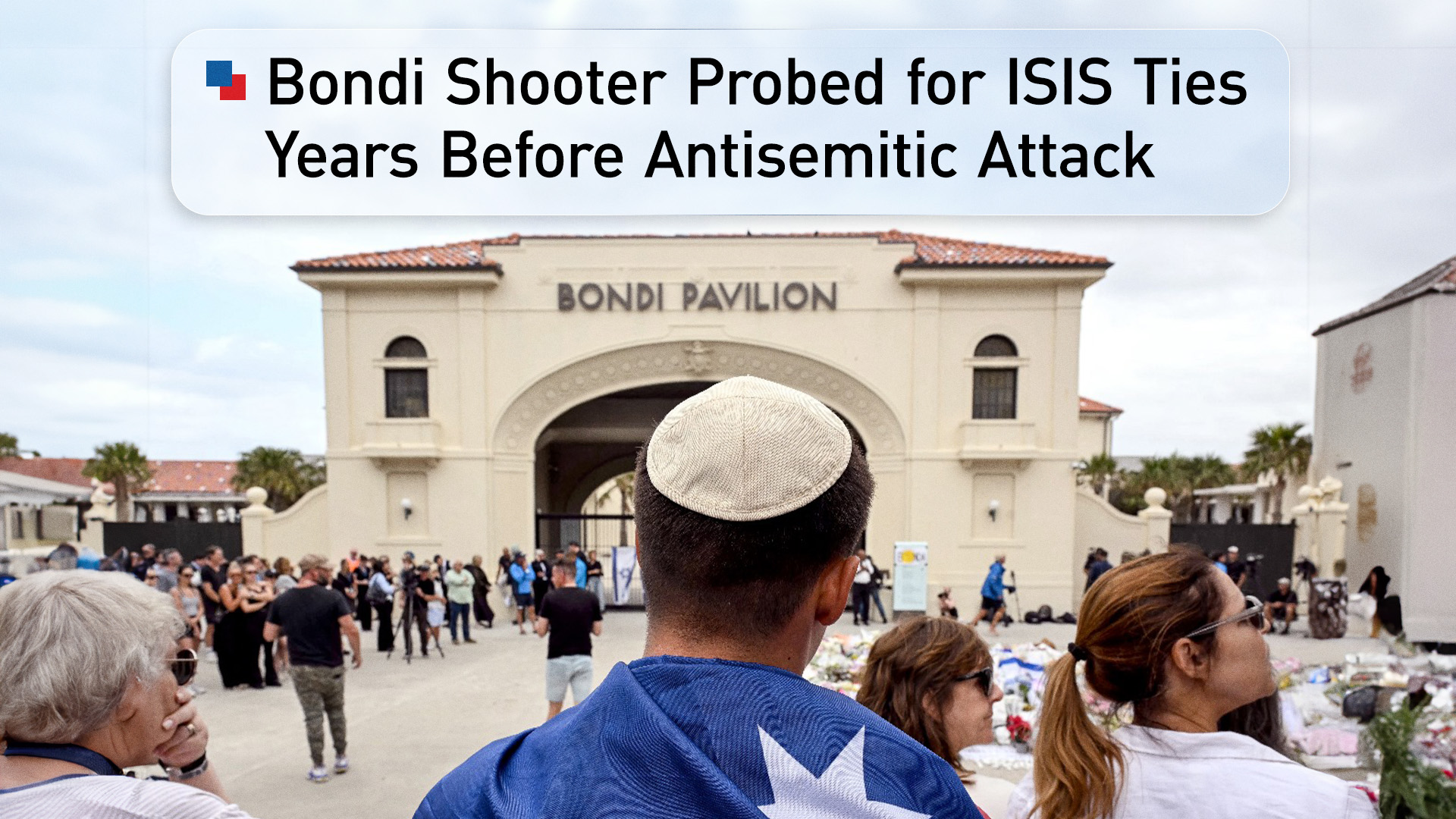
ERBIL (Kurdistan24) – In a revelation that has deepened the national sense of shock and raised urgent questions about domestic surveillance, it has emerged that Naveed Akram, the 24-year-old gunman responsible for the Bondi Beach massacre alongside his father, had been under the scrutiny of Australia’s top intelligence agency six years ago due to his proximity to a Sydney-based Islamic State (IS) terrorism cell.
The Australian Broadcasting Corporation (ABC), citing senior counter-terrorism sources, reported on Monday that the Australian Security Intelligence Organisation (ASIO) first examined Akram in 2019, uncovering close connections to convicted extremists, yet concluded at the time that he posed no imminent threat.
This assessment now stands in stark, tragic contrast to the bloodshed unleashed on Sunday evening, when Akram and his father, Sajid, opened fire on a Hanukkah celebration, killing 15 people in what Prime Minister Anthony Albanese has condemned as an "act of pure evil" and "antisemitic terrorism."
The massacre, which has plunged the nation into mourning and triggered a sweeping review of gun laws, unfolded with terrifying speed as the father-son duo targeted families gathered for the "Chanukah by the Sea" event.
Sajid Akram, 50, was killed in a shootout with police at the scene, while Naveed Akram remains hospitalized under heavy police guard, facing critical injuries. The ABC’s exclusive investigation into Naveed’s background reveals a disturbing history of radical association.
According to a senior official from the Joint Counter Terrorism Team (JCTT), Naveed was closely connected to a notorious figure known as Matari, the self-declared Australian commander of IS who is currently serving a seven-year prison sentence for planning an insurgency.
Matari was part of a broader cell of Sydney men convicted of terrorist offenses, a circle within which Naveed Akram reportedly moved.
Australia's Prime Minister Albanese confirmed on Monday that Naveed had indeed come to ASIO’s attention in October 2019 and was subjected to a six-month investigation. However, the Prime Minister noted, "He was examined on the basis of being associated with others, and the assessment was made that there was no indication of any ongoing threat or threat of him engaging in violence."
This historical oversight is now being scrutinized as investigators piece together how the pair transitioned from sympathizers to active shooters.
Senior officials told the ABC that two Islamic State flags were discovered in the gunmen's car at Bondi Beach, with one visible on the bonnet in footage from the scene, suggesting that the attackers had pledged formal allegiance to the terror group before launching their assault.
The JCTT, comprising ASIO, NSW Police, the Australian Federal Police, and the NSW Crime Commission, is now driving the investigation. While police have stated they are not looking for other direct participants, the focus has shifted to understanding the radicalization pathway.
ASIO Director-General Mike Burgess acknowledged on Sunday that "one of these individuals was known to us," admitting the need to urgently review "what happened here."
The assault has also ignited a fierce debate over gun control.
New South Wales Police Commissioner Mal Lanyon revealed that Sajid Akram had been a licensed firearms holder for a decade, legally amassing the six weapons used in the attack. "He was determined to be entitled to have a firearms licence... for which there were no incidents and it was regulated," Lanyon told reporters.
This regulatory compliance, juxtaposed with the carnage, prompted Prime Minister Albanese to propose tougher national gun laws on Monday.
"The government is prepared to take whatever action is necessary. Included in that is the need for tougher gun laws," Albanese declared, suggesting limits on the number of firearms an individual can own and ending perpetual licenses. "People’s circumstances can change. People can be radicalized over a period of time," he added.
The human toll of the attack is staggering.
At least 15 people, including a 10-year-old girl, a prominent rabbi, and a Holocaust survivor, were killed in the indiscriminate fire.
More than 38 others remain hospitalized with injuries ranging from gunshot wounds to trauma sustained during the stampede. Among the dead, media reports have identified Rabbi Eli Schlanger of Chabad of Bondi and French citizen Dan Elkayam.
Israeli officials also confirmed the death of one of their nationals. The violence unfolded near a petting zoo and face-painting stalls, creating a juxtaposition of innocence and slaughter that has deeply traumatized the nation.
Police operations continued into Monday, with heavily armed officers raiding the Akram family home in Bonnyrigg and an Airbnb property in Campsie where the men had reportedly stayed prior to the attack. Neighbors expressed shock at the revelations.
Lemanatua Fatu, who lives next door to the family in Bonnyrigg, described them as "normal" neighbors. "We were so shocked to notice one of the guys who shoot people live here. Shocking and terrifying," she told the ABC. Another neighbor, Renato Padilla, witnessed police detaining three people from the house late Sunday night.
The investigation has also touched upon Naveed Akram’s educational background.
The ABC confirmed that he studied Quranic recitation and Arabic for one year at the Al Murad Institute in Western Sydney starting in late 2019.
Institute founder Adam Ismail strongly condemned the violence, stating he was "deeply saddened" and clarifying that his teaching was strictly religious and linguistic.
"What I find completely ironic is that the very Koran he was learning to recite clearly states that taking one innocent life is like killing all of humanity," Ismail said, distancing his institution from the shooter's actions.
The Jewish community, already on edge following a spike in antisemitic incidents over the past year, has reacted with a mixture of grief and anger.
Alex Ryvchin, spokesperson for the Australian Council of Executive Jewry, lambasted the federal government for what he termed an "immense failure" to protect citizens. "I think the federal government has made a number of missteps on antisemitism," Ryvchin told reporters.
This sentiment was echoed by Israeli Prime Minister Benjamin Netanyahu, who claimed he had warned Australian leaders months ago about the dangers of unchecked antisemitism.
In response to the heightened threat environment, Commissioner Lanyon announced the deployment of 328 police officers to places of worship across Sydney as part of "Operation Shelter," calling for calm in the wake of the tragedy.
Prime Minister Albanese vowed that the violence would be met with national unity, asserting, "There is no place in Australia for antisemitism."
As the investigation deepens, the focus remains on the "brazen and targeted" nature of the attack.
Investigators found two improvised explosive devices in a car on nearby Campbell Parade, indicating the potential for even greater devastation. With the elder gunman dead and the younger critically injured, authorities are racing to map out the full extent of the network that may have supported or inspired the pair.