Dutch Police Detain 22 After Violent Demonstrations Over Israeli Military Cantor
Dutch police arrested 22 people during clashes with protesters in Amsterdam outside a private concert featuring the Israeli army's chief cantor.
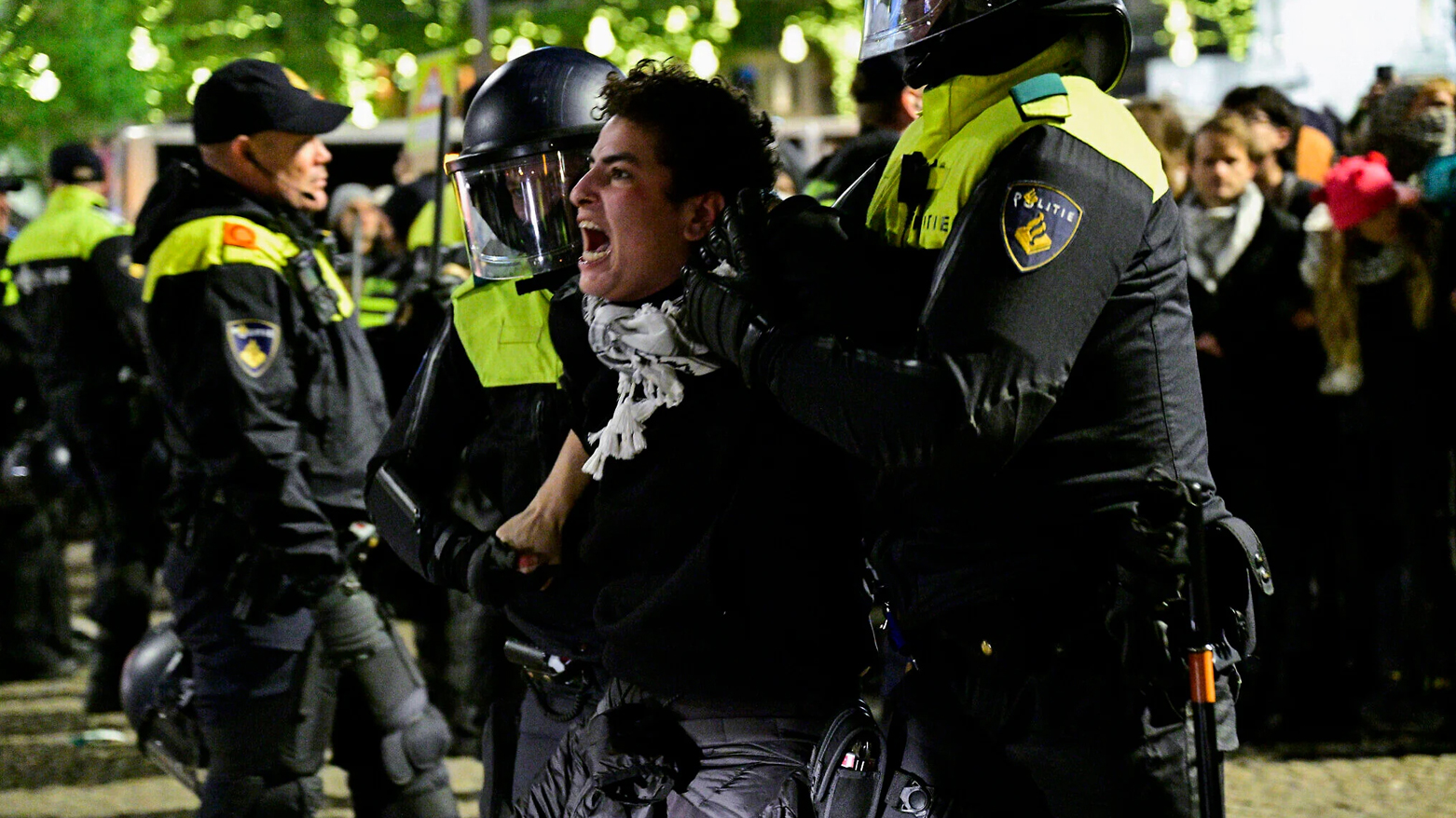
ERBIL (Kurdistan24) – Dutch law enforcement detained nearly two dozen individuals following violent clashes outside one of Amsterdam’s most prestigious concert halls on Sunday, as a performance by the Israeli military’s chief cantor became the focal point of a volatile demonstration against the ongoing legacy of the war in Gaza.
The unrest, which unfolded in the cultural heart of the city, underscores the extent to which the conflict in the Middle East continues to reverberate through European capitals, challenging authorities to balance public safety with the freedom of assembly amidst heightened geopolitical sensitivities.
According to a report by Agence France-Presse (AFP), the confrontation took place near the renowned Concertgebouw hall, where several hundred demonstrators had gathered in the evening to protest the presence of Shai Abramson, the chief cantor of the Israel Defense Forces.
The situation outside the venue deteriorated as protesters set off smoke bombs, prompting riot police to deploy batons in an effort to disperse the crowd and secure the perimeter of the building. In a statement addressing the sequence of events, Dutch police confirmed that they were forced to intervene "several times to keep the demonstrators at a distance and maintain public order."
The clashes resulted in the arrest of 22 people on a variety of charges, including violations of public assembly regulations, possession of fireworks, and resisting arrest. Authorities also reported that one police officer sustained minor injuries during the scuffles.
The intensity of the police response reflected the heightened security posture surrounding the event, which had already been significantly altered due to public pressure before the first note was sung.
The controversy centered specifically on the scheduled appearance of Abramson, whose official role within the Israeli military drew sharp criticism from activists.
AFP reported that the cantor was initially slated to lead the Concertgebouw's annual public Hanukkah concert on Sunday afternoon. However, this plan faced a significant public outcry stemming from Abramson's direct ties to an army that has faced international condemnation regarding its conduct during the war in Gaza.
Bowing to the pressure of the controversy, organizers cancelled Abramson's participation in the public afternoon event. Instead, his performance was relegated to two private concerts held later in the evening, a move intended to lower the profile of his visit but which ultimately failed to forestall the demonstrations outside the venue.
The protest in Amsterdam occurred against the backdrop of a tentative and fragile calm in the Middle East.
A United States-sponsored ceasefire has largely halted the fighting in Gaza, a conflict ignited by Hamas's deadly attack on Israel on October 7, 2023. This truce, which has been in effect since October 10, remains precarious.
While it has paused the kinetic warfare, the underlying tensions persist, with AFP noting that Israel and Hamas continue to accuse one another almost daily of violating the terms of the agreement.
The events in Amsterdam serve as a microcosm of the broader diplomatic and social challenges facing European nations as they navigate the fallout of the conflict.
The shift from a celebratory public Hanukkah concert to a secured private event besieged by riot police illustrates how cultural exchanges have become entangled with political grievances.
As Dutch authorities process those arrested for public order offenses, the incident highlights the continuing volatility of public sentiment regarding the Israel-Gaza conflict, even during periods of nominal ceasefire.