Kurdistan Region Oil Exports Top 200,000 Barrels a Day as Baghdad Confirms Agreement Renewal
KRG oil exports surpass 200,000 bpd as Baghdad confirms the renewal of the export deal, cementing the recovery of the sector after a 2.5-year halt.
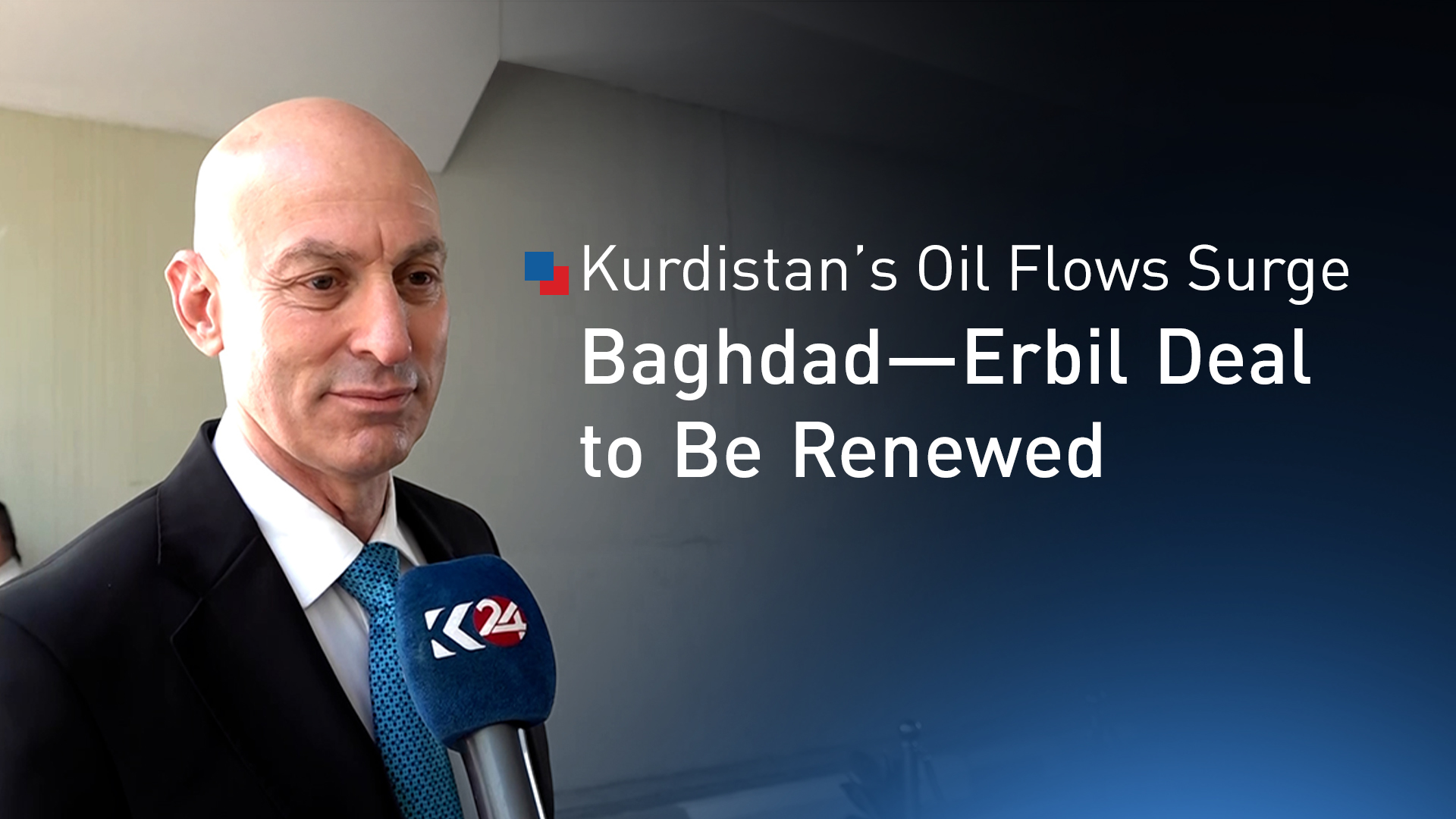
ERBIL (Kurdistan24) — Crude oil exports from the Kurdistan Region have surpassed 200,000 barrels per day, a senior Iraqi oil official confirmed, signaling a robust recovery for the energy sector three months after the resumption of flows through the Türkiye-Iraq pipeline. The federal government in Baghdad also announced that the interim agreement governing these exports, initially set to expire this month, will be renewed, ensuring the continued flow of Kurdish crude to global markets.
Hamdy Singary, the Deputy Director General of Iraq’s State Oil Marketing Organization (SOMO), told Kurdistan24 in an exclusive interview that the operational framework established between the Kurdistan Regional Government (KRG) and the federal government has faced "no issues" since its implementation in late September.
"The volume of the Region's oil exports abroad has exceeded 200,000 barrels of oil per day," Singary said. "The process will continue, and the agreement will be extended."
The confirmation of the renewal and the increased export volume marks a significant milestone in the stabilization of relations between Erbil and Baghdad.
The two governments have been working to reintegrate the Kurdistan Region’s energy output into the national export infrastructure following a costly diplomatic and legal standoff that had frozen the pipelines for more than two years.
A sustained recovery
The current export levels represent an increase from the targets set during the initial resumption of operations earlier this year.
When exports officially restarted on September 27, 2025, the agreed-upon framework targeted a daily export volume of 190,000 barrels, with an additional 50,000 barrels reserved for domestic consumption within the Kurdistan Region.
Singary’s disclosure that exports have now cleared the 200,000-barrel threshold indicates that production and logistical capacity have ramped up efficiently during the initial three-month trial period.
The crude is transported from the Khurmala oil field near Erbil, which serves as a collection point for output from eight different fields across the region.
From Khurmala, the oil travels approximately 600 kilometers to the Peshkabour metering station on the border, where it enters the pipeline network managed by Türkiye for transport to the port of Ceyhan on the Mediterranean coast.
The initial agreement, finalized in September after months of negotiations involving the KRG Ministry of Natural Resources, the Iraqi Federal Ministry of Oil, and international oil companies, was designed as a temporary measure valid for three months.
This timeline placed the renewal decision squarely in December 2025. The assurance from SOMO’s leadership that the deal will be extended provides critical certainty for international buyers and investors monitoring the reliability of Kurdish supplies.
Ending a costly suspension
The steady flow of oil stands in stark contrast to the disruptions that characterized the preceding years.
Exports through the Ceyhan pipeline were halted on March 25, 2023, following an arbitration ruling involving Türkiye and Iraq. The suspension lasted for more than two and a half years, a period during which the Kurdistan Region and the federal budget reportedly suffered damages amounting to tens of billions of dollars due to lost revenue.
The breakthrough came earlier this year on September 27, when valves at the Peshkabour station were reopened at 6:50 a.m., marking what officials described as a historic breakthrough.
The resumption was overseen by joint committees from Erbil and Baghdad, establishing a new model of cooperation where the KRG manages extraction and transport to the border, while SOMO assumes responsibility for marketing the oil internationally once it reaches the Turkish port.
Under the terms of the accord, SOMO has contracted with a major Swiss oil trading company to handle the sales. According to previous reports by Kurdistan24, the crude is being directed primarily toward European markets, which have sought to diversify energy sources, as well as to buyers in North America.
Strategic and economic implications
Ali Nizar, the Director General of SOMO, emphasized the geopolitical relevance of the Kurdish crude during the resumption ceremonies in September.
"Kurdistan’s oil will be exported to global markets via Ceyhan on the Mediterranean, a center of European trade," Mr. Nizar stated at a press conference on September 26. He noted that Europe specifically requires Kurdish oil as an alternative to Russian supplies, a dynamic that has heightened the strategic importance of the Iraq-Türkiye pipeline.
The arrangement also addressed the complex issue of compensating international oil companies (IOCs) operating in the region.
The framework established a payment rate of $16 per barrel to cover production and transportation costs for these companies. To ensure transparency and confidence, these payments are processed through the U.S. Federal Reserve, a mechanism designed to insulate the funds from local political disputes.
The renewal of the agreement is expected to segue into broader discussions regarding Iraq’s 2026 federal budget. Officials have previously indicated that export volumes would be recalibrated in the upcoming budget to reflect the full production capacity of the Kurdistan Region, suggesting that the current figure of 200,000 barrels per day could rise further in the coming year.
Political alignment
The technical success of the export resumption has been matched by a rare alignment in political rhetoric between the KRG and the federal government. Following the September restart, the Iraqi Federal Ministry of Oil described the cooperation as a "notable step toward managing national resources in a spirit of partnership."
Iraqi Prime Minister Mohammed Shia al-Sudani publicly supported the deal, emphasizing that it ensures the fair distribution of resources and strengthens national revenues.
Similarly, Kurdistan Region Prime Minister Masrour Barzani hailed the September agreement as the result of "tireless efforts," noting that it allowed Kurdish oil to re-enter the global market after a long hiatus.
With the initial three-month window concluding and export volumes exceeding expectations, the renewal of the agreement cements a new status quo for Iraq's energy sector.
The integration of Kurdish fields into the SOMO marketing structure, supervised jointly by Baghdad and Erbil, appears to have moved beyond a tentative experiment to become a functioning pillar of the country’s economy.