Kuwait Signs $4.1 Billion Port Construction Deal With China to Expand Global Trade Role
Kuwait signs $4.1B deal with China to build Mubarak Al-Kabeer Port, aiming to diversify its economy and boost trade ties via the Belt and Road Initiative.
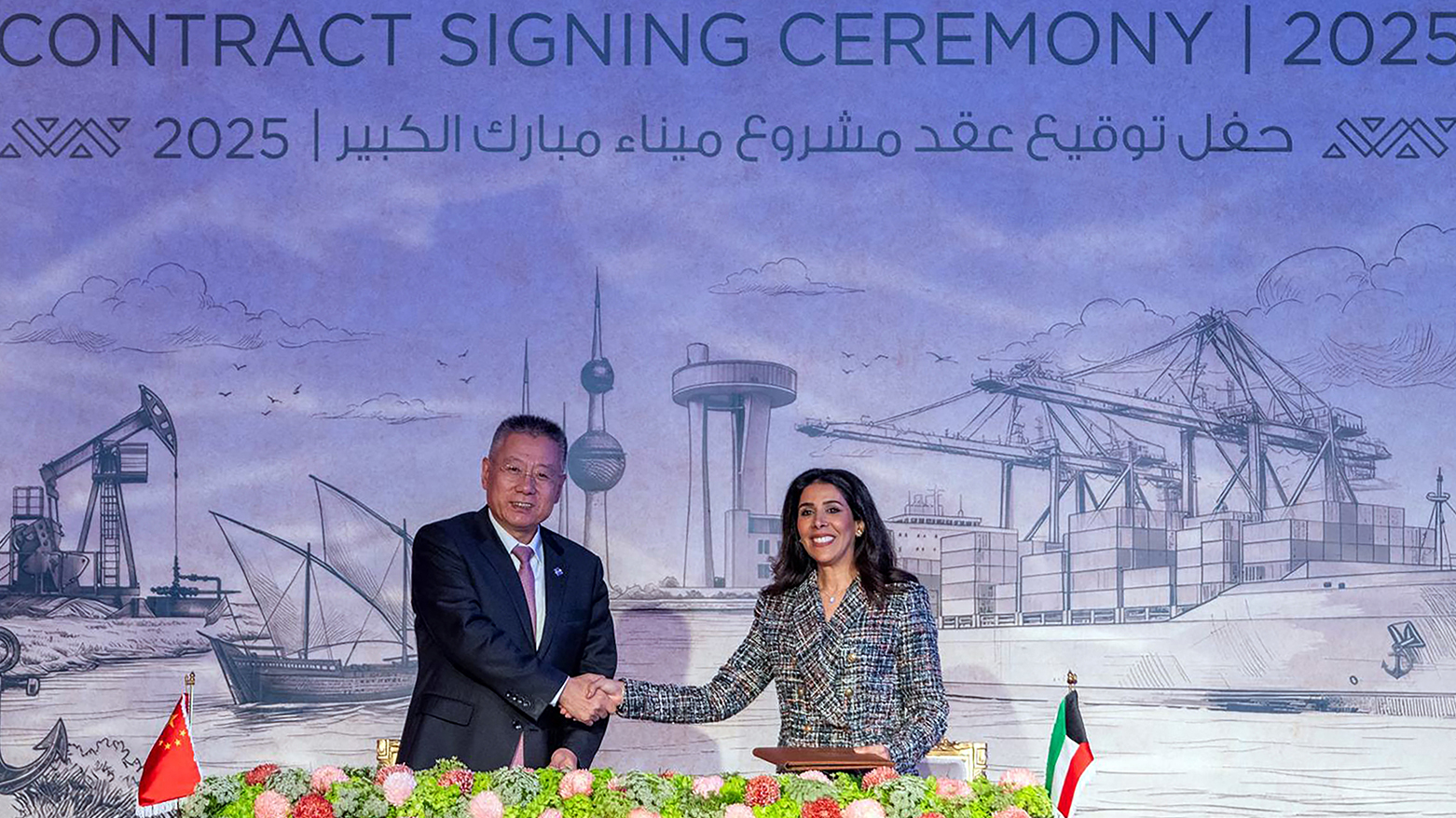
ERBIL (Kurdistan24) — Kuwait has formally entered into a major infrastructure agreement with China, signing a contract valued at approximately $4.1 billion to complete the construction of the Mubarak Al-Kabeer Port.
The massive deal, finalized on Boubyan Island, marks a significant strategic maneuver for the oil-rich Gulf nation as it seeks to diversify its economy and secure a more prominent position in regional and international trade.
The details of the financial arrangement were disclosed on Monday by the State Audit Bureau, the government oversight body in Kuwait tasked with the monitoring of public funds.
In a formal statement regarding the project, the Bureau announced that the government had secured an "engineering, procurement, and construction contract to complete the Mubarak Al-Kabeer Port project."
The State Audit Bureau specified the total value of the contract at 1.28 billion Kuwaiti dinars, which the body noted is equivalent to $4.164 billion. This significant allocation of state resources underscores the priority the government has placed on bringing the long-planned infrastructure project to completion.
The signing of the agreement was commemorated at a high-level ceremony attended by Kuwait’s senior leadership, signaling the project's importance to the national agenda.
Prime Minister Sheikh Ahmad Al-Abdullah Al-Ahmad Al-Sabah was present for the inking of the engineering-supply-construction contract. According to state media reports covering the event, the Prime Minister viewed the contract not merely as a construction project, but as a pivotal economic instrument for the country.
During the ceremony, Prime Minister Sheikh Ahmad Al-Abdullah Al-Ahmad Al-Sabah addressed the strategic implications of the port. He stated that the key project would "enhance Kuwait's share in the regional and international trade and global supply chain."
His remarks reflect the administration's broader objective to leverage Kuwait’s geographic position to become a central logistics hub, moving the country beyond its traditional economic reliance on energy exports.
The event also underscored the deepening economic ties between Kuwait and Beijing.
Liu Xiang, the Chinese acting charge d'affaires, attended the ceremony to represent the Chinese government. In his comments regarding the successful finalization of the deal, the Chinese diplomat framed the project within the context of China's global economic strategy.
Mr. Liu stated that the agreement "constitutes participation in the 'belt and road' initiative." The Belt and Road Initiative is a vast global infrastructure project that has been developed over the last decade under the leadership of Chinese President Xi Jinping.
By securing the contract for the Mubarak Al-Kabeer Port, China continues to expand its footprint in the Middle East, a region it has been focusing on as part of the initiative to build trade and infrastructure connectivity.
The finalization of this $4.1 billion contract is the culmination of a series of diplomatic and economic engagements between the two nations over recent years. The groundwork for this specific agreement was laid in 2023, when Kuwait and China signed seven memoranda of understanding (MOUs) aimed at fostering cooperation across multiple critical sectors.
According to the background of the bilateral relationship, the 2023 memoranda included specific provisions for the Mubarak Al-Kabeer Port, alongside other developmental projects. The scope of the 2023 agreements was broad, encompassing cooperation in housing, water treatment, and renewable energy.
The transition from a memorandum of understanding to a finalized engineering and construction contract represents a major step forward in realizing the commitments made during those diplomatic exchanges.
For Kuwait, the project is a central component of its effort to diversify its economy.
Described as an oil-rich country, Kuwait faces the long-term challenge of reducing its dependence on hydrocarbon revenues. The investment in the Mubarak Al-Kabeer Port is designed to create alternative sources of income by integrating the nation more deeply into the global supply chain, a goal explicitly cited by the Prime Minister during the signing event.
The State Audit Bureau’s involvement in announcing the cost highlights the scale of the public expenditure involved.
As the body responsible for monitoring public funds, the Bureau’s confirmation of the 1.28 billion Kuwaiti dinar cost sets the financial baseline for the project’s execution phase. With the engineering, procurement, and construction terms now settled, the focus shifts to the physical completion of the facility on Boubyan Island.
The deal cements China's role as a primary partner in Kuwait’s infrastructure development.
As the Belt and Road Initiative enters its second decade, the collaboration on the Mubarak Al-Kabeer Port serves as a tangible example of China’s strategy in the Middle East, matching Chinese engineering and construction capacity with the developmental capital and diversification goals of Gulf states like Kuwait.