Rising Anti-Kurdish Hate Speech in Syria Threatens to ignite New Conflict, undermines Political Solutions
Rising anti-Kurdish hate speech in Syria alarms activists and politicians, who warn it fuels instability, undermines dialogue, and threatens coexistence amid fragile political efforts.
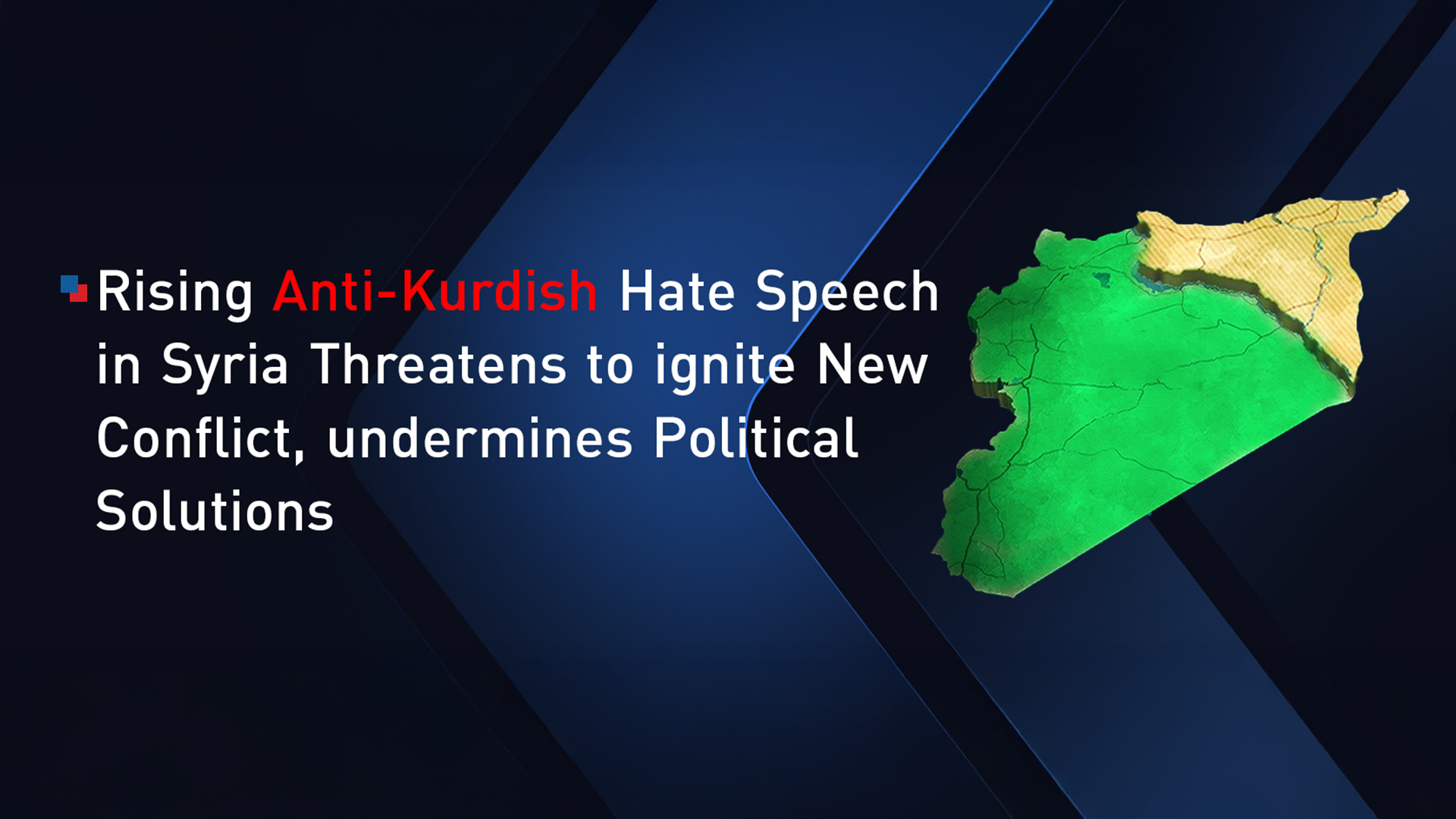
ERBIL (Kurdistan24) - The language of exclusion is returning to Syria’s public sphere, this time louder and more normalized, alarming Kurdish activists, politicians, and civil society figures who warn that rising anti-Kurdish hate speech risks igniting new conflict and undermining political solutions.
Following recent developments in Syria, Kurdish communities have voiced deep concern over the spread of racist and exclusionary rhetoric by supporters of the Damascus Transitional Government. Observers and activists caution that such discourse is no longer confined to social tension but has evolved into a political problem capable of fueling fresh clashes among Syria’s diverse social components.
The issue gained urgency after clashes in the Sheikh Maqsoud and Ashrafiya neighborhoods of Aleppo, where hate speech circulating in media and on social platforms has, according to multiple voices, negatively affected the implementation of the “March 10 agreement” and stalled dialogue efforts.
Warnings from human rights monitors
In an interview with Kurdistan24 English, Rami Abdulrahman, director of the Syrian Observatory for Human Rights (SOHR), described the phenomenon as clear and escalating.
“Yes, categorically, there is a rising discourse with racist and exclusionary tones toward Kurds in Syria,” he said. “We are now witnessing incitement and even denial of Kurdish existence in Syria, portraying Kurds as guests who arrived sixty years ago.”
Abdulrahman rejected such narratives, pointing to historical grievances. He recalled that prior to the Baath Party’s rise to power more than six decades ago, an exceptional census in Hasaka province stripped around 120,000 Kurds of Syrian citizenship.
“Yes, there is hate speech,” he said. “And under the label of the Syrian Democratic Forces, there is a process of practicing and escalating racist rhetoric against Kurds in Syria.”
Abdulrahman argued that while the Baathist system collapsed on Dec. 8, 2024, and ISIS lost territorial control in 2019, the ideologies behind exclusion and extremism persist.
He also criticized pro-government media.
“Media is a weapon,” Abdulrahman said. “It can build nations or destroy them. What we have seen from official and pro-government media over recent months is clear incitement against Kurds under the label of the SDF.”
Parliamentary concerns
Mohammad Sido, a Kurdish member of Syria’s People’s Assembly, echoed these concerns in a separate interview with Kurdistan24 English, describing the language as a product of long-standing Baathist indoctrination.
“In my view, the exclusionary and racist language exchanged among Syrians is truly unfortunate,” he said. “It is the result of an inherited culture planted by Baathist chauvinism throughout its rule.”
Sido stressed that popular escalation in rhetoric often appears precisely when calm and dialogue are most needed.
He warned that rising racism and sectarian discourse directly threaten coexistence and civil peace, arguing that such behavior must be treated as a serious crime because Syrians have paid a heavy price and now need national reconstruction.
Despite the challenges, Sido expressed cautious optimism.
“I am convinced that Syrians, along with the current transitional government, are capable of overcoming this phase and eliminating the seeds of racist and sectarian strife,” he said.
Public celebrations and social backlash
The debate intensified after the Damascus branch of the Kurdish Democratic Students and Youth Union – Rojava held a celebration for Kurdish Flag Day under the sponsorship of Kurdistan TV. The event triggered mixed reactions on social media, with both support and opposition.
Omar Saleh Omar, head of the Damascus branch of the union, told Kurdistan24 English that the shift in discourse is unmistakable.
“Yes, there is a noticeable change in tone in some media outlets and digital spaces,” he said. “Exclusionary and racist terms that had relatively receded are returning.”
He warned that such language is no longer marginal.
“It now appears in public discussions, signaling a dangerous normalization of exclusionary rhetoric against Kurds,” Omar said.
He linked the discourse to developments on the ground, including events in Aleppo. Omar noted that the impact is visible in daily life, including discrimination, unspoken restrictions, and degrading language, sometimes reflected in the behavior of local institutions in mixed areas.
He attributed the rise to political stagnation, social grievances, and media practices driven by mobilization rather than de-escalation.
“Yes, this discourse serves forces that have no interest in Syria’s stability or in building a democratic state,” Omar said. “Stoking Arab-Kurdish strife weakens society and keeps conflict open.”
Afrin and calls for a new national page
From Afrin, the only Kurdish region under the authority of the transitional administration, Ahmed Hassan, head of the Kurdish National Council in Afrin, emphasized Syria’s diversity.
Hassan argued that Syria cannot be rebuilt without genuine partnership in power and wealth and called for turning the page after the fall of Bashar al-Assad’s regime.
“The new page must be one of tolerance, reconciliation, and cooperation,” he said, advocating a modern constitution, a transitional government, and free elections.
He warned that denying any Syrian component threatens the entire national project.
“Difference is richness, not weakness,” Hassan said, calling for a federal, democratic, parliamentary system guaranteeing dignity and freedom.
Escalation on the ground
Mohammad Amin, from the Office of Relations at the Syrian Democratic Council (SDC), linked hate speech directly to developments in Aleppo and Western Kurdistan (northeastern Syria), saying online incitement has translated into real-world violations.
He stated that this rhetoric was among the factors behind the attacks that occurred before Oct. 6 and again on Dec. 22, noting that what began on digital platforms later manifested on the ground.
Amin also stressed that while political factors also exist, hate speech has contributed to mobilizing the street and deepening divisions, including through regional agendas that exploit these narratives.
He warned that such discourse threatens coexistence and Syria’s social fabric, particularly given the deep societal fractures created by more than sixty years of Baathist rule.
Amin sharply criticized official and state-affiliated media, describing it as negative and polarizing rather than inclusive.
He argued that any Syrian rapprochement under such discourse would remain impossible unless the state assumes its responsibility through a genuine national dialogue, an inclusive constitution guaranteeing cultural and linguistic rights, and real partnership among all Syrian components.
Party perspectives
Hanan Sido, a member of the Central Committee of the Kurdistan Democratic Party – Syria, traced the roots of hate speech to Baathist policies but said it intensified after the collapse of the previous regime.
He argued that monopolization of power by the current authority, without real participation from other Syrian components, deepened feelings of grievance among Kurds, Alawites, Druze, Christians, Assyrians, and Turkmen.
According to Sido, social media amplified the problem, allowing unaccountable voices, whether aligned with the government or other actors, to inflame tensions.
He warned that political and security chaos would negatively shape the future of coexistence unless a comprehensive national dialogue begins, leading to a modern constitution that recognizes Syria’s diversity and criminalizes hate speech.
In His view, saving Syria requires a balanced political vision toward Kurds, recognition of Kurdish identity, and guaranteed national and political rights within a democratic, multi-ethnic Syria.
A fragile path forward
Political observers warn that unless Damascus and its supporters abandon provocative rhetoric, Syria’s political solution will become increasingly complex. The rise of hate speech, they argue, threatens social brotherhood and regional stability.
Across interviews, one message remained consistent: without confronting exclusionary discourse and rebuilding trust through inclusive dialogue, Syria’s fragile social fabric risks further unraveling.