Senior Kurdish Politician: President Barzani Is a ‘National Reference’ Key to Resolving Regional Crises
Mala Bakhtiar calls President Barzani the Kurdish national leader, warns census endangers Kurdish rights, praises Rojava’s recovery, urges KDP-PUK unity on Iraq’s presidency, and rejects posts without both parties’ approval.
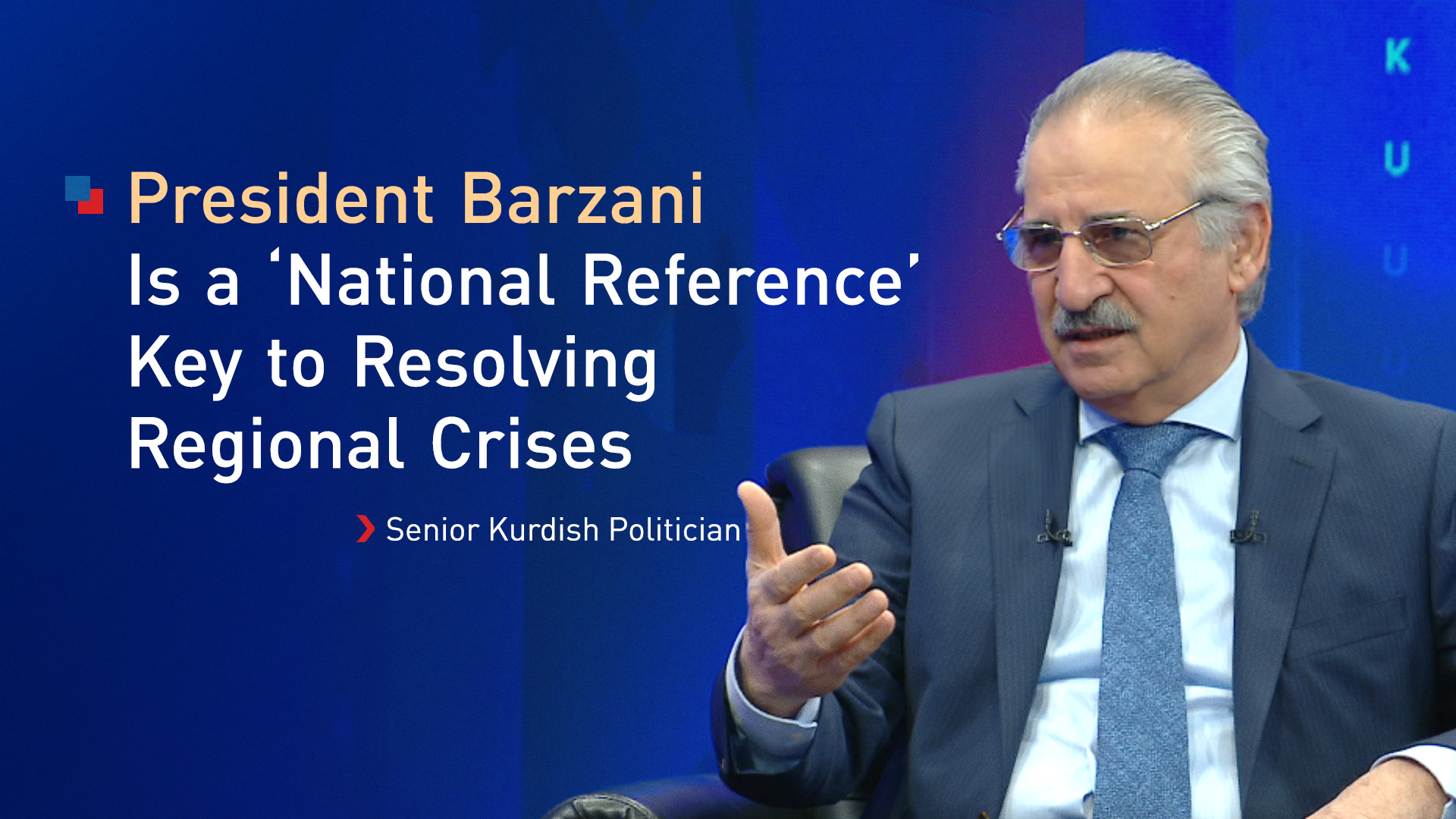
ERBIL (Kurdistan24) - On Wednesday, Mala Bakhtiar, a prominent Kurdish political figure, appeared on Kurdistan24’s "Basi Roj" program, providing a profound geopolitical and national analysis of the current situation in Kurdistan, Iraq, and the region. During the interview, he reaffirmed the status of President Masoud Barzani as a "National Reference" (Marja'), while warning of the consequences of failing to establish a unified Kurdish discourse in Baghdad and the potential risks associated with the population census.
President Barzani: The Pivot of Solutions and National Reference
In his opening assessment of the national situation, Mala Bakhtiar explicitly described President Masoud Barzani as the "Great Leader of the Kurdish Nation." He noted that President Barzani's role is not confined to the Kurdistan Region (Southern Kurdistan) but that the issues facing Kurds in the North, West, and East also require his wisdom.
"The problems of the South can only be resolved by His Excellency Kak Masoud; indeed, for the other parts of Kurdistan as well, the Kurdistan Region and His Excellency serve as a lifeline," Bakhtiar stated. "The strategic meetings held in Pirmam regarding Rojava (Western Kurdistan), conducted under his supervision—had they not occurred, the Kurds would have suffered immense losses."
Bakhtiar revealed that Salih Muslim had proposed holding a National Congress to designate President Barzani as the "National Leader," a move Bakhtiar supports, while calling for detailed planning and a shared program before such a congress is convened.
Western Kurdistan: Escaping Defeat and a New Strategy
Regarding the situation in Western Kurdistan (Northern Syria), Mala Bakhtiar expressed optimism, stating: "For the first time in history, the Kurds in Rojava are emerging from the brink of a major defeat." He attributed this success to a unified national stance and the resilience of the public.
According to Bakhtiar, Turkey no longer behaves as it once did and was unable to carry out a military intervention because the dynamics of the Middle East have changed. He noted that Ankara now understands that deepening the crisis in Rojava would undermine the peace process in Northern Kurdistan (Turkey).
He proposed that a high-level delegation from Rojava visit the United States and Europe to provide assurances that if Kurdish rights are granted in Syria, the Kurds will not pose a threat to Syrian territorial integrity or regional interests.
Türkiye and Ocalan’s Decision
Mala Bakhtiar praised Abdullah Ocalan's recent stance, describing it as a "correct decision at the right time," but criticized the Turkish state for failing to take practical steps. He emphasized that "without a resolution to the Kurdish issue, the Middle East will not see stability."
On the international stage, the politician believes the world is heading toward a "Second Cold War," albeit in a different form. Regarding U.S. President Donald Trump, Bakhtiar said: "Trump represents the 'Post-Imperialism' era and openly states that he will impose peace by force. He values the central authority of the Syrian government and holds the same perspective regarding Iraq."
The Presidential Deadlock: A Message to President Barzani and the KDP
Addressing the relations between the KDP and the PUK, Mala Bakhtiar stated that there is currently no agreement on the post of the President of Iraq and that viewpoints remain far apart. He appealed to President Barzani to resolve the issue of the presidency through his "customary greatness."
"If the presidency is given to the PUK, nothing in the grand scheme changes," Bakhtiar argued. "In the past, the PUK held the presidency four times, yet the situation remained the same, and now the KDP has become the primary party in Iraq. The KDP possesses a 'weighty' (dignified and stable) policy in decision-making, which is why it remains the victor."
Conflict Over the Iraqi Premiership and Census Risks
Regarding Baghdad, Bakhtiar highlighted the conflict between Nouri al-Maliki and Mohammed Shia al-Sudani. He revealed that despite the Framework Coordination's decision to nominate Maliki, the matter remains unresolved due to a "Trump veto." He suggested that a secret Shia committee should visit the U.S. to resolve this issue.
In his view, Sudani remains the strongest candidate for the Prime Minister post should Maliki withdraw.
Bakhtiar also warned against the publication of the population census results, describing them as "dangerous." He stated: "This is an attempt to marginalize the Kurds numerically, obstruct the implementation of Article 140, and erase the remnants of Arabization."
Presidential Candidacy Secrets and Grievances
Mala Bakhtiar disclosed details regarding his own previous candidacy for the Iraqi presidency, claiming he was the victim of a plot involving his academic degree. He stated that had it not been for PUK pressure, he would have become the presidential candidate.
"I had received promises from Iraqi parties, particularly the Shias, that I would be elected president in the first round," he said. "The degree I hold was recognized until 2013, but now the Iraqi Ministry of Higher Education does not recognize the university. I was wronged and slandered, but I sacrifice that grievance for the headstone of a single martyr."
Relations with the PUK and Criticism of Bafel Talabani
Mala Bakhtiar clarified his stance toward the current PUK leadership, criticizing Bafel Talabani’s policies and stating: "I have never accepted Bafel as the leader of the PUK."
Regarding the agreement between the PUK and the New Generation Movement, he remarked: "That is not a strategic agreement; it is merely a political tactic."
Bakhtiar concluded with a clear message: "Without the approval of both parties (KDP and PUK), I will not accept any post in Iraq in the future, nor will I be a part of the fragmentation of the Kurdish house."