Trial of Two Former Regime Officers Over Barzani Genocide Case to Begin in Baghdad
An Iraqi court will begin the trial of two former regime officers in Baghdad on Dec. 28, 2025, over crimes against humanity linked to the 1983 Barzani genocide.
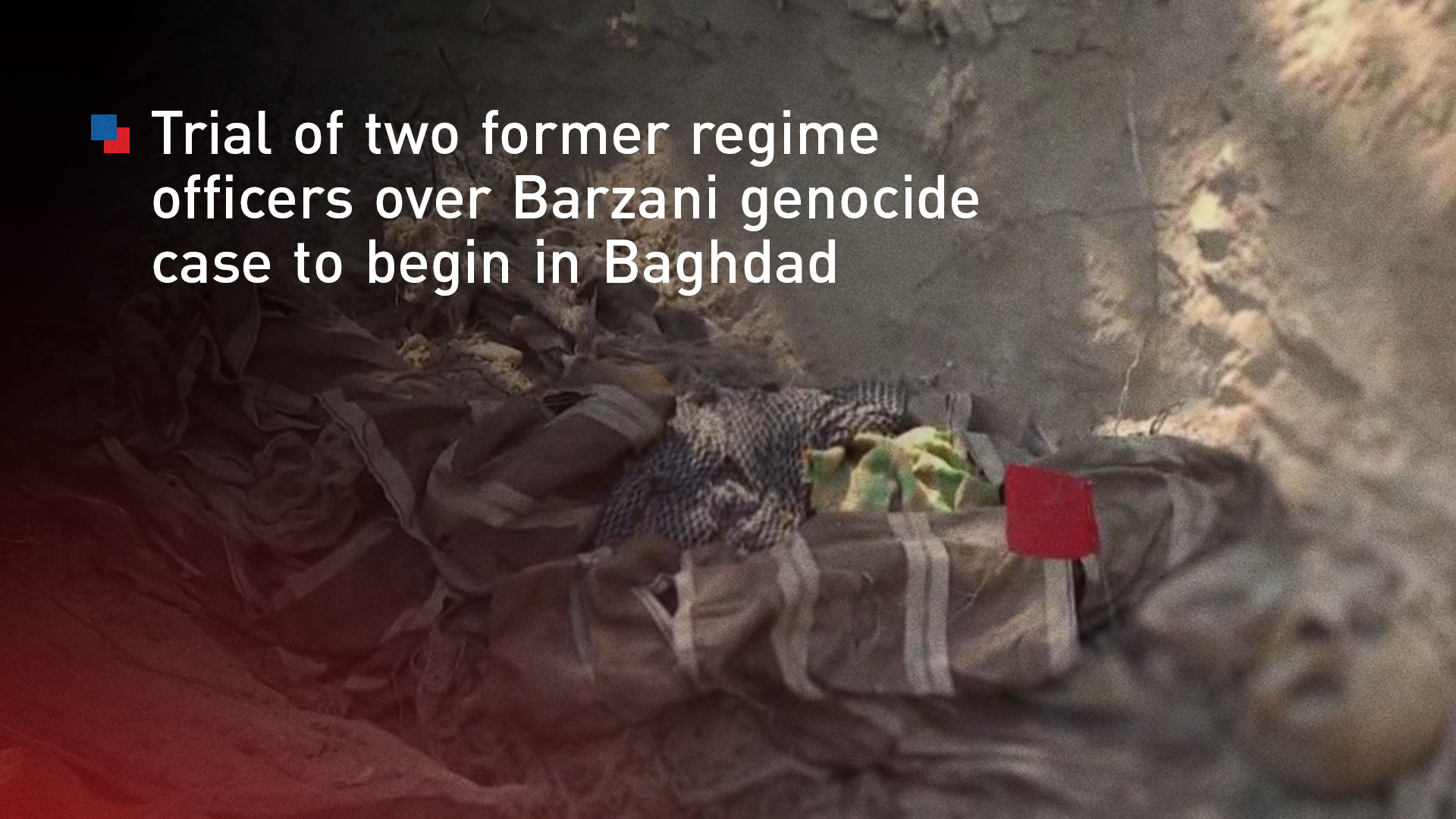
ERBIL (Kurdistan24) - In a long-awaited moment for survivors and families of victims, Iraq’s judiciary is set to open proceedings in one of the most painful chapters of Kurdish history, as the trial of two senior officers from the former regime begins in Baghdad.
The trial is scheduled to start on Saturday, Dec. 28, 2025, in Baghdad, where two high-ranking officers of the former Iraqi regime, both holding the rank of lieutenant general, will stand accused of crimes against humanity and direct involvement in the Barzani genocide.
The move follows their arrest by security forces, after which both suspects were transferred for investigation. One of the accused has formally confessed during preliminary interrogations to his role in carrying out the crimes.
According to official documents issued by the Iraqi High Criminal Court and the Presidency of the Rusafa Criminal Court, the two principal defendants are Lt. Gen. Shakir Taha Yahya Ghafoor al-Douri and Lt. Gen. Saadoun Sabri Jamil al-Qaisi.
The court has issued formal summonses requiring their appearance for trial under Articles 12 and 15 of the Iraqi High Criminal Court Law, which address international crimes, including genocide and crimes against humanity.
During initial investigations, Lt. Gen. Shakir al-Douri provided detailed testimony outlining the plans and operational mechanisms used to arrest and forcibly disappear members of the Barzani community. These confessions are expected to be presented as key evidence during sessions of the Rusafa Criminal Court.
Legal teams representing the Barzani case, along with representatives of victims’ families, will attend the court hearings to monitor proceedings and defend the legal rights of the victims.
Court documents indicate that a list of thirty-five complainants and eyewitnesses has been prepared. They are residents of the Barzan, Harir, Soran, Pirmam, Maseef, and Bahrka areas. These individuals have been summoned as plaintiffs in Case No. 9/J/2025 to provide testimony about the atrocities committed against their families during the Baath regime era.
The Barzani genocide forms a core part of the broader Anfal campaign, one of the gravest crimes committed against the Kurdish people in the latter half of the 20th century under Iraq’s former Baath regime.
The systematic targeting of the Barzanis unfolded in several phases. In the late 1970s, Iraqi authorities began forcibly displacing Barzani families from their ancestral lands, relocating them to tightly controlled military camps under the pretext of “security measures.” These relocations were later revealed to be preparatory steps for mass detention and elimination.
In 1978, large numbers of Barzanis were transferred to camps in Diana, Harir, Bahrka, and Goratu, where they were placed under strict military surveillance and effectively isolated from the outside world. In 1980, additional groups were moved to the Quds and Qadisiya camps in the Qushtapa area, as part of a broader strategy to centralize control over the population.
According to Baath-era documents, a secret operation was launched in late July and early August 1983 by elite units of the General Security Directorate, supported by Republican Guard forces and rapid-response military units. The operation aimed to arrest all Barzani males over the age of 15 and was carried out in three stages.
The first phase, on July 31, 1983, targeted residents of the Quds and Qadisiya camps in Qushtapa. The second phase, on Aug. 10, 1983, expanded arrests to camps in Harir, Diana, Bahrka, and surrounding areas of Mergasor. A third phase followed on Oct. 1, 1983, during which soldiers conducted house-to-house searches to detain those who had evaded earlier arrests.
One of the clearest confirmations of the operation’s scope appears in an official document dated March 29, 1989, marked No. 84, sent by the Director of General Security to the Secretariat of the Presidency. The letter states that, on Aug. 1, 1983, following directives issued by then-General Security Director Dr. Fadel Barak, all Barzani males above the age of 15 were seized from the Quds and Qadisiya camps and transported by military trucks to Baghdad. None of those taken were ever seen again.
More than 8,000 Barzani men and boys were forcibly disappeared and executed during the operation, which later became formally recognized as an act of genocide within the Anfal campaign.
More than four decades on, the trauma of the Barzani genocide remains deeply embedded in Kurdish collective memory. The current trial is widely viewed as a critical step toward justice, accountability, and historical recognition for crimes that targeted civilians solely because of their ethnic identity.
The trial, scheduled to commence on Dec. 28, 2025, is being regarded as a historic step toward accountability, aimed at prosecuting surviving perpetrators who played a direct role in the genocide.