PM Barzani, Egyptian CG Highlight Stronger Ties Following Cairo Visit
Egyptian Consul General Mahmoud Farouk Youssef met PM Masrour Barzani on Monday, reaffirming Cairo's desire to strengthen ties. The talks followed PM Barzani's recent Cairo summit, focusing on expanding trade and security cooperation.
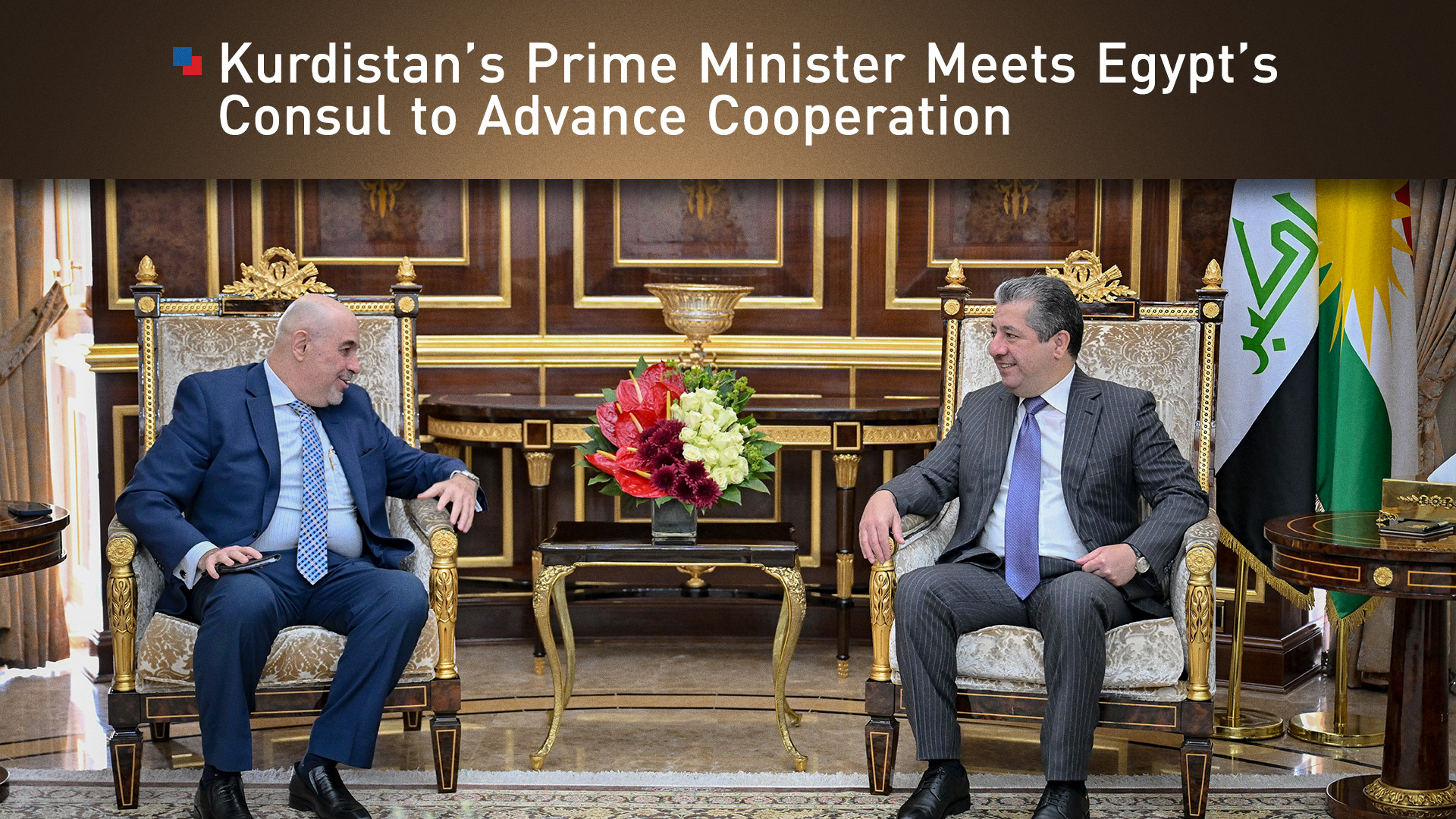
ERBIL (Kurdistan24) – Prime Minister Masrour Barzani received Mahmoud Farouk Youssef, the Consul General of Egypt in the Kurdistan Region, on Monday for a high-level discussion that underscored Cairo’s intent to deepen its diplomatic and economic engagement with Erbil. The meeting, held in the Kurdistan Region on Jan. 12, 2026, served as a follow-up to the Prime Minister’s official visit to Cairo last month, focusing on the implementation of bilateral agreements and the expansion of cooperation across multiple sectors.
According to a statement from the Prime Minister's office, Monday's talks centered on the outcomes of PM Barzani’s recent summit with Egyptian President Abdel Fattah el-Sisi.
During the meeting, Consul General Youssef highlighted the strategic significance of that visit, describing it as a pivotal moment for advancing relations between Egypt and the Kurdistan Region.
He explicitly reiterated his country’s desire to strengthen these ties, emphasizing that Cairo views the relationship as a priority within its broader regional policy.
Prime Minister Barzani expressed his appreciation for Egypt’s constructive role in the Middle East.
He specifically acknowledged President Sisi’s efforts in supporting the Kurdish cause and promoting peace and stability throughout the region.
The Prime Minister reaffirmed the KRG's commitment to the partnership, which officials in Erbil view as essential for both economic development and regional security.
Building on the Cairo Summit
The meeting on Monday builds directly on the diplomatic momentum generated three weeks ago during Prime Minister Barzani’s trip to Egypt. On Dec. 21, 2025, PM Barzani met with President Sisi at the Presidential Palace in Cairo.
That summit was characterized by a mutual commitment to broaden the scope of the relationship beyond traditional diplomatic channels.
During the Cairo talks, President Sisi expressed Egypt’s readiness to further develop bilateral relations across various fields, with a particular emphasis on investment and trade.
The two leaders also addressed security-related issues, agreeing on the necessity of enhanced coordination to safeguard stability in the Kurdistan Region, Iraq, and the wider Middle East.
Following the December meeting, Prime Minister Barzani stated on social media platform X that both sides had "stressed closer ties between the Kurdistan Region and Egypt, particularly in investment and trade."
This top-level political alignment has set the stage for the operational discussions that took place with the Consul General on Monday.
Economic Foundations of the Partnership
The diplomatic rhetoric is underpinned by a growing economic reality. Data released by the Ministry of Trade and Industry of the Kurdistan Region indicates that commercial relations are robust and expanding.
Nawzad Sheikh Kamil, the General Director of Trade for the Kurdistan Region, recently confirmed that registered capital from Egyptian firms operating in the region now exceeds $15 million.
According to ministry statistics, 23 Egyptian companies successfully imported goods into the Kurdistan Region in 2025. The trade volume is diversified across several critical sectors, with primary imports including agricultural supplies, medical supplies, and electrical appliances.
This flow of goods reflects a broad-based demand for Egyptian industrial and agricultural output within the local market.
Egyptian enterprise has also become increasingly visible in the region’s infrastructure and service sectors. Companies from Egypt are active in construction, housing, and energy services, while the Kurdistan Region has emerged as an attractive destination for Egyptian labor and investment.
Erbil has actively sought to leverage Egypt’s expertise in large-scale development projects to support its own modernization goals.
Strategic and Cultural Dimensions
Beyond economics, the relationship is anchored in shared strategic interests regarding regional stability. Both Erbil and Cairo have engaged in consistent dialogue on counterterrorism and the challenges posed by political fragmentation in the Middle East.
Egypt has repeatedly expressed support for the stability of the Kurdistan Region, viewing it as a constructive actor within the Iraqi federal framework and essential to the security of the wider area.
Cultural and educational ties serve as another pillar of this multidimensional partnership.
Egypt’s status as an intellectual hub in the Arab world has facilitated academic exchanges, with Kurdish students studying in Egyptian universities and cultural institutions from Cairo engaging with counterparts in Erbil.
The continued high-level engagement, exemplified by Monday’s meeting between Prime Minister Barzani and Consul General Youssef, signals a sustained effort by both governments to institutionalize these ties.
By prioritizing direct dialogue and following up on the executive agreements reached in Cairo, officials aim to translate diplomatic goodwill into tangible cooperation that addresses the shifting political and economic dynamics of the region.