Kurdish Hackers Breach Syrian Government Ministries' Website
Kurdish hackers defaced Syrian ministry websites to protest government policies, coinciding with militia attacks on the Tishreen Dam and a forced SDF withdrawal from Aleppo.
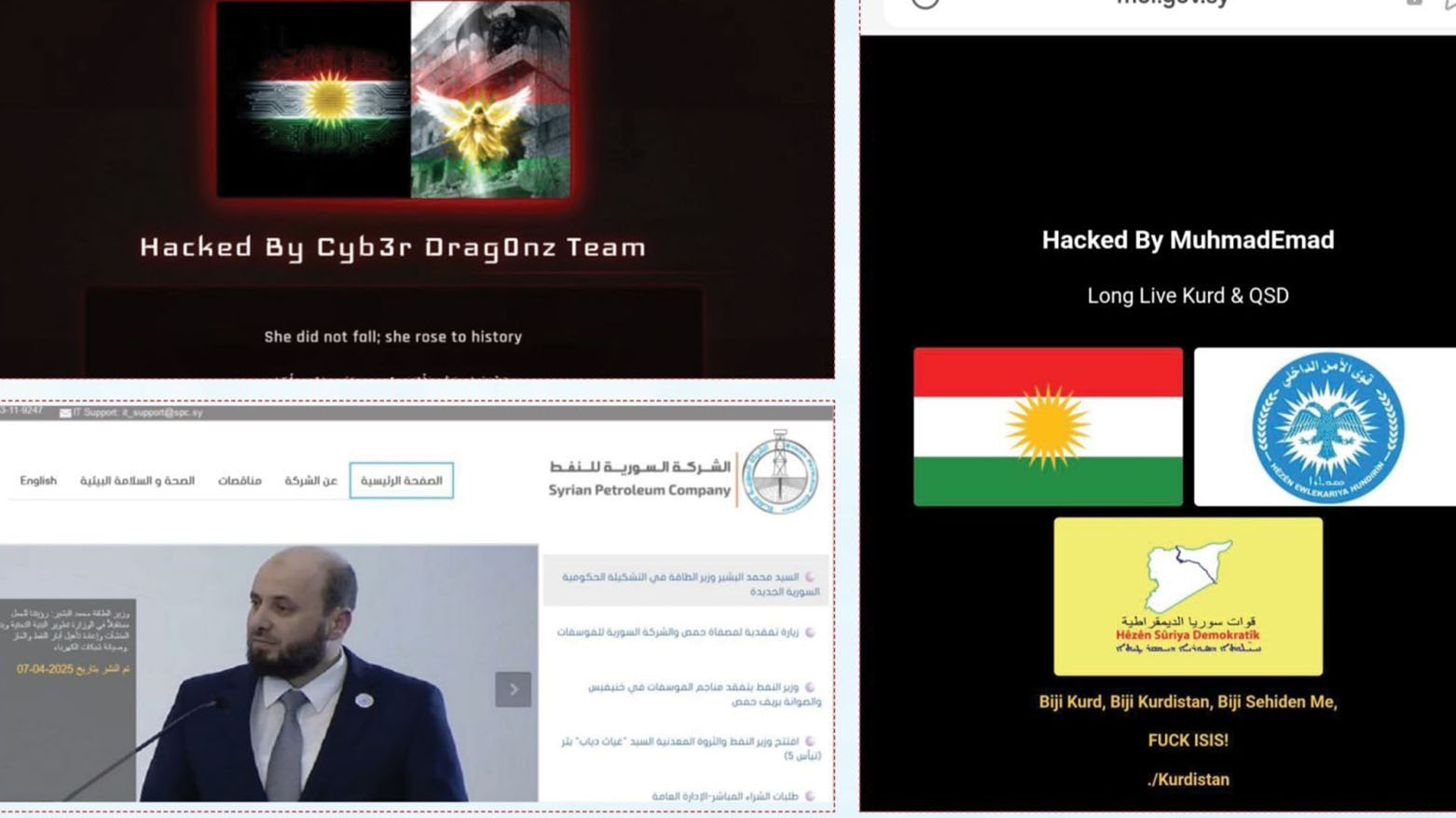
ERBIL (Kurdistan24) – A coordinated cyberattack compromised the digital infrastructure of several Syrian government ministries on Monday, replacing official state content with political messages and Kurdish symbols. The breach, which targeted high-profile sovereign interfaces including the Ministry of Information, marks a digital expansion of the widening conflict between the Autonomous Administration of North and East Syria and the central government in Damascus.
According to technical reports observing the incident, a group identifying itself as "Kurdish Hackers" executed a "defacement" operation against the state-run platforms. Visitors to the official websites were met with slogans written in Kurdish, Arabic, and English, transforming the government's primary digital outlets into what analysts described as a "protest podium."
The attackers broadcast messages explicitly condemning Damascus's policies toward the northeastern regions of the country, signaling an intent to utilize cyber warfare as a tool for political embarrassment alongside the ongoing military friction on the ground.
Cybersecurity experts reviewing the incident noted that the breach exposes "chronic security gaps" within the Syrian government's digital infrastructure. While technical teams at the Ministry of Information moved quickly to shut down servers to scrub the sites of "digital traces" and regain control, the intrusion is viewed as a significant symbolic blow.
By compromising the Ministry of Information—the entity responsible for disseminating the state's official narrative—the attackers demonstrated a capability to penetrate sovereign electronic spaces during a period of acute political sensitivity. Analysts suggest the primary objective was not the destruction of data, but rather to challenge the regime's image and ability to secure its assets.
Attacks Coincide with Military Escalation
The cyberattack occurred against a backdrop of deteriorating security conditions in northern Syria. Less than 24 hours prior to the digital breach, the Syrian Democratic Forces (SDF) placed their units on maximum alert following a surge in kinetic attacks targeting critical infrastructure.
The SDF Media Center reported that the airspace surrounding the strategic Tishrin Dam witnessed "intensive activity" by suicide drones at dawn on Monday.
The SDF attributed these strikes to "armed groups and militias loyal to the Damascus government." The drone incursions were synchronized with violent artillery shelling directed at the vicinity of the dam, compounding the threat to one of the region's most vital energy and water resources.
Adding to the complexity of the battlefield, the SDF noted that warplanes belonging to the Turkish Army were flying heavily over the region during the bombardment.
While the jets appeared to be monitoring the situation, their presence increased the "severity of field complexities" for Kurdish forces already contending with pro-government militia assaults.
Fallout from Aleppo Withdrawal
The cyber and military escalations follow a week of intense urban combat that resulted in a significant shift in the balance of power in Aleppo.
On Sunday, SDF General Commander Mazloum Abdi announced an internationally mediated ceasefire that facilitated the withdrawal of Kurdish fighters and civilians from the Sheikh Maqsud and Ashrafiyeh neighborhoods.
The withdrawal was precipitated by what the Internal Security Forces in Sheikh Maqsud described as a systematic offensive aimed at the "extermination" of the local population.
In a statement released Sunday, local security officials alleged that paramilitary units affiliated with the Syrian government employed drones, tanks, and heavy artillery in a deliberate effort to alter the demographic structure of the Kurdish-majority districts.
The humanitarian impact of the Aleppo offensive has been severe, providing the immediate context for the hackers' condemnation of Damascus. Reports indicate that at least 60 civilians were killed and nearly 100 others wounded during the clashes.
The violence triggered a mass displacement, with Aleppo Governor Azam al-Gharib reporting that approximately 155,000 people had fled their homes.
Specific allegations regarding the conduct of government-affiliated forces have further inflamed tensions. Security forces reported that the Khalid Fajr Hospital, the sole medical facility in the besieged neighborhood, was struck "dozens of times" by heavy weapons and drones.
The bombardment rendered the hospital out of service, a development that forced the SDF to agree to the ceasefire terms to evacuate the wounded and medical staff to areas administered by the Autonomous Administration.
Diplomatic Standoff
The crisis has drawn high-level diplomatic intervention from the United States, which views the renewed violence as a threat to Syria’s fragile political transition. On Saturday, U.S. Ambassador to Türkiye and Special Envoy for Syria Tom Barrack met with Syrian President Ahmed al-Sharaa in Damascus.
Envoy Barrack conveyed warnings from President Donald Trump and Secretary of State Marco Rubio that continued violence could undermine the post-Assad political order.
The United States has urged the Syrian leadership to return to the terms of the "March 2025 integration agreement," which outlines a framework for incorporating SDF forces into national institutions while addressing Kurdish rights.
However, the coordinated nature of the attacks—ranging from the physical shelling of the Tishrin Dam to the cyber-infiltration of the Ministry of Information—suggests that the integration framework is under severe strain.
While the Syrian government usually maintains silence regarding data leaks, characterizing such breaches as "subversive terrorist acts," the ability of Kurdish actors to strike Damascus's digital sovereign interfaces while simultaneously navigating a military withdrawal in Aleppo highlights the multi-front nature of the current standoff.