U.S. Envoy to Syria and SDF Commander Arrive in Erbil Ahead of Talks
Mazloum Abdi and U.S. envoy Tom Barrack arrived in Erbil to discuss Aleppo clashes and reinforce the March 10, 2025 SDF-Syrian government agreement.
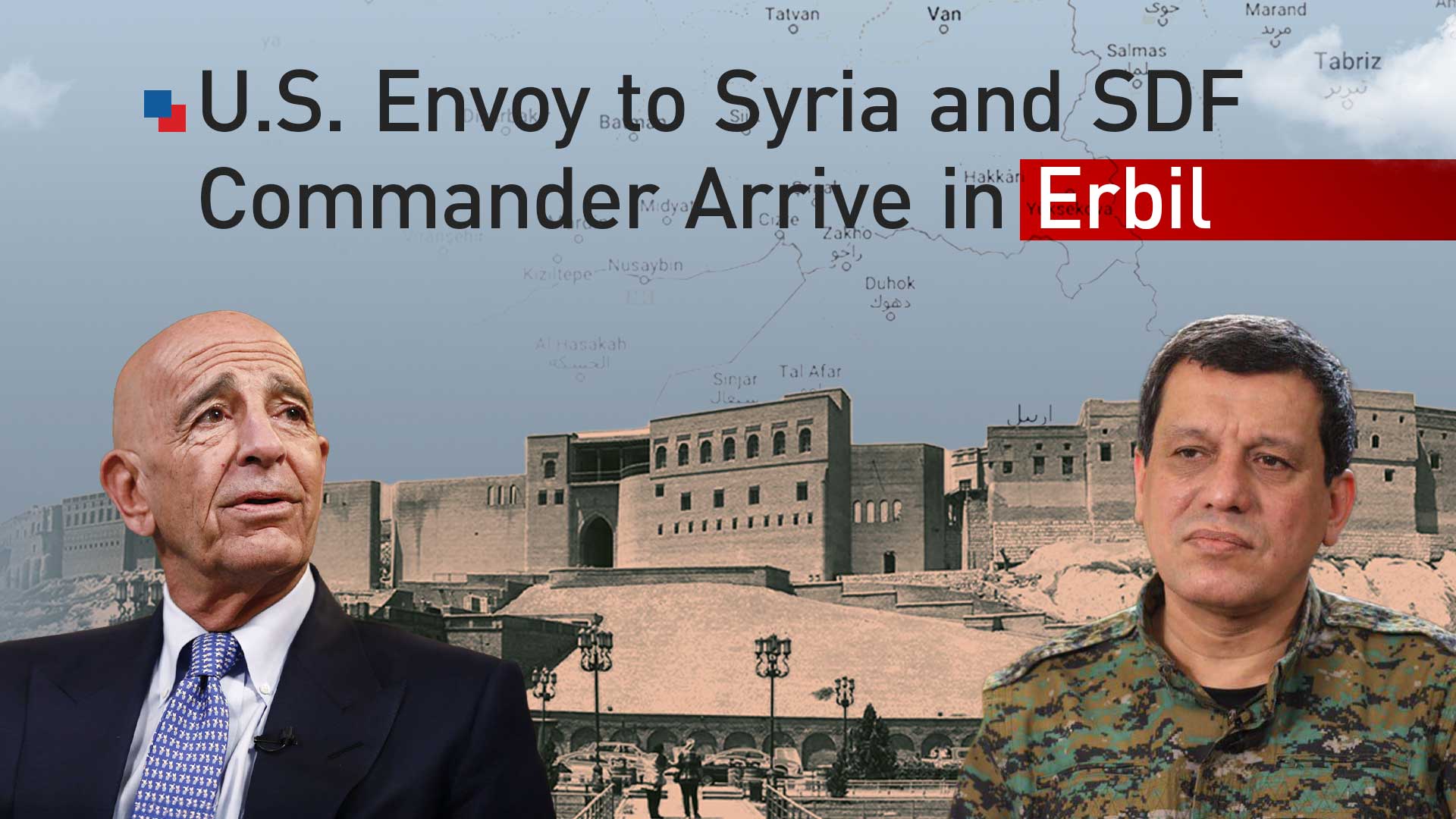
ERBIL (Kurdistan24) - Mazloum Abdi, General Commander of the Syrian Democratic Forces (SDF), and Tom Barrack, U.S. Special Envoy for Syrian Affairs, have arrived in Erbil for discussions focused on recent tensions in Syria and the implementation of the March 10, 2025, agreement between the SDF and the Syrian government, according to information gathered by Kurdistan24 correspondent Hoshmand Sadiq.
A source speaking to Kurdistan24 reporter Hoshmand Sadiq confirmed that the two officials are scheduled to address the March 10 agreement, recent clashes in Aleppo, and other key issues affecting the region.
The meeting comes amid escalating hostilities in Kurdish-inhabited neighborhoods, including Sheikh Maqsud and Ashrafiyeh, where heavy fighting has reportedly resulted in the deaths of dozens of Kurdish civilians and the displacement of thousands.
The March 10 agreement, signed last year by Mazloum Abdi and Ahmed al-Sharaa, the Interim President of Syria, was intended to integrate the institutions of the Autonomous Administration into Syrian state institutions.
Reports indicate that the recent clashes have posed a serious challenge to the implementation of this agreement, heightening concerns over the stability of the region.
Sources told Kurdistan24 that the Erbil meeting forms part of broader U.S. diplomatic efforts aimed at de-escalating tensions between the SDF and Syrian government forces.
Sinam Mohamad, the representative of the Syrian Democratic Council (SDC) in the United States, stated that Washington has shifted its approach toward Damascus, signaling increased engagement on the matter.
During the discussions, it is expected that Mazloum Abdi and Tom Barrack will review measures to protect Kurdish populations affected by the recent clashes, as well as strategies to reinforce the institutional integration envisioned under the March 10 agreement.
While the Kurdistan24 report did not specify the full agenda, sources indicated that the meeting will cover both immediate security concerns and longer-term political arrangements.
The presence of U.S. diplomatic representation highlights Washington’s continued role in mediating tensions between the SDF and the Syrian state.
Analysts cited in the report suggest that the engagement in Erbil is intended to prevent further deterioration of security in Aleppo and surrounding Kurdish-majority areas, where recent fighting has exacerbated humanitarian and displacement challenges.
Kurdistan24 notes that the Erbil meeting also aims to reaffirm commitments to the March 10 framework, which established mechanisms for cooperation between the Autonomous Administration and Syrian government institutions.
Maintaining this framework is considered crucial for avoiding a breakdown in dialogue and preserving relative stability in areas under Kurdish administration.
The discussions come at a time when both military and civilian concerns are intensifying. Heavy clashes in Aleppo’s Kurdish neighborhoods have strained local resources and triggered significant population displacement, raising the urgency for diplomatic intervention.
The report emphasizes that both Mazloum Abdi and the U.S. envoy are expected to seek practical measures to address these immediate challenges while sustaining progress on institutional integration.
According to the report, Washington’s renewed engagement reflects a recalibration of U.S. policy toward Syria, with a focus on stabilizing conflict zones and mitigating risks of further escalation.
Sinam Mohamad indicated that this engagement represents a departure from previous periods of limited U.S. involvement, signaling a more active diplomatic posture aimed at reinforcing the March 10 agreement.
Observers cited by Kurdistan24 note that the outcome of the Erbil discussions could influence broader regional dynamics, particularly in relation to the governance of Kurdish areas within Syria and coordination with Syrian state authorities.
While the immediate focus is on Aleppo and the implementation of the agreement, the meeting may also shape subsequent U.S. policy approaches to maintaining stability across other conflict-affected regions.