President Barzani, U.S. Envoy to Syria to Hold Talks in Erbil
President Barzani to meet with US Envoy Barrack in Erbil to address Syrian violence. Talks focus on saving the 2025 SDF-Syria deal amid Aleppo clashes, with SDF redeploying forces to ease tensions.
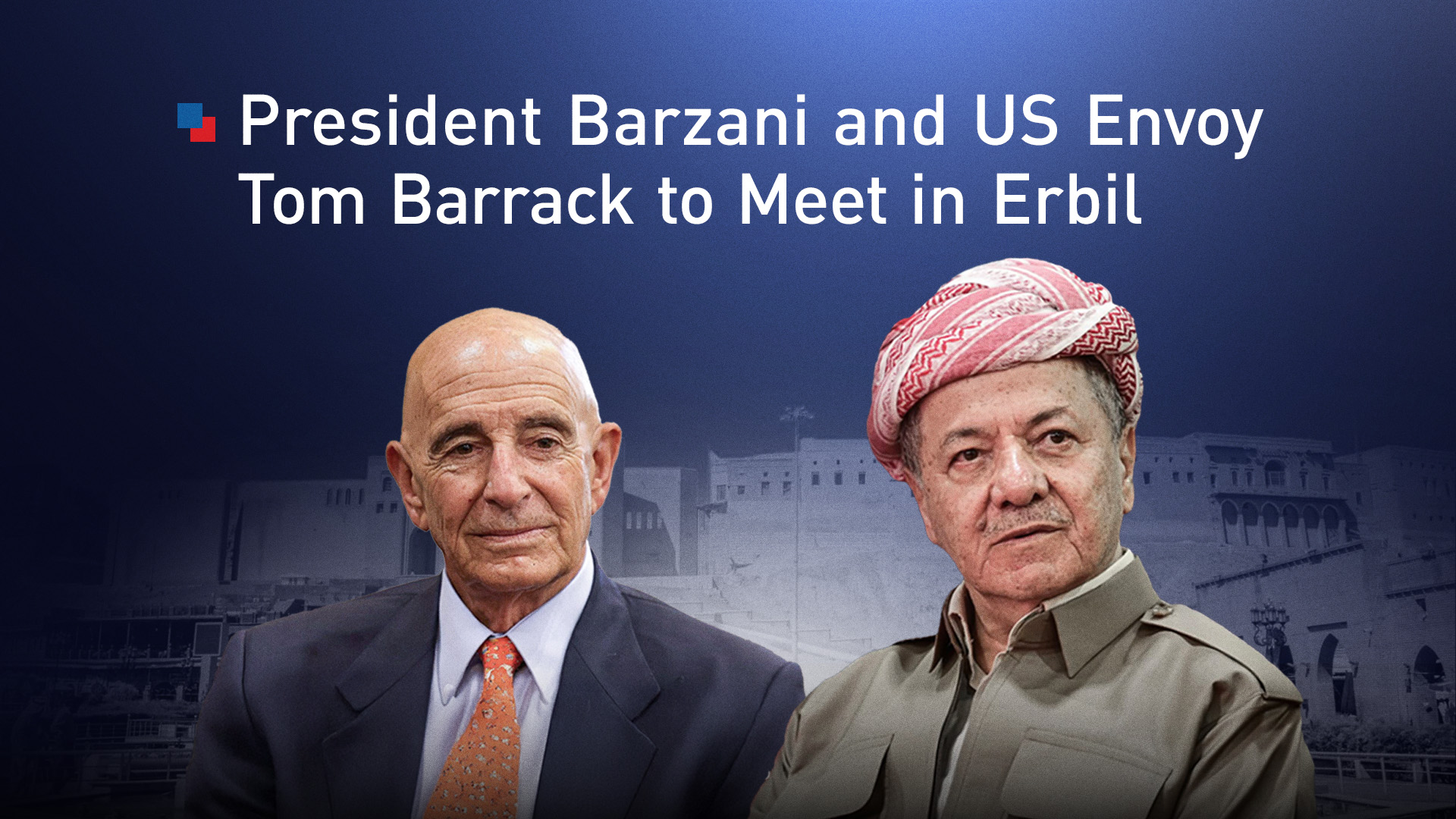
ERBIL (Kurdistan24) - President Masoud Barzani is scheduled to meet with Tom Barrack, the United States President's Special Envoy for Syrian Affairs, in Erbil on Saturday to address the rapidly deteriorating security situation in Syria. The high-level diplomatic engagement comes as American officials and Kurdish leadership seek to salvage a critical integration agreement amid renewed military hostilities involving Syrian government forces.
A Kurdistan24 correspondent reported that the meeting between President Barzani and Amb. Barrack is expected to focus on the status of the March 10, 2025, agreement, a landmark accord signed last year between the Syrian Democratic Forces (SDF) and the Syrian government.
The discussions will also address the broader instability in the region, specifically recent outbreaks of violence in Aleppo and Deir Hafer that threaten to unravel political progress.
The diplomatic activity in the Kurdistan Region was underscored by the arrival in Erbil on Saturday morning of a delegation including Amb. Barrack and Mazloum Abdi, the General Commander of the SDF.
Sources familiar with the matter indicated that the convergence of officials in Erbil is part of a broader American diplomatic initiative designed to restore calm and maintain stability following weeks of unrest.
Fawzi Hariri, Chief of Staff of the Kurdistan Region Presidency, stated on Saturday that President Barzani is maintaining continuous contact with the governments of Türkiye and Syria, as well as with SDF's Abdi, to de-escalate tensions.
Speaking to a Kurdistan24 reporter, Hariri emphasized that the primary objective of these communications is to ensure the protection of Kurds residing in Western Kurdistan (Rojava).
"President Barzani Continuously Works to Protect Kurds in Western Kurdistan," Hariri said, noting that the Presidency is leveraging its relationships to bridge diverging perspectives on the Syrian file.
The urgency of the talks is driven by a sharp escalation in violence on the ground. Reports indicate that heavy clashes have erupted in the Sheikh Maqsud and Ashrafiyeh neighborhoods of Aleppo, both of which house significant Kurdish populations.
These confrontations between the SDF and the Syrian Army have reportedly resulted in the deaths of dozens of Kurdish citizens and the displacement of thousands of residents, creating a humanitarian crisis that officials warn could destabilize the March 10 agreement.
That agreement, signed by Abdi and Ahmed al-Sharaa, the Interim President of Syria, outlined a framework for integrating the institutions of the Autonomous Administration into the formal institutions of the Syrian state.
Compounding the security crisis, the SDF reported on Friday that the Syrian Arab Army had launched an intense artillery barrage on the city of Deir Hafer, east of Aleppo.
The SDF Media Center stated that the city was struck by more than twenty artillery shells within a single hour, alongside an attack by an explosive-laden drone. The SDF characterized the use of heavy weapons as a serious threat to civilian safety and regional stability.
In an effort to facilitate the diplomatic track and demonstrate adherence to the March 10 framework, General Commander Abdi announced on Friday that SDF forces would withdraw from contact lines east of Aleppo.
In a statement, Abdi cited calls from "friendly countries and mediators" and expressed a commitment to the integration process. The withdrawal, scheduled to begin Saturday morning, involves redeploying forces to areas east of the Euphrates river.
The diplomatic push in Erbil reflects a recalibration of Washington's approach to the region.
Sinam Mohamad, the representative of the Syrian Democratic Council (SDC) in the United States, noted that the U.S. has broken its previous silence and altered its stance toward Damascus, signaling a more active role in mediating the conflict.
Hariri also suggested that if Mark Savaya, the U.S. President's Special Envoy for Iraqi Affairs, is present in the Kurdistan Region, he would likely play an effective role in the ongoing discussions to resolve problems peacefully.
International concern regarding the trajectory of Syria’s transition extends beyond Washington.
Valérie Hayer, President of the Renew Europe Group in the European Parliament, stated on Friday that European Union support for Syria’s new leadership would be strictly conditional.
Speaking in Brussels, Hayer emphasized that any engagement depends on guarantees regarding minority rights, women's rights, and counter-radicalization efforts.
"We have always been supportive of the Kurdish community," Hayer told Kurdistan24's correspondent Barzan Hassan, adding that the EU intends to accompany the transition step-by-step only if these conditions are met.
Concurrently, U.S. Senator Lindsey Graham issued a stark warning regarding the security implications of the fighting.
Senator Graham cautioned that any military escalation against Kurdish forces by Syria or Türkiye could jeopardize the containment of approximately 9,000 ISIS prisoners currently held by the SDF in northeast Syria.
He described the Kurdish forces as Washington’s strongest ally in the defeat of ISIS and warned that undermining their control could trigger bipartisan opposition in the U.S. Congress.
As the meetings in Erbil proceed, the focus remains on whether the tripartite communication channels maintained by President Barzani, combined with direct U.S. intervention, can arrest the cycle of violence and preserve the institutional integration plan agreed upon in 2025.
The article was updated on Saturday, Jan. 17, 2026, at 12:13pm.