Humanitarian Relief Efforts for Rojava Scale Up as UN Warns of Deteriorating Siege in Kobani
The Barzani Charity Foundation delivered 102 aid trucks and 300,000 liters of fuel to Rojava, as the UN warns that a siege has trapped 150,000 civilians in Kobani without food, power, or medicine.
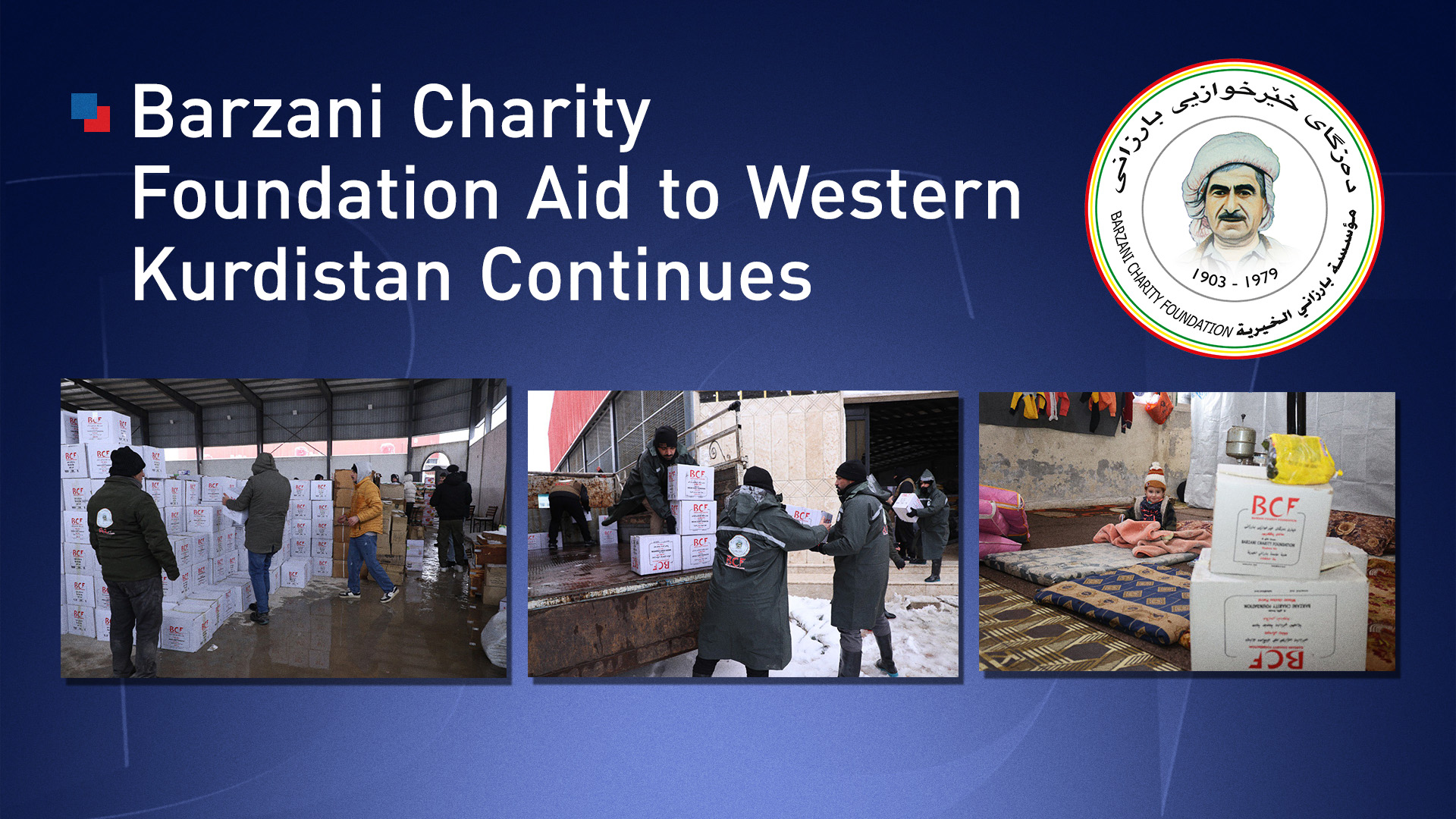
ERBIL (Kurdistan24) - The Barzani Charity Foundation (BCF) has expanded its humanitarian mission into northeastern Syria, delivering more than 100 trucks of essential supplies and tripling its fuel provisions to assist populations facing a severe winter and military instability.
The increase in regional aid comes as the United Nations issued a public warning on Friday regarding a suffocating siege of the city of Kobani, where approximately 150,000 civilians are reported to be trapped without access to electricity, water, or medical supplies.
The relief campaign, which officials in Erbil described as an extensive initiative launched following the orders of President Masoud Barzani and under the direct supervision of Masrour Barzani, the Prime Minister of the Kurdistan Region, reached a significant milestone this week.
Karzan Nuri, a member of the Administrative Board of the Barzani Charity Foundation, confirmed in an interview with Kurdistan24 that a total of 102 trucks have successfully entered Rojava (Western Kurdistan). This logistical operation has transported over 850 tons of food and various non-food items to address the immediate needs of the population.
Mr. Noori provided a detailed breakdown of the convoy’s progression, noting that the first phase of the delivery included 67 trucks carrying 710 tons of supplies.
To facilitate the distribution of these resources, the foundation has deployed a ground team of more than 160 employees who have established a presence within the region.
The administrative board member emphasized that the materials were gathered through the collective efforts of the Barzani Charity Foundation, supported by a network of partners, philanthropists, and members of the Kurdistan business community.
The humanitarian intervention has also incorporated a specialized medical component to address the scarcity of healthcare services in the conflict-affected areas.
According to foundation records, a specialized medical team has been operating in the region for the past 48 hours. During this period, healthcare professionals have conducted clinical examinations and provided necessary medical treatments to 685 individuals, marking a concerted effort to mitigate the health risks posed by the ongoing crisis.
In addition to the delivery of food and medical services, the foundation has moved to address an acute energy shortage as temperatures drop across the region.
Musa Ahmad, the President of the Barzani Charity Foundation, told Kurdistan24 that the organization has decided to significantly increase the volume of fuel being dispatched to the area. The supply, which was initially set at 100,000 liters, has been raised to 300,000 liters.
Ahmad detailed the distribution strategy for these energy resources, stating that the first phase involves providing 40 liters of kerosene per family to ensure household heating capabilities.
The fuel distribution is currently being conducted across four key locations in northeastern Syria: Qamishlo, Amuda, Girkê Legê, and Tirbespi.
This specific component of the aid mission was formally endorsed by the Kurdistan Regional Government (KRG) in a communique issued on Thursday, Jan. 22, 2026.
Peshawa Hawramani, the KRG spokesperson, stated that the necessary fuel is being funneled through the foundation upon the recommendation of Prime Minister Masrour Barzani. Mr. Hawramani clarified that the fuel supply process is intended to be a sustained effort, confirming that the "process will continue until the end of the cold season."
While the Barzani Charity Foundation has successfully accessed several urban centers, the United Nations has expressed grave concern regarding the accessibility of other regions, specifically the city of Kobani.
Farhan Haq, the Deputy Spokesperson for the UN Secretary-General, addressed the situation on Friday, noting that the lives of citizens are at high risk due to an encompassing military siege. Haq reported that all primary and secondary access routes into Kobani have been closed, leading to a rapid deterioration of the humanitarian environment.
According to the UN assessment, Kobani is currently functioning without a centralized electricity grid, and water services are described as poor.
While some health centers remain technically operational, Haq warned that medicine and basic medical supplies have become "very scarce," creating a precarious situation for those requiring urgent care. The United Nations is reportedly engaged in active discussions with officials in Aleppo to establish a mechanism for delivering emergency aid to the city.
While the UN has managed to deliver supplies to Hasakah, Raqqa, and Deir ez-Zor, it has formally requested "facilitation" from the relevant authorities to allow similar shipments to reach the trapped population of Kobani.
Parallel to the UN's concerns, the Kurdish Red Crescent team stationed in Kobani has characterized the conditions as a "major humanitarian disaster." In an urgent communication addressed to international organizations and the United Nations High Commissioner for Refugees, the medical team appealed for immediate intervention.
Their report states that Kobani and its surrounding villages have been subjected to a "brutal military campaign" and a "heavy siege" for several days. Crucially, the Red Crescent team noted that the blockage of essential supplies persists despite the announcement of a regional ceasefire.
Information emerging from the city indicates that roughly 150,000 civilians are currently trapped within the siege lines. The total suspension of water, electricity, fuel, food, and internet services has paralyzed the internal functions of the city and driven a wave of internal displacement.
A large number of families from the surrounding countryside have fled into the city center, but the lack of infrastructure has left many with no choice but to stay outdoors in sub-zero temperatures or shelter inside their vehicles.
The human cost of these conditions has already become lethal. The Kurdish Red Crescent has reported that a number of children have lost their lives due to exposure to the extreme cold.
This environmental and human tragedy has unfolded even as the Barzani Charity Foundation delivered its largest humanitarian aid convoy to Rojava on Wednesday, Jan. 21, following the specific directive of President Barzani.
The foundation has characterized the ongoing campaign as a fulfillment of its "humanitarian and national duty" to support the regional population during what it describes as one of the most difficult periods in the area’s recent history.
Despite the delivery of over 100 trucks and the medical treatment of hundreds of civilians, the blockade of Kobani remains the primary obstacle to a comprehensive regional relief effort.
As the KRG and the foundation continue to coordinate with international partners, the focus remains on securing the necessary facilitation to break the isolation of Kobani and prevent further loss of life among the trapped civilian population.