Al-Sharaa Heads to Moscow for Meeting With Putin
President al-Sharaa met President Putin in Moscow Wednesday to discuss military bases and the extradition of Bashar al-Assad, as Russia withdrew heavy equipment from Qamishlo Airport to the coast.
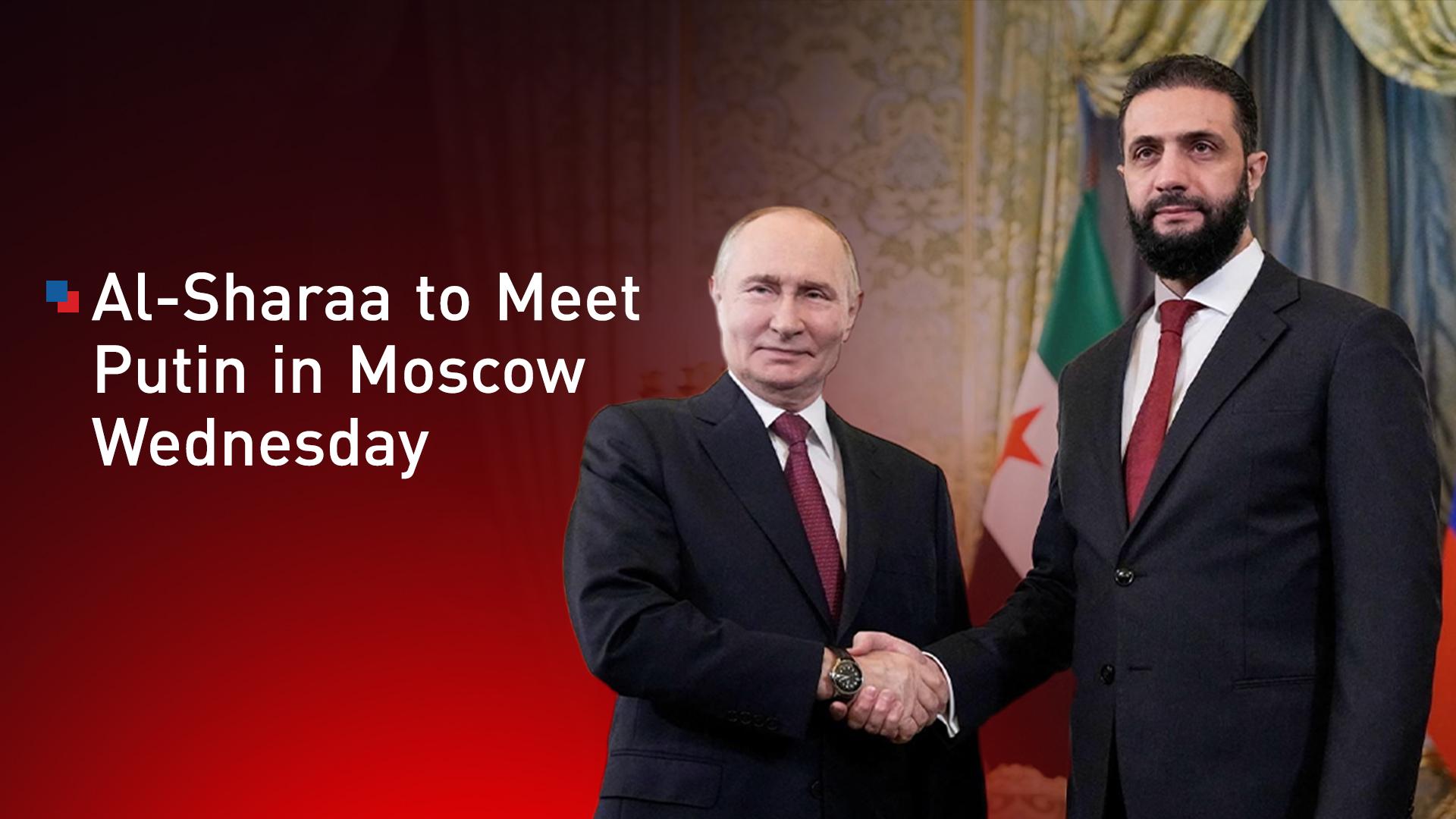
ERBIL (Kurdistan24) - Syrian President Ahmed al-Sharaa arrived in Moscow on Wednesday for high-level talks with Russian President Vladimir Putin, a summit that marks a significant recalibration of bilateral relations following the collapse of the Bashar al-Assad government. The meeting occurs as Russia executes a systematic military withdrawal from northern Syria, shifting its assets to coastal strongholds while Damascus aggressively pursues the extradition of the former ruler from Russian protection.
The official visit, reported by Syrian state television, is the second face-to-face encounter between al-Sharaa and Putin since the former rebel commander assumed power in late 2024.
According to a statement released Tuesday by the Kremlin and carried by Agence France-Presse (AFP), the discussions are intended to address the "status of bilateral relations and prospects for developing them in various fields," alongside a review of the rapidly evolving security architecture in the Middle East.
The diplomatic engagement comes at an acute juncture for both nations. For Moscow, the summit represents an effort to secure long-term agreements regarding its sovereign military outposts at the Hmeimim airbase and the Tartus naval facility.
These Mediterranean sites remain Russia’s only official military installations outside the former Soviet Union. For the new administration in Damascus, the priority remains the consolidation of national authority and the pursuit of transitional justice.
Syrian officials noted that al-Sharaa intends to reiterate requests for the handover of Bashar al-Assad and other former officials to face prosecution for alleged war crimes.
Military Realignment in the Northeast
The summit is taking place against the backdrop of a visible reduction in Russia’s security footprint in Syria’s interior. An AFP correspondent reported that Russian forces completed a withdrawal of troops and heavy equipment from Qamishlo Airport in the Kurdish-held northeast on Tuesday.
By the time of the departure, the base was reportedly devoid of Russian flags, cargo, and helicopters that had been present only 24 hours earlier.
Dilan Barzan, a correspondent for Kurdistan24 reporting from Western Kurdistan (Rojava), confirmed that the withdrawal process began several days ago and intensified on Monday morning. Russian units transferred a significant number of tanks, military vehicles, radars, and associated equipment to military bases in Latakia on the coast.
This movement marks the end of a mission at Qamishlo that began in November 2019, when Russian forces established a presence there to monitor the region and act as a buffer following a Turkish offensive.
The departure of Russian units from the northeast coincides with a broader shift in international military postures. The recently released 2026 United States National Defense Strategy (NDS) has signaled a move toward "more limited" support for traditional allies as Washington pivots toward homeland defense and the deterrence of China.
As reported by Kurdistan24's correpondent, the NDS characterizes the threat from Russia as "persistent but manageable," urging European and regional actors to assume primary responsibility for their own conventional defense.
The vacuum left by the Russian monitoring component at Qamishlo Airport removes a long-standing international arbiter from a region currently defined by an unstable ceasefire between the Syrian Democratic Forces (SDF) and the central government.
The United Nations High Commissioner for Refugees (UNHCR) has reported that tens of thousands of people have already been displaced in northeastern Syria due to these prevailing tensions.
Resetting Ties and Seeking Extradition
The relationship between Moscow and the new Syrian authority has entered what analysts describe as a "new phase." While Russia was the primary military patron of the Assad regime during the 14-year civil war—frequently conducting air strikes against the very Islamist forces now led by al-Sharaa—both sides appear eager to find a pragmatic working arrangement.
The first formal communication between the two leaders occurred in February 2025. During that telephone call, President Putin reaffirmed Russia's support for Syria's territorial integrity and expressed a willingness to review previous agreements signed during the Assad era.
However, the legacy of the former government remains a primary point of friction. During a previous visit to Moscow in October 2025, a senior Syrian official stated that al-Sharaa had explicitly requested the extradition of Assad, whom Russia has sheltered since his removal from power.
The Kremlin’s sheltering of the former leader has highlighted the limits of Moscow’s regional influence, particularly as its military resources remain stretched by the ongoing conflict in Ukraine. AFP noted that the ouster of Assad in December 2024 dealt a significant blow to Russia’s geopolitical standing in the Levant.
Regional Security and Integration
Beyond bilateral ties, the Moscow summit is expected to touch upon the integration of the Kurdish-administered northeast into the new Syrian state.
This month, Kurdish authorities agreed to merge their administration into the central government. A two-week ceasefire, set to expire early next month, is currently being observed to facilitate those integration talks.
The talks also occur as Damascus engages in U.S.-mediated negotiations with Israel. As reported by Kurdistan24, recent discussions in Paris have led to the establishment of a "joint fusion mechanism" for intelligence sharing and military de-escalation under U.S. supervision.
Al-Sharaa has emphasized Syria's commitment to restoring its national rights while signaling a strategic shift toward regional coexistence.
The Moscow summit concludes a week of intensive diplomacy for the al-Sharaa government. As Russia consolidates its forces in the Hmeimim and Tartus bases, the future of the new Syrian army—and Moscow’s role in arming it—remains a critical component of the ongoing discussions.
The outcome of the meeting is expected to determine the level of Russian involvement in Syria's reconstruction and its continued influence as a mediator between Damascus and the remaining autonomous factions in the north.