PM Barzani Urges Constitutional Guarantees for Kurds in Syria, Outlines Regional and Domestic Priorities
Prime Minister Masrour Barzani told The National that Syria must constitutionally guarantee Kurdish rights, outlined mediation efforts with the SDF, and detailed Kurdistan’s regional balancing and domestic reform agenda.
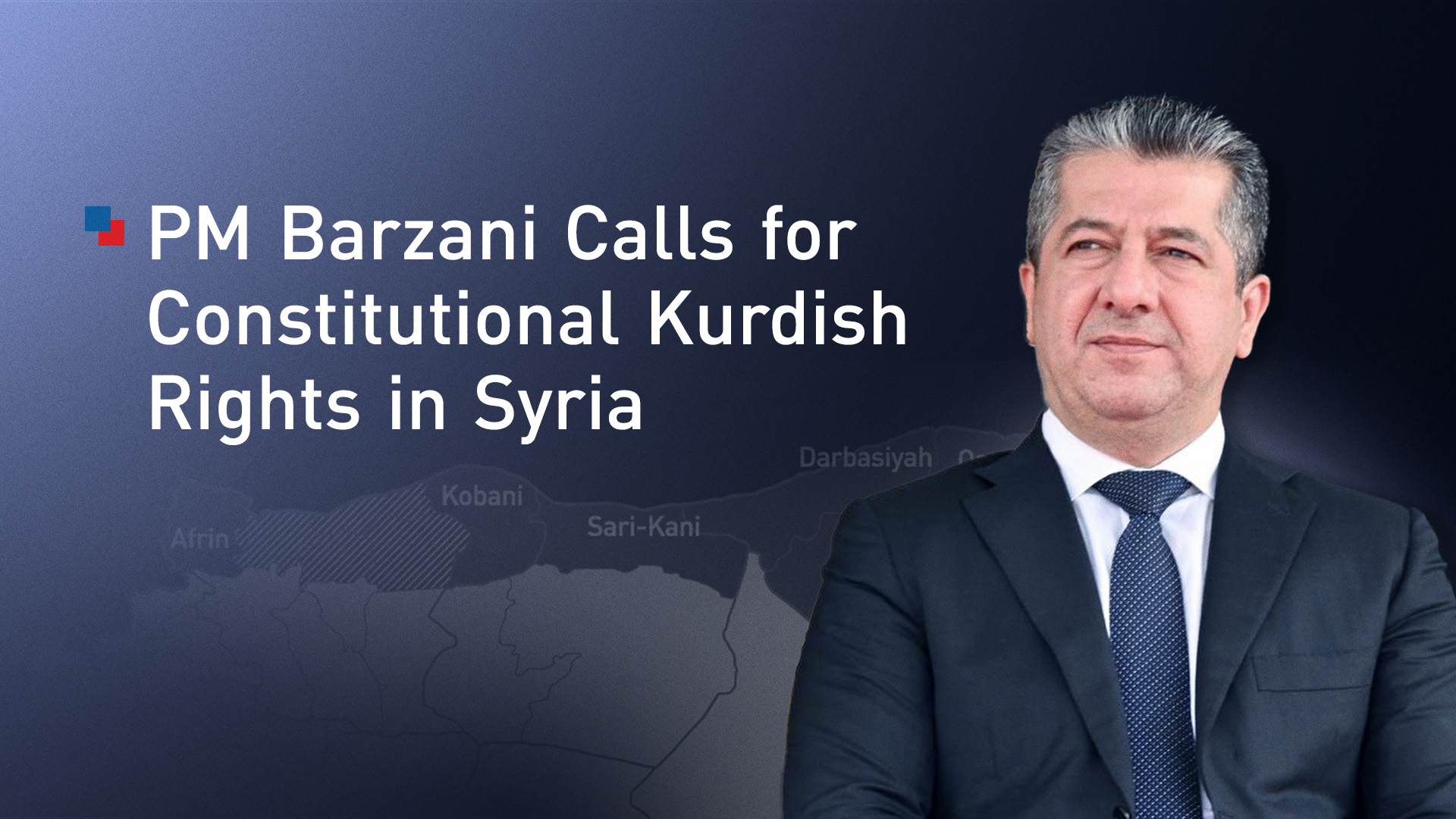
ERBIL (Kurdistan24) - Kurdistan Region's Prime Minister Masrour Barzani called on Syria’s authorities to pursue what he described as a “sustainable solution” to the Kurdish issue by embedding Kurdish rights in the country’s constitution, following mediation efforts aimed at ending recent clashes in Western Kurdistan (north-eastern Syria), according to an interview published by the Abu Dhabi-based news website The National.
Speaking to The National in Dubai on Feb. 5, 2026, PM Barzani said that tensions in Syria had eased to some extent but warned that the situation remained fragile. He urged Syrian leaders, under President Ahmad al-Shara, to approach negotiations with restraint and foresight.
“We see that there is a diffusion of tension to some extent, but it’s not over,” he said, according to The National. He added that all actors should act “with wisdom and with calm and with a calm mind” to allow space for negotiations that could lead to a more lasting settlement.
PM Barzani emphasized that Syria’s diversity made inclusive governance essential to long-term stability.
“Syria is not a homogeneous state,” he said, noting that it is home to multiple communities and religions. According to The National, he argued that Damascus must take into account the concerns of all groups and ensure that they feel they are part of what he described as a “new Syria.”
His comments came as an agreement between the Syrian government and the Kurdish-led Syrian Democratic Forces (SDF) began to take shape, aimed at resolving recent conflict in the Kurdish majority regions of Syria. The emerging framework would involve the gradual integration of SDF forces and institutions into the Syrian state, according to the report by The National.
PM Barzani said that Kurdish leaders in the Kurdistan Region played a central role in mediation efforts.
The National reported that President Masoud Barzani, Kurdistan Region President Nechirvan Barzani, and Prime Minister Masrour Barzani played a central role in contacts between Damascus, the SDF, and the United States.
In the interview, Prime Minister Barzani described a period of intensive diplomacy, marked by direct communication with Syrian authorities in Damascus, Kurdish officials in Qamishlo, and international actors including the United States and France.
This diplomatic activity included several visits by SDF commander Mazloum Abdi and U.S. envoy Tom Barrack to Erbil, as well as phone calls between Kurdish leaders and President al-Shara, PM Barzani told The National. He said the aim of these efforts was to calm the situation and prevent further escalation.
The interview also addressed the Kurdistan Regional Government’s approach toward the SDF.
Following the fall of the Assad regime in late 2024 and amid renewed violence, the KRG has intensified its engagement with Western Kurdistan and the SDF through political and diplomatic outreach to Syrian authorities and Kurdish leadership in the region, alongside an expanded humanitarian campaign.
Prime Minister Barzani said the policy is rooted in solidarity with Kurds facing repression. “We are Kurds at the end,” he said, according to The National. “We may have differences of opinion or disagree politically with a party, but when Kurds are oppressed anywhere in the world, we feel sympathy.”
He added that reports of abuses, particularly against Kurdish women, were unacceptable not only to Kurds but to humanity as a whole, according to The National.
PM Barzani reiterated his belief that Kurdish rights in Syria must be anchored in law rather than left to informal arrangements. He expressed hope that Syrian leaders would eventually agree to constitutional provisions guaranteeing Kurdish rights.
“Hopefully, over time, they will realise and come to some sort of agreement that there would be Kurdish rights stipulated in the constitution,” he said. Such an approach, he added, would create a legal relationship rather than one based on verbal understandings.
At the same time, he warned of what he described as “negative elements” seeking to disrupt potential agreements. According to The National, he urged Syrian leaders to rise above such pressures and to “lead and not be led.”
Beyond Syria, the interview addressed the Kurdistan Region’s broader regional posture.
PM Barzani described the Kurdistan Region as the most institutionalised Kurdish entity in the Middle East, while acknowledging that its political and economic room for manoeuvre has narrowed under pressure from Baghdad and neighbouring states.
According to The National, he said the region has sought to balance relations with Iraq’s federal government, neighbouring countries and the United States.
The Kurdistan Region hosts U.S. troops and is home to the largest American consulate, factors that have drawn it into wider regional tensions. PM Barzani noted that Erbil has been targeted in the past by Iran and its allies during periods of heightened tension between Tehran and Washington, The National reported.
Those tensions have been elevated this year, with U.S. President Donald Trump threatening strikes against Iran and Tehran warning it would retaliate against U.S. bases in the region, raising the prospect of a broader conflict.
Nuclear talks scheduled to take place in Oman have heightened concerns of escalation if they fail, according to The National. PM Barzani said the Kurdistan Region would seek to avoid being drawn into such a confrontation. “We will definitely try to stay out of this conflict. It’s not our war, we are not going to be part of this war,” he said.
Relations between Erbil and Baghdad have been further complicated by domestic issues.
According to The National, disputes over the federal budget, delays in salary payments to the KRG, and a series of Federal Supreme Court rulings affecting Kurdish oil revenue and autonomy have strained ties.
PM Barzani said that full respect for Iraq’s constitution could pave the way for improved relations. “If the constitution is fully respected and implemented, we could have the best relations with the government in Baghdad,” he said.
At the federal level, Iraq’s parliamentary elections in November resulted in the KDP winning more than a million votes, the first time a Kurdish party has achieved such a result. Government formation has been delayed by disagreements over the position of presidency.
Under arrangements established after the 2003 U.S.-led liberation of Iraq, the presidency is reserved for a Kurd, while the speaker of parliament is Sunni and the prime minister Shiite. An additional informal understanding, as The National wrote, has traditionally seen the presidency go to the PUK.
PM Barzani challenged that convention, arguing that election results should carry greater weight.
According to The National, he said that whichever party wins should be able to nominate a candidate and suggested resolving the issue through a vote among Kurdish representatives. He outlined options that included a vote within the Kurdish parliament or among Kurdish members of the Iraqi parliament to select a unified candidate.
Despite political challenges, PM Barzani said the KRG was pursuing what he described as an ambitious reform agenda. According to The National, he pointed to digitisation initiatives and efforts to provide 24-hour electricity in some areas as part of what he called a “very aggressive reform programme.”
He also highlighted efforts to strengthen economic ties with Gulf partners, particularly the United Arab Emirates. While in Dubai for the World Governments Summit, PM Barzani met UAE President Sheikh Mohamed and other senior Emirati officials. According to The National, he said UAE companies were already active in sectors including energy, agriculture and tourism, with others invited to explore opportunities in the region.
PM Barzani said he hoped these engagements would lead to deeper economic relations. He described the Kurdistan Region as having proven itself to be an “oasis of stability” in a turbulent region, a quality he said was attractive to Gulf countries seeking reliable partners, according to The National.