Kurdish Now Taught as Formal Subject in Sweden and Germany Under Joint KDC-KRG Initiative
Kurdish is now taught formally in Sweden and Germany under a joint project with the Kurdistan Region’s Education Ministry, registering thirty schools abroad and serving three thousand online students.
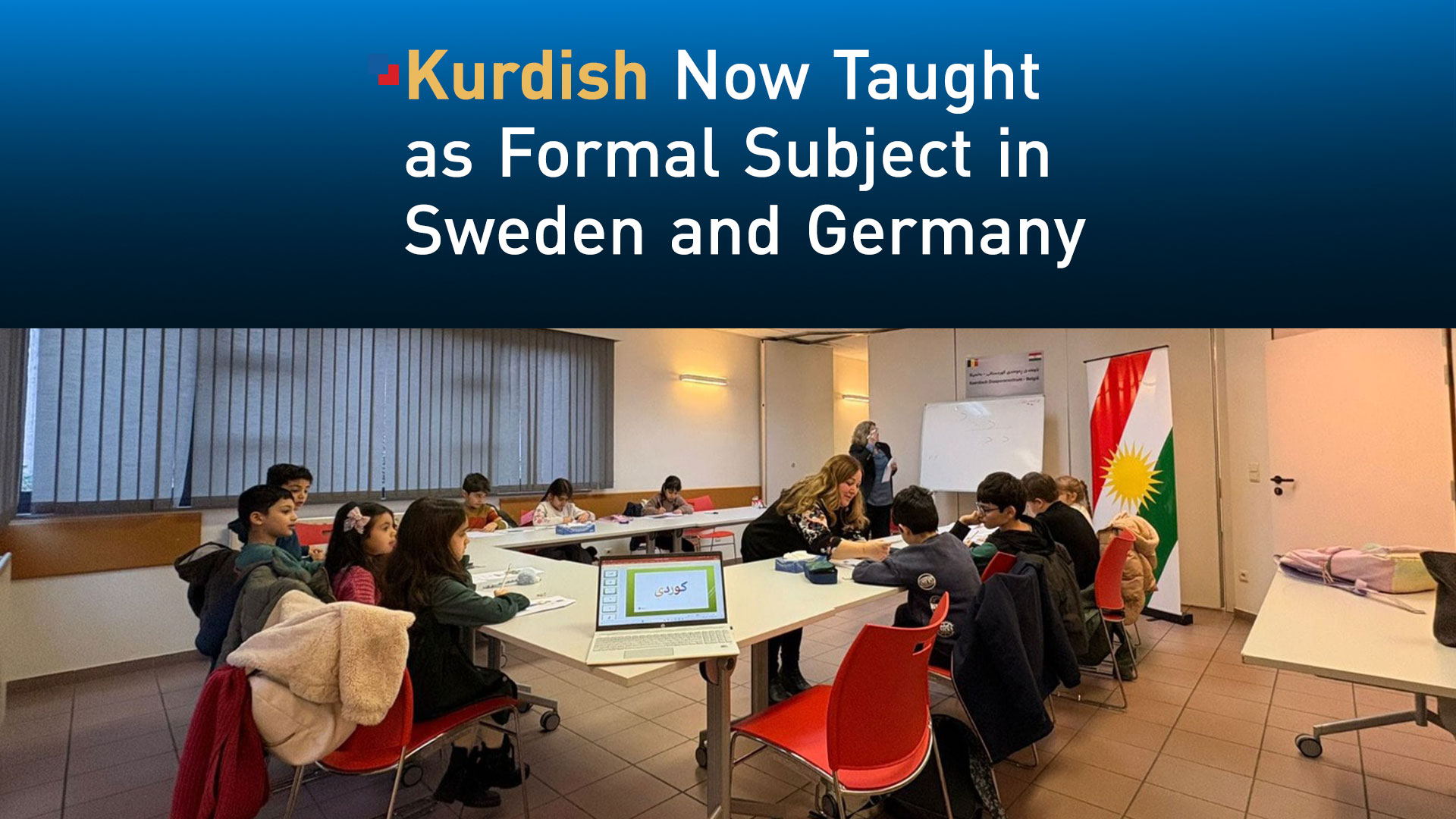
ERBIL (Kurdistan24) - Thirty Kurdish schools abroad join a joint national initiative with the Kurdistan Region’s Education Ministry, as thousands of students study their mother tongue through in-person and online programs.
From classrooms in Europe to digital platforms reaching across continents, Kurdish is now being taught as a formal subject in Sweden and Germany under a joint national project aimed at safeguarding the mother tongue among diaspora communities.
On Wednesday, Khalil Sharif, representative of the Kurdistani Diaspora Confederation in the Kurdistan Region, revealed details of a national initiative designed to expand Kurdish language education abroad, benefiting thousands of Kurdish children through both physical schools and electronic learning systems.
In remarks to Kurdistan24, Sharif said that thirty Kurdish schools outside the country have been officially registered under the umbrella of the national project. The initiative is being jointly implemented by the Kurdistani Diaspora Confederation (KDC) in Europe and the Kurdistan Region Government’s Ministry of Education, with the core goal of preserving and teaching the mother tongue.
Sharif pointed to significant progress in countries such as Sweden and Germany, where Kurdish language education has become part of the formal system, and Kurdish teachers now deliver lessons to children within recognized schools.
He explained: “The process is not limited to classroom teaching, but also includes providing textbooks, Kurdish alphabets, and facilitating examinations, in order to encourage students to continue.”
For regions where Kurdish schools are not available, or to broaden access, Sharif said that three thousand students are currently enrolled through an online system. The program is delivered across four different levels and in the Sorani, Kurmanji, and Badini dialects.
A key component of the project, according to Sharif, is that the certificates are officially recognized by the Kurdistan Region Government’s Ministry of Education and awarded to students after completing each level.
He also noted that the registration process begins annually during the summer season, and that interested applicants can enroll through a dedicated link to benefit from the national program.
Saman Siwaili, spokesperson for the Kurdistan Region Government’s Ministry of Education, said in a statement that within the framework of a memorandum of understanding between the ministry and the Kurdistani Diaspora Confederation, and as part of support for teaching and preserving Kurdish abroad, six thousand Kurdish-language textbooks in the Kurmanji dialect were printed at the ministry’s press.
The shipment, weighing two tons and 570 kilograms, was sent to Europe by cargo transport.
As part of the same efforts, the ministry had previously, on Oct. 25, 2025, sent eight thousand five hundred Kurdish textbooks in the Sorani and Badini dialects, weighing two tons and 320 kilograms, to Kurdish schools in Europe and the United States.
With formal recognition, expanding access, and institutional backing, the initiative positions Kurdish language education as a structured and sustainable bridge between diaspora generations and their cultural identity.