'Stronger Bilateral Ties Depend on Iraq’s Sovereign Decision-Making,' U.S. Diplomat Says
U.S. Chargé d’Affaires reaffirms support for the Kurdistan Region within a federal Iraq and praises President Barzani’s pivotal role in shaping Iraq’s political process since 2003
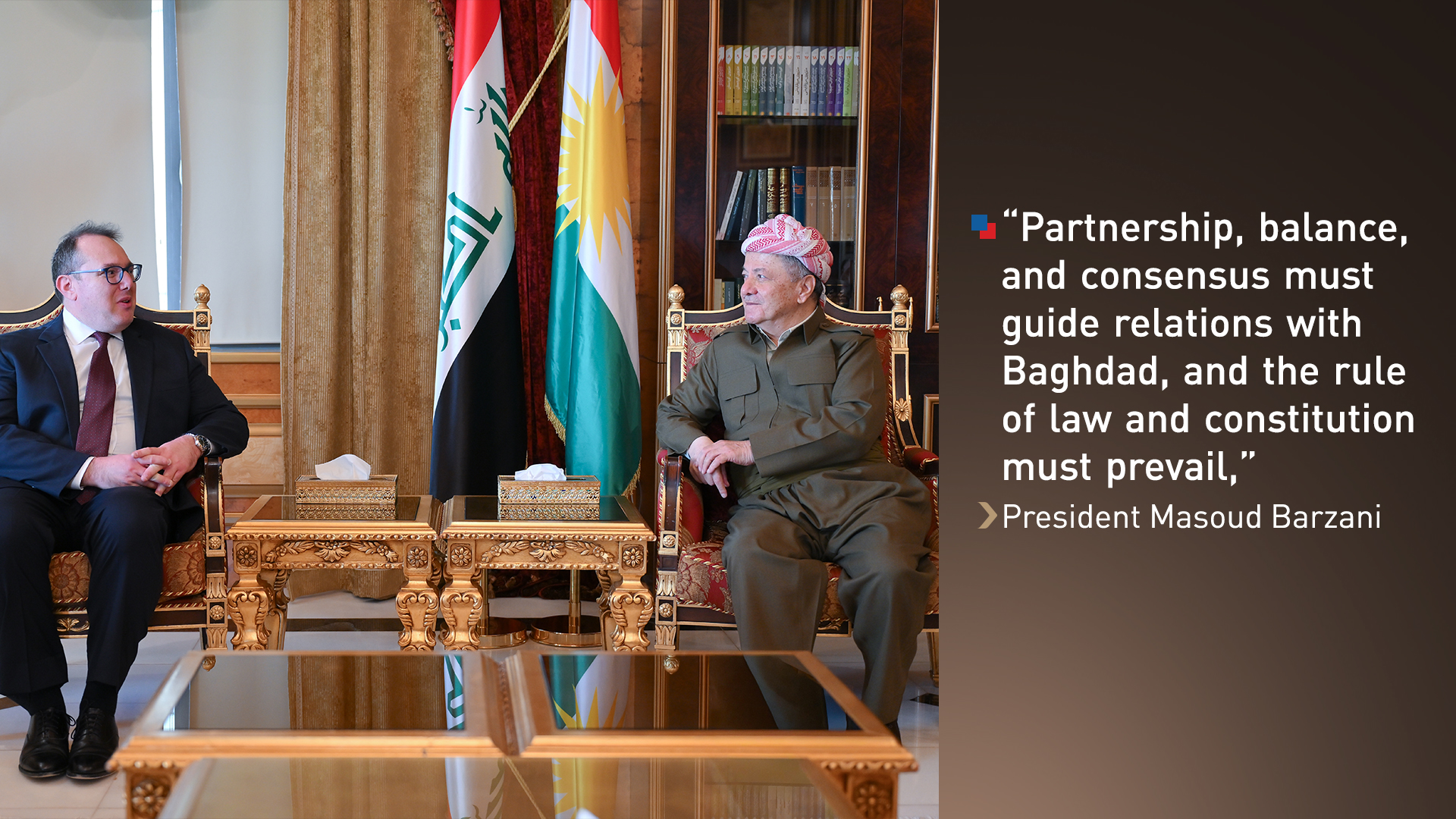
ERBIL (Kurdistan24) — President Masoud Barzani on Wednesday welcomed Joshua Harris, Chargé d’Affaires of the U.S. Embassy in Iraq, to Pirmam in Erbil for high-level discussions on strengthening bilateral ties, advancing regional stability, and reinforcing the strategic partnership between the Kurdistan Region and Washington.
According to a press release issued by Barzani Headquarters following the meeting, Harris emphasized that the United States supports the Kurdistan Region within the framework of a federal Iraq. He underscored Washington’s recognition of President Barzani’s role in the Iraqi political process since 2003, describing it as vital to the country’s political trajectory and future stability.
The U.S. diplomat further noted that the United States seeks a strategic partnership with both Iraq and the Kurdistan Region. He stressed that the development of stronger bilateral relations depends on Iraq’s sovereignty in decision-making and its commitment to prioritizing national interests above other considerations.
For his part, President Barzani reaffirmed that the Kurdistan leadership has consistently called for the supremacy of the rule of law and the Iraqi constitution. He stressed that partnership, balance, and consensus must remain the foundational principles governing relations between the Kurdistan Region and Baghdad.
Barzani highlighted the importance of adhering to these principles in the formation of the future Iraqi government, ensuring full implementation of the constitution, and ending what he described as inappropriate treatment toward the people of Kurdistan, particularly regarding budgetary allocations and other outstanding issues.
He also emphasized that Iraq must maintain sovereign decision-making and pursue balanced relations with neighboring countries.
The meeting additionally addressed developments in Syria and the internal political process within the Kurdistan Region, reflecting the broader regional context shaping discussions between Erbil and Washington.
Since 2003, President Masoud Barzani has remained one of Iraq’s most influential political figures, playing a decisive role in shaping post-Saddam governance structures and advocating for federalism as the constitutional foundation of the state. As President of the Kurdistan Region from 2005 to 2017, he was instrumental in consolidating the Region’s institutions, navigating Baghdad-Erbil disputes, and positioning the Kurdistan Region as a key actor in Iraq’s security and political landscape.
His leadership during critical junctures—including the fight against ISIS and successive government formation negotiations in Baghdad—cemented his standing as a central interlocutor in both domestic and regional diplomacy.
Bilateral relations between the Kurdistan Region and the United States have evolved into a longstanding strategic partnership rooted in security cooperation, political dialogue, and economic engagement. From U.S. support for the Peshmerga forces in the campaign against ISIS to sustained diplomatic coordination through the U.S. Consulate General in Erbil, Washington has consistently viewed the Kurdistan Region as a stabilizing partner within Iraq.
The relationship, forged in the aftermath of 1991 and deepened after 2003, continues to rest on shared interests in counterterrorism, institutional reform, and promoting stability across Iraq and the wider Middle East.