Trump Imposes New 10% Global Tariff After Supreme Court Strikes Down Prior Duties
The U.S. President signed a new 10 percent global tariff order following the court’s ruling, invoking alternative authorities to maintain his trade policy.
ERBIL (Kurdistan24) - U.S. President Donald Trump on Friday imposed an additional 10 percent tariff on imports into the United States after the Supreme Court struck down many of his previously enacted global duties, ruling that the law he relied upon did not authorize the president to impose tariffs.
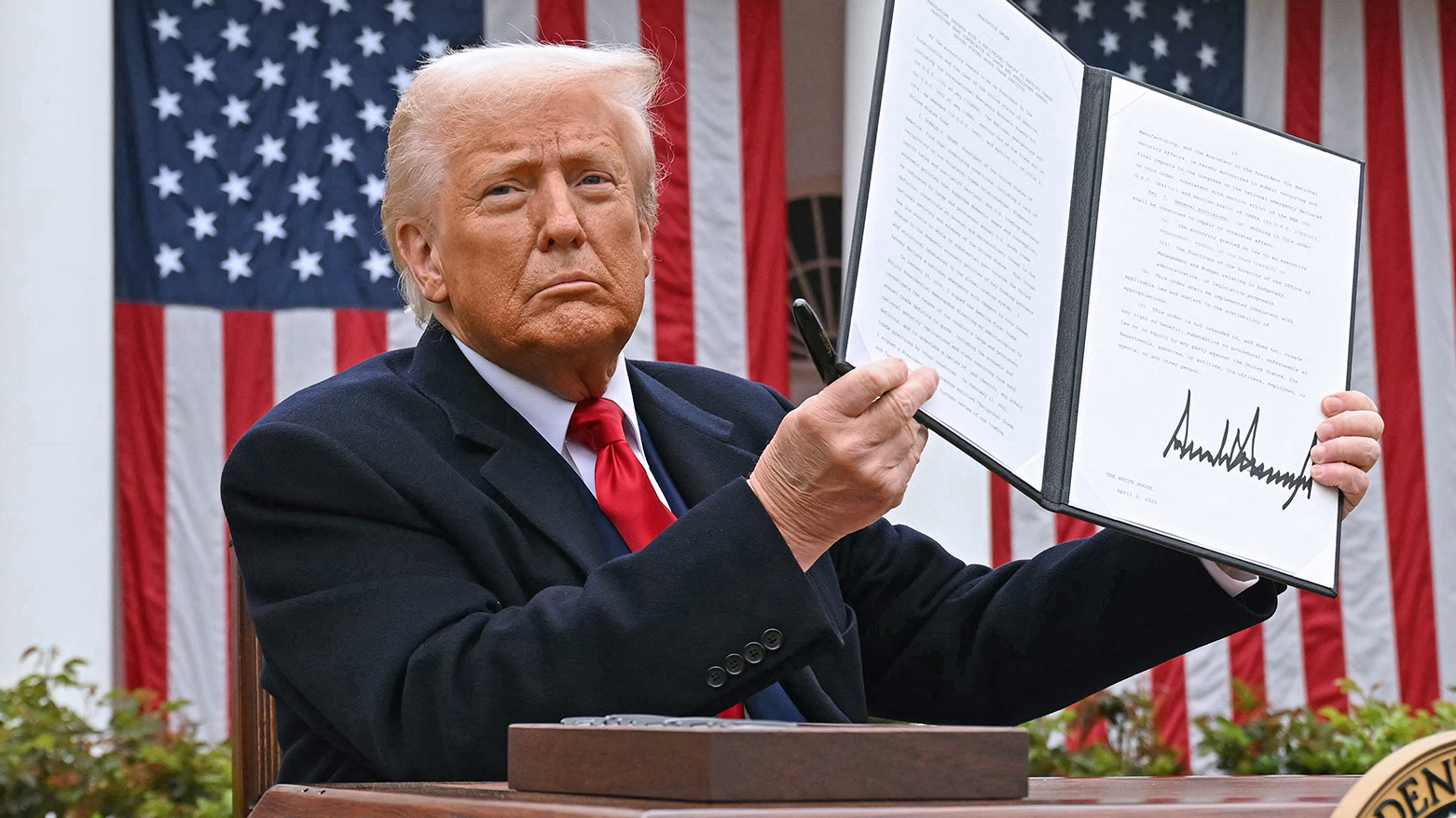
Trump signed the tariff order in the Oval Office and said on social media that it was “effective almost immediately,” according to AFP.
A White House factsheet cited by AFP stated that the new duty will take effect on February 24 for 150 days. Exemptions will remain in place for sectors subject to separate investigations, including pharmaceuticals, and for goods entering the United States under the U.S.-Mexico-Canada Agreement.
The Supreme Court ruled 6–3 that the 1977 International Emergency Economic Powers Act (IEEPA), which Trump had used to impose sweeping “reciprocal” tariffs on numerous countries, “does not authorize the President to impose tariffs.” Chief Justice John Roberts wrote in the majority opinion that “IEEPA contains no reference to tariffs or duties” and that if Congress had intended to grant such authority, “it would have done so expressly, as it consistently has in other tariff statutes,” according to AFP and AP.
The ruling marked the first major element of Trump’s economic agenda to receive a final decision from the high court since his return to office 13 months ago, AP reported. Lower courts had also ruled against the president in the case.
Speaking to reporters, Trump criticized the decision and said he was “ashamed” of certain members of the court. “In order to protect our country, a president can actually charge more tariffs than I was charging in the past,” he said, adding that the ruling left him “more powerful,” according to AFP.
AP reported that Trump described the ruling as incorrect but said it would not prevent him from pursuing alternative authorities. “Their decision is incorrect,” he said. “But it doesn’t matter because we have very powerful alternatives.”
Treasury Secretary Scott Bessent told the Economic Club of Dallas that the alternative method “will result in virtually unchanged tariff revenue in 2026,” according to AFP.
The court’s decision did not affect sector-specific duties previously imposed on steel, aluminum, and other goods under separate legal authorities. Government investigations still underway could lead to additional sectoral tariffs, AFP reported.
The majority opinion concluded that it is unconstitutional for a president to unilaterally set and change tariffs because taxation authority rests with Congress. “The Framers did not vest any part of the taxing power in the Executive Branch,” Roberts wrote, according to AP.
Justices Brett Kavanaugh, Samuel Alito, and Clarence Thomas dissented. Kavanaugh wrote that the tariffs “may or may not be wise policy” but were “clearly lawful” under existing statutes, AP reported.
The ruling did not address whether businesses would receive refunds for tariffs already collected. During court arguments, the administration had said companies would receive refunds if the tariffs were deemed unlawful. However, the decision left the issue unresolved.
Kavanaugh noted that the refund process could be complicated. “The Court says nothing today about whether, and if so how, the Government should go about returning the billions of dollars that it has collected from importers,” he wrote, adding that the process is likely to be a “mess,” according to AP.
Federal data cited by AP show that the Treasury had collected more than $133 billion from import taxes imposed under the emergency powers law as of December. The University of Pennsylvania’s Penn Wharton Budget Model projected that refunds could reach up to $175 billion, AFP reported.
Elizabeth Warren, the top Democrat on the Senate Banking Committee, cautioned that there remained “no legal mechanism for consumers and many small businesses to recoup the money they have already paid,” according to AFP. California Governor Gavin Newsom called for immediate refunds, describing the tariffs as an “illegal cash grab,” AFP reported.
The Budget Lab at Yale University estimated that consumers face an average effective tariff rate of 9.1 percent following the ruling, down from 16.9 percent before the decision, AFP reported. The lab said the rate “remains the highest since 1946,” excluding 2025.
Wall Street saw modest gains in share prices after the decision, which had been widely anticipated, AFP reported. Business groups largely welcomed the ruling, with the National Retail Federation saying it provides “much needed certainty” for companies, according to AFP and AP.
Close trading partners, including the European Union and Britain, said they were studying the decision, while Canada described the levies as “unjustified” and said it was preparing for potential new measures, AFP reported.
The White House indicated that the administration had prepared contingency plans in anticipation of the court’s decision.
According to The New York Times, the president is considering invoking additional trade authorities, including Section 301 of U.S. trade law, which allows investigations into unfair trade practices, and Section 122 of the 1974 Trade Act, which permits a baseline tariff of up to 15 percent for 150 days to address trade deficits.
Section 122 has never been invoked by a president, The New York Times reported. The White House declined to comment on specific plans but officials indicated that announcements could follow.
AP reported that the Supreme Court’s ruling does not prevent Trump from imposing tariffs under other statutes, though those authorities contain different procedural requirements and limitations.
Vice President JD Vance described the decision as “lawlessness” in a post on X, according to AP.
The case had drawn legal challenges from small businesses and several states, with challengers arguing that the emergency powers law does not mention tariffs and that Trump’s interpretation failed legal standards, including the major questions doctrine referenced by the court.
In its decision, the majority wrote that “There is no exception to the major questions doctrine for emergency statutes,” according to AP.
Despite the ruling, Trump pledged to proceed with new measures. “But it doesn’t matter because we have very powerful alternatives,” he said.