President Barzani: Protecting the Mother Tongue Is a National Duty
President Masoud Barzani said on International Mother Language Day that preserving one’s mother tongue is a national duty, calling it “the foundation of authenticity, identity, awareness, and national solidarity” and wishing all Kurds a happy celebration.
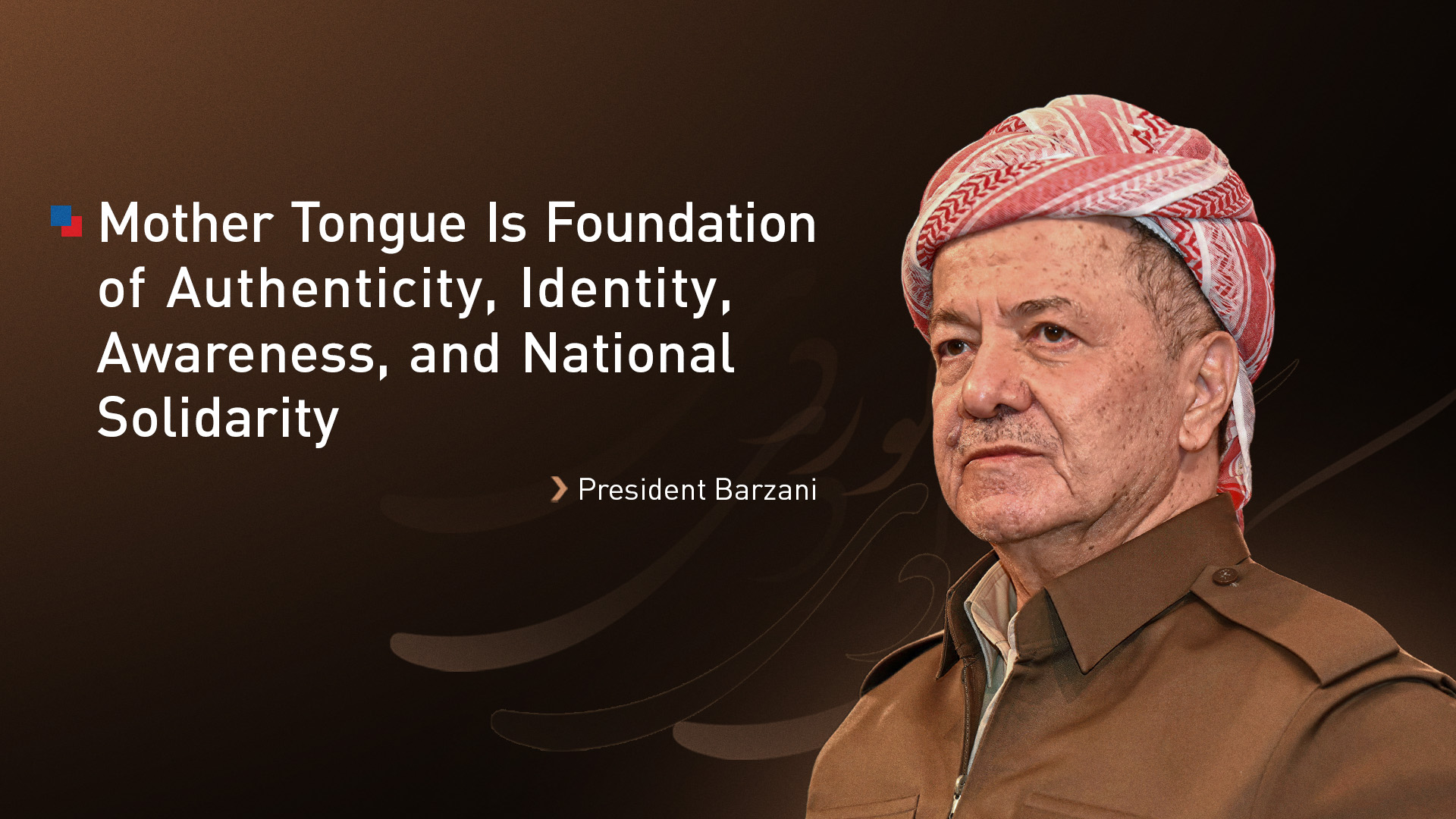
ERBIL (Kurdistan24) - On International Mother Language Day, President Masoud Barzani emphasized that preserving one’s mother tongue is a national duty, stating in a message on X that “Mother tongue is the foundation of authenticity, identity, awareness, and national solidarity; its preservation is a national duty. Happy Mother Language Day to all the dear people of Kurdistan.”
The message highlights the Kurdistan Region’s focus on maintaining linguistic and cultural heritage as part of broader efforts to reinforce national identity and social cohesion. President Barzani’s statement reaffirms the Kurdistan Regional Government’s policies supporting Kurdish and other regional languages, including their use in education, public administration, and community life.
Earlier on the same day, Prime Minister Masrour Barzani issued a statement underscoring the region’s commitment to linguistic diversity. “The Kurdistan Region is enriched by its diverse languages and cultures. It is a source of pride that all components of Kurdistan can freely speak and study in their mother tongues,” he wrote on X.
He described language as “a vital and fundamental pillar of our existence and our national identity,” and reaffirmed that the government supports Kurdish and the languages of all components of the people of Kurdistan.
Internationally, Kurdish institutions based in Switzerland, Brussels, and Stockholm released a coordinated declaration emphasizing that education in a native language is essential for preserving national dignity. The statement highlighted that nearly half of the world’s 7,000 estimated languages are at risk, with approximately 2,500 to 3,000 currently considered endangered.
The declaration noted the Kurdish language’s historical depth, citing its four main dialects—Kurmanji, Sorani, Zazaki, and Hawrami—as independent linguistic entities with centuries of literary, historical, and philosophical documentation produced by Kurdish scholars.
The institutions’ statement also noted that despite this rich heritage, Kurdish has faced marginalization over the twentieth century, particularly under policies promoting monolithic state languages.
These included campaigns of Arabization, Persianization, and Turkification in various countries, which aimed to suppress linguistic diversity in favor of a single national language. Kurdish organizations have reported declines in language use and structural disruptions, especially in regions within Türkiye, where assimilation pressures have historically affected local dialects.
Academic efforts have sought to counter these pressures. Amir Hassanpour, a sociolinguist, conducted research in international journals to underscore the value of Kurdish and the risks to its survival.
Scholars emphasized that maintaining the language across generations requires both domestic transmission and formal institutional education, noting that social and political instability—including the Anfal campaign, chemical attacks, and conflicts against ISIS—have disrupted intergenerational language transmission.
Families affected by violence often experienced linguistic shifts or silences, particularly as women and mothers navigated the burden of preserving Kurdish within households.
Modern preservation strategies have extended beyond the home, with nurseries and kindergartens providing structured Kurdish-language education.
Linguists and education specialists argue that systematic teaching is necessary to produce a generation fluent in academically grounded Kurdish, complementing traditional family-based language transmission. Women continue to play a central role in these educational efforts, reflecting the historical responsibility they held in maintaining linguistic continuity within households.
The Kurdistan Regional Government’s reinforcement of mother-tongue rights aligns with broader international initiatives to protect multilingualism. UNESCO formally designated February 21 as International Mother Language Day following a 1999 proclamation, commemorating the 1952 Bengali language movement in East Pakistan.
During that movement, protesters demonstrating against the government’s declaration of Urdu as the sole official language were shot by police, a catalyst for eventual independence in Bangladesh in 1971. The observance emphasizes the global importance of language preservation and cultural diversity, principles echoed in the Kurdistan Region’s policies.
By supporting unrestricted use of all regional languages, the Kurdistan Regional Government seeks to safeguard cultural identity against historical threats of linguistic and cultural erosion. The administration promotes opportunities for education, public expression, and institutional recognition of Kurdish and other languages, reinforcing the region’s collective memory and heritage.
President Barzani’s statement and the Prime Minister’s reaffirmation together underscore that protecting mother tongues is central to national identity, cultural continuity, and social cohesion in the Kurdistan Region. Both leaders highlighted the role of language as a foundation for authenticity, solidarity, and awareness, calling on citizens to observe the day as a reminder of their shared linguistic heritage.
The Kurdistan Regional Government continues to advance policies ensuring that Kurdish and other regional languages are freely used in education and public life, marking International Mother Language Day with official support for linguistic preservation across the region.
This article was updated on Saturday, Feb. 21, 2026, at 01:04pm.