KRG Establishes Joint Crisis Room to Assist Citizens Returning from Abroad
Safin Dizayee says Kurdistan Region remains a factor of stability and will not allow its territory to be used to attack neighbors
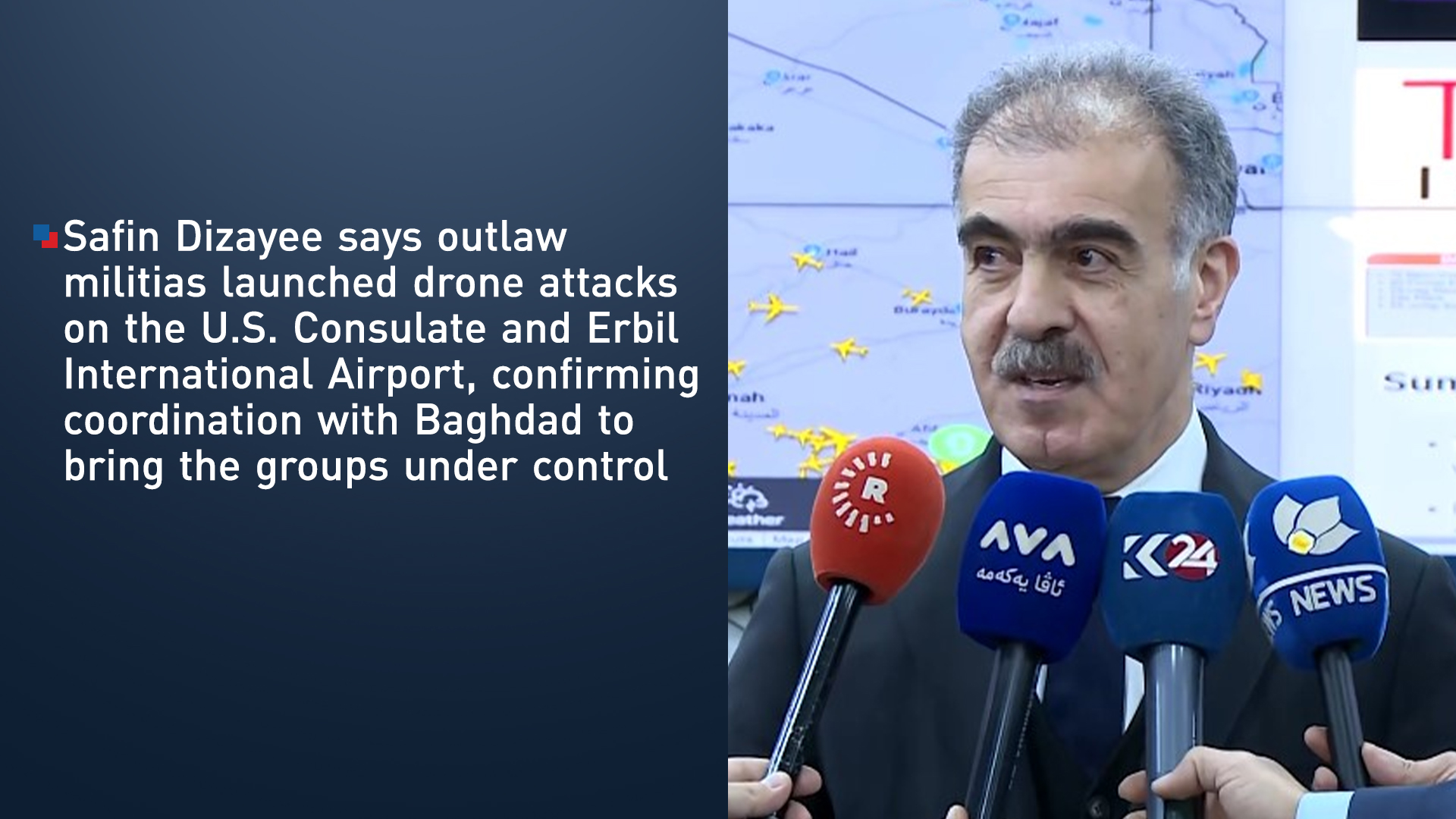
ERBIL (Kurdistan24) — The Kurdistan Regional Government (KRG) has established a joint operations room and activated two emergency hotlines to assist citizens seeking to return to the Kurdistan Region from abroad, according to Safin Dizayee, head of the KRG Department of Foreign Relations (DFR).
In a statement to media outlets, Dizayee said the Middle East is once again facing war and renewed conflict, with civilians often becoming the first victims. He expressed hope that the current situation would de-escalate swiftly.
“As the Kurdistan Regional Government, we have always worked to respond to the needs and concerns of our citizens,” Dizayee said. He noted that two days ago, a broad coordination meeting was held involving the Ministry of Interior, the Ministry of Health, and the Department of Foreign Relations.
A joint operations room has since been established within the Joint Crisis Coordination Center (JCC) to streamline response efforts.
Dizayee added that two dedicated hotlines have been set up to enable citizens in Gulf countries, Europe, and elsewhere to obtain information and assistance. “We have put mechanisms in place so our citizens abroad can contact us and receive the necessary guidance to facilitate their safe and swift return to the Kurdistan Region,” he explained.
He also thanked the Turkish Consulate for its coordination in granting five-day transit visas to individuals returning to the Region via land routes. Regarding Kurdistani citizens currently in Iran for medical treatment or education, Dizayee said they may return through border crossings, but at present, no travel from the Kurdistan Region into Iran is permitted.
Addressing recent security incidents, Dizayee confirmed that the U.S. Consulate and Erbil International Airport were among the sites targeted in recent attacks.
Some of the projectiles were drones launched from within Iraq by what he described as “outlaw militias.” He said coordination with Baghdad is ongoing to ensure control over such armed groups.
On relations with Washington, Dizayee underscored the longstanding partnership between the Kurdistan Region and the United States.
“Since 1991, the United States has supported the Kurdistan Region, including through the establishment of a no-fly zone. In 2014, during the war against ISIS, the U.S. again stood by us. This partnership is not new,” he said.
Concluding his remarks, Dizayee reaffirmed that the KRG’s policy is to remain a stabilizing force in the region. “We will not allow the territory of the Kurdistan Region to become a launching ground for attacks against our neighbors. Iraq already faces many challenges and should not be dragged into a war that is not its own,” he stated.