Trump Says He Does Not Want Kurdish Offensive Against Iran as Conflict Escalates
Trump said he does not want Kurdish forces to launch an offensive against Iran, citing concerns that such involvement could further complicate the ongoing conflict.
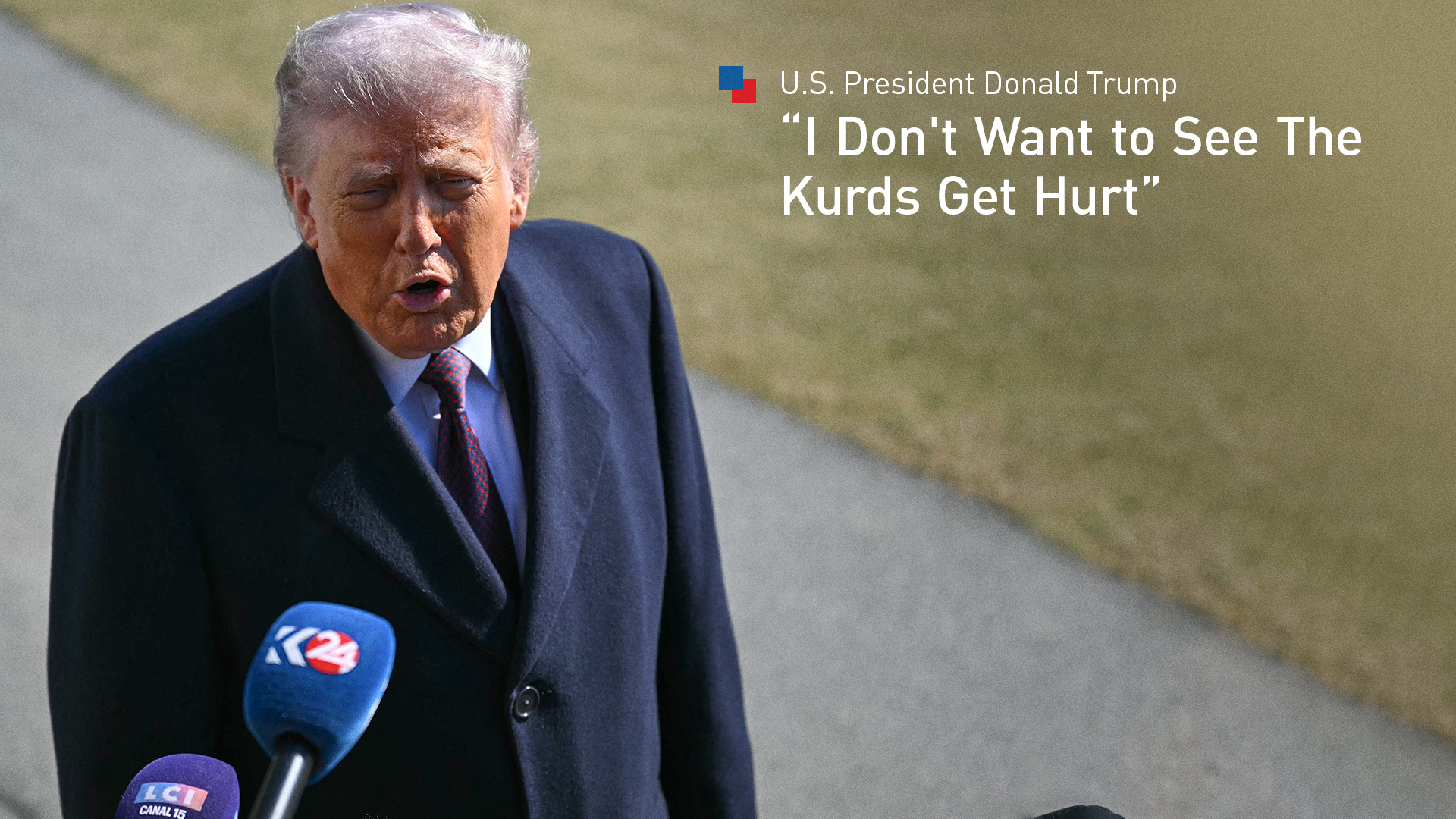
ERBIL (Kurdistan24) - U.S. President Donald Trump said Saturday that he does not want Kurdish forces to launch an offensive against Iran as the United States and Israel continue military operations against the Islamic Republic, according to statements he made to reporters aboard Air Force One cited by AFP.
“We're not looking to the Kurds going in,” Trump told reporters during a briefing on the presidential aircraft, AFP reported. “We're very friendly with the Kurds, as you know, but we don't want to make the war any more complex than it already is.”
Trump made the remarks in response to questions from reporters about whether Kurdish forces could become involved in the conflict. One reporter asked about concerns among some Iranians that Kurdish groups could attempt to establish an autonomous region similar to those formed in parts of Syria and Iraq.
Responding to the question, Trump reiterated that he did not support Kurdish participation in military operations inside Iran.
“We're not having...We're not looking to the Kurds going in. We're very friendly with the Kurds, as you know, but we don't want to make the war any more complex than it already is, no,” he said, according to remarks cited by AP.
When asked directly whether he had ruled out such involvement, Trump replied that he did not want Kurdish forces entering the conflict.
“We don't want, yeah, I've ruled...I don't want the Kurds going in. I don't want to see the Kurds get hurt, get killed. We've had a good relationship. They're willing to go in, but we really, I've told them I don't want them to go in,” he said.
“I just think, the war's complicated enough without having, getting the Kurds involved,” Trump added during the exchange with reporters aboard Air Force One.
The remarks came amid ongoing hostilities between Iran and a U.S.-Israeli military coalition that began last week. Trump’s comments appeared to signal caution about expanding the scope of the conflict, particularly through the involvement of Kurdish fighters operating in areas bordering Iran.
According to AFP, Trump had earlier indicated a different position during comments to Reuters earlier in the week. On Thursday, he reportedly said he would be “all for” an offensive by Iranian Kurdish fighters to support military operations against the Islamic Republic.
The shift in tone emerged as Trump addressed reporters traveling with him aboard Air Force One, where he answered questions on several aspects of the conflict with Iran, including potential military strategies and the humanitarian impact of recent strikes.
During the same briefing, Trump raised the possibility that U.S. ground forces could be deployed inside Iran to secure the country’s stockpiles of enriched uranium, a move he said could form part of efforts to dismantle Tehran’s nuclear program.
“At some point maybe we will. That would be a great thing,” Trump said, according to AFP. “We haven't gone after it but it's something we could do later.”
Asked more broadly about the potential use of ground troops, Trump did not rule out the option but indicated that any such deployment would depend on specific circumstances.
“Could there be? Possibly, for a very good reason — it'd have to be a very good reason,” he said during the briefing, AFP reported.
Trump also suggested that if U.S. forces were ever deployed on the ground inside Iran, the conditions would significantly limit Iran’s ability to mount a conventional response.
“And I would say if we ever did that, they would be so decimated that they wouldn't be able to fight at the ground level,” he said.
The comments were made as debate continues in Washington and internationally over the strategy behind the current military campaign against Iran. Critics cited by AFP have argued that air strikes alone may not be sufficient to achieve the stated objective of dismantling Iran’s military capabilities and preventing it from developing a nuclear weapon.
During the briefing, Trump also addressed reports of a deadly strike that Iranian authorities say hit a girls’ elementary school in the southern county of Minab. Iranian officials reported that the strike killed more than 150 people, most of them students.
Trump blamed Iran for the incident during his remarks aboard Air Force One.
“We think it was done by Iran,” he said, according to AFP. “Because they are very inaccurate, as you know, with their munitions. They have no accuracy whatsoever.”
Neither the United States nor Israel has claimed responsibility for the reported strike, AFP reported. U.S. officials have said the incident remains under investigation.
Iran has accused Washington of carrying out the attack, according to AFP.
The news agency reported that it has not been able to independently verify the incident, as journalists have not been granted access to the site. AFP also reported that it has not obtained independent confirmation of the casualty figures cited by Iranian authorities.
The reported strike has become part of a broader exchange of accusations between Iran and the United States during the ongoing conflict.
Iran’s Revolutionary Guards said Friday that they had targeted a U.S. military installation in the United Arab Emirates, claiming the base had been used as a launch point for the strike in Minab.
“Al-Dhafra air base, belonging to American terrorists in the region, was targeted using drones and precision missiles,” the Guards said in a statement broadcast on state television, according to AFP.
U.S. officials have confirmed that the Pentagon is investigating the circumstances surrounding the reported school strike. Secretary of State Marco Rubio said that the United States would not deliberately target a school, AFP reported.
Meanwhile, reporting by The New York Times cited by AFP suggested that U.S. military statements issued around the time of the incident indicated that American forces were conducting operations against naval targets near the Strait of Hormuz, an area where a base used by Iran’s Revolutionary Guards is located.
According to AFP, the newspaper said the timing of those strikes suggests U.S. forces were “most likely to have carried out the strike,” although the report did not provide definitive confirmation.
The newspaper also cited an analysis of social media posts, photographs, and videos recorded by witnesses, which appeared to show that the school was struck at the same time as nearby Revolutionary Guards naval facilities.
Those findings have not been independently verified by AFP.
The developments come as tensions between Iran and the United States continue to escalate following the launch of the current military campaign last Saturday. The conflict has triggered regional security concerns and prompted discussions among international observers about the potential expansion of hostilities.
Trump’s remarks about Kurdish involvement reflect the broader strategic considerations surrounding the conflict, particularly regarding the possible participation of regional actors and allied groups.
According to AFP, Trump emphasized during the briefing that the United States maintains friendly relations with Kurdish groups but expressed concern that their direct involvement in an offensive against Iran could further complicate the conflict.
The comments highlight Washington’s effort to balance military objectives with the risk of widening the war across multiple fronts.
U.S. officials continue to investigate the reported school strike in Minab, while the administration weighs potential next steps in its military campaign against Iran, including the possible deployment of ground forces and the role of regional partners.