Hegseth Says U.S. Launching “Most Intensive” Phase of Strikes in Iran
Defense Secretary Pete Hegseth said U.S. and Israeli strikes have hit more than 15,000 targets in Iran during “Operation Epic Fury,” crippling missile production and naval forces. Hegseth also said Iran’s new supreme leader is wounded and in hiding.
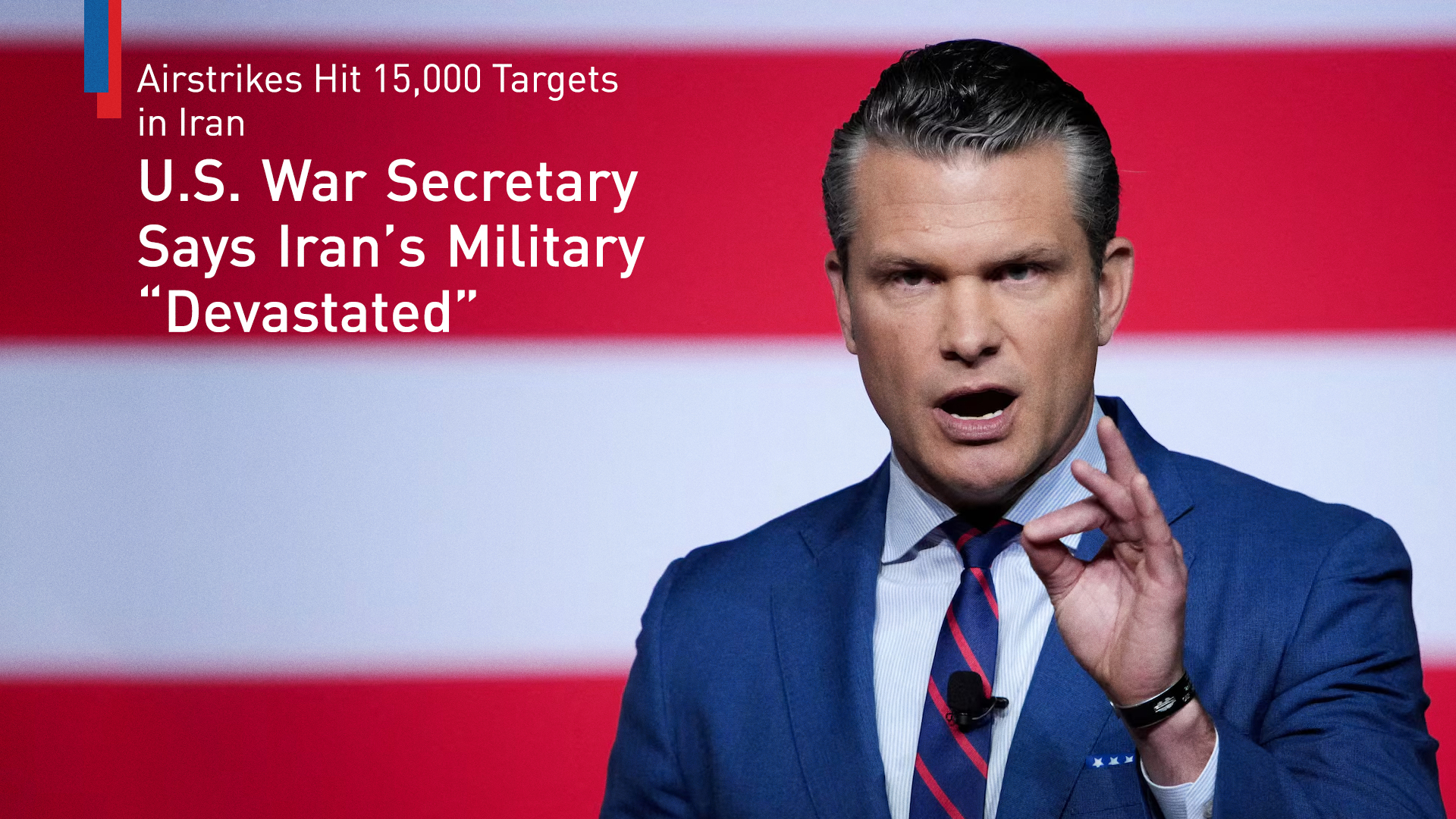
ERBIL (Kurdistan24) - United States War Secretary Pete Hegseth and Chairman of the Joint Chiefs of Staff General Dan Caine announced Friday that the U.S. military has initiated its most intensive phase of aerial bombardment against Iran, reporting the systematic destruction of the country's military infrastructure and defense industrial base.
Speaking from the Pentagon on the 13th day of what has been designated "Operation Epic Fury," officials detailed a campaign that has transitioned from neutralizing active threats to the permanent dismantling of Iran’s capacity to manufacture advanced weaponry. Secretary Hegseth stated that the combined air power of the United States and Israel has struck over 15,000 targets to date, averaging more than 1,000 strikes per day, a tempo he described as unprecedented in modern warfare.
"The United States is decimating the radical Iranian regime's military in a way the world has never seen before," Hegseth said. "Never before has a modern, capable military... been so quickly destroyed and made combat ineffective."
Industrial and Production Infrastructure
The Secretary emphasized that the current phase of operations is focused on the "defense industrial base" to ensure the Iranian government cannot replenish its depleted stockpiles. According to the Pentagon, the country's entire ballistic missile production capacity was functionally destroyed as of 48 hours ago.
The strikes have targeted buildings, factory lines, and defense innovation centers across the country. Hegseth noted that while U.S. and allied forces continue to intercept remaining missiles and drones in the air, the strategic priority has shifted to ensuring those systems cannot be replaced.
"We’re shooting down and destroying what missiles they still have in stock, but more importantly, ensuring that they have no ability to make more," Hegseth said.
Status of Iranian Leadership and Command
The Pentagon provided a stark assessment of the Iranian leadership’s operational status, characterizing the government as "confused" and struggling to coordinate a coherent defense. Secretary Hegseth confirmed reports that the Iranian leadership has moved into underground bunkers and civilian areas to evade ongoing strikes.
Addressing the status of the Iranian leadership, Hegseth stated that the "new, so-called, not-so-supreme leader" is believed to be wounded and "likely disfigured." He noted that a written statement calling for unity was released by the Iranian leader yesterday, but emphasized the lack of accompanying audio or video as evidence of the leadership's compromised state.
"He’s scared, he’s injured, he’s on the run, and he lacks legitimacy," Hegseth said, adding that the Iranian government is currently suffering from a breakdown in communication and a lack of clear succession or command.
Naval Operations and the Strait of Hormuz
General Dan Caine, Chairman of the Joint Chiefs of Staff, reported that the Iranian Navy has been rendered "combat ineffective" in less than two weeks. U.S. forces have targeted and destroyed all Soleimani-class warships, which were equipped with anti-ship and anti-aircraft weaponry.
The status of the Strait of Hormuz remains a primary concern for international shipping. General Caine clarified that while the Strait remains physically open for transit, Iranian forces continue to act as "belligerents," firing on commercial shipping and attempting to hold the waterway hostage.
"The only thing preventing commercial traffic and flow through the straits right now... is Iran," Caine said.
U.S. Central Command (CENTCOM) is currently prioritizing the destruction of Iran’s mine-laying enterprise, including naval bases, depots, and the specialized vessels used to deploy mines. Despite the degradation of the Iranian Navy, officials cautioned that the regime still retains some capability to threaten commercial vessels and friendly forces, necessitating continued strikes.
New Combat Technologies and Artillery
General Caine highlighted the role of ground-based artillery and new missile technologies in the campaign. For the first time in history, the U.S. Army and Marine Corps have deployed the Precision Strike Missile (PrSM) in active combat.
Operating from positions outside of Iran’s borders, artillery units—including the 3rd Battalion, 27th Field Artillery Regiment—have utilized High Mobility Artillery Rocket Systems (HIMARS) and Army Tactical Missile Systems (ATACMS) to strike deep into Iranian territory. These units have been credited with sinking naval vessels, including at least one submarine, and destroying inland weapon depots.
"Our artillery forces have made history," Caine said, noting that the deployment of PrSMs allows for high-precision strikes against hardened targets that were previously difficult to reach with ground-based assets.
U.S. Casualties and Operational Risks
The Pentagon addressed the human cost of the operation, confirming the loss of a KC-135 refueling aircraft over western Iraq on Thursday. General Caine stated that the crash was not the result of hostile fire or friendly fire. Four Airmen have been recovered in what remains an active rescue and recovery operation.
Additionally, a fire was reported on the USS Gerald R. Ford, resulting in injuries to several crew members. Officials stated that the injuries are not believed to be life-threatening and referred further inquiries to the Navy.
Regarding ground casualties, Hegseth reported that while there have been injuries to U.S. service members in Kuwait, Jordan, and along the "southern flank" due to one-way attack drones, approximately 90% of those injured have already returned to duty. He emphasized that the Pentagon is attempting to provide higher "fidelity" in its reporting of wounded-in-action (WIA) figures to distinguish between minor and severe injuries.
Nuclear Non-Proliferation Objectives
A core objective of Operation Epic Fury remains the denial of nuclear weapons capabilities to Iran. Secretary Hegseth linked the current conventional campaign to previous operations, specifically citing "Operation Midnight Hammer," which he said successfully obliterated key nuclear facilities.
"The conventional side is a huge part of getting at denying nuclear capabilities," Hegseth said. He argued that by destroying the "conventional umbrella" of ballistic missiles that Iran used to protect its nuclear sites, the U.S. has created the conditions necessary to ensure the regime can never produce a weapon.
When questioned about the status of enriched uranium stockpiles, Hegseth stated that the U.S. retains "a range of options across the spectrum" to ensure the material is never weaponized, though he declined to specify whether those options included a physical seizure of the material or were dependent on unconditional surrender.
Regional Partnerships and Diplomatic Context
The Pentagon confirmed that Gulf partners have moved from a purely defensive posture to an offensive role, integrating their air defense systems with U.S. and Israeli forces. Secretary Hegseth dismissed reports of internal divisions within the Trump administration regarding the conflict, specifically praising Vice President Vance’s role in counseling the President.
Addressing the broader geopolitical landscape, Hegseth noted that President Trump is scheduled to meet with Chinese President Xi Jinping in the coming weeks. While declining to provide specific details on Chinese support for the Iranian regime, Hegseth stated the meeting would focus on advancing U.S. interests.
The Secretary reiterated that the tempo and duration of the conflict remain at the discretion of the President. "President Trump holds the cards. He’ll determine the pace, the tempo, and the timing of this conflict," Hegseth said.
Humanitarian and Civilian Impact
The Pentagon officials noted that as Iranian leaders move into civilian areas to avoid strikes, the risk of collateral damage increases. However, Hegseth asserted that the U.S. would continue to press its advantage, stating there would be "no quarter, no mercy" for those designated as enemies of the mission.
The Secretary also addressed the Iranian government’s history of domestic suppression, citing the deaths of "tens of thousands of protesters" as a reason for the regime’s lack of legitimacy during its current calls for national unity.
Summary of Military Successes
The Pentagon summarized the current state of the conflict as a total shift in the balance of power in the Middle East. With Iranian air defenses, the navy, and air force described as non-existent, and the ballistic missile production lines destroyed, officials believe the regime’s ability to project power has been fundamentally broken.
"With every passing hour, we know, and we know they know, that the military capabilities of their evil regime are crumbling," Hegseth said. He concluded the briefing by stating that the U.S. would continue to ramp up the volume of strikes, utilizing artificial intelligence, cyber warfare, and space-based assets to maintain total dominance over the operating area.
The Department of War confirmed that today’s operations will involve the highest volume of sorties and "bomber pulses" since the conflict began 13 days ago, signaling an intensification of the campaign rather than a de-escalation.
The United States military reports that 13 days into Operation Epic Fury, it has neutralized Iran's navy and air defenses while systematically destroying its ballistic missile production capacity.