Iran's President Warns of 'Dangerous Precedent' as Netanyahu Declares US-Israel Are 'Winning' War
Iran’s president warns that assassinations and US-Israel actions set a dangerous precedent, as Netanyahu claims victory in an escalating regional war impacting global energy and security.
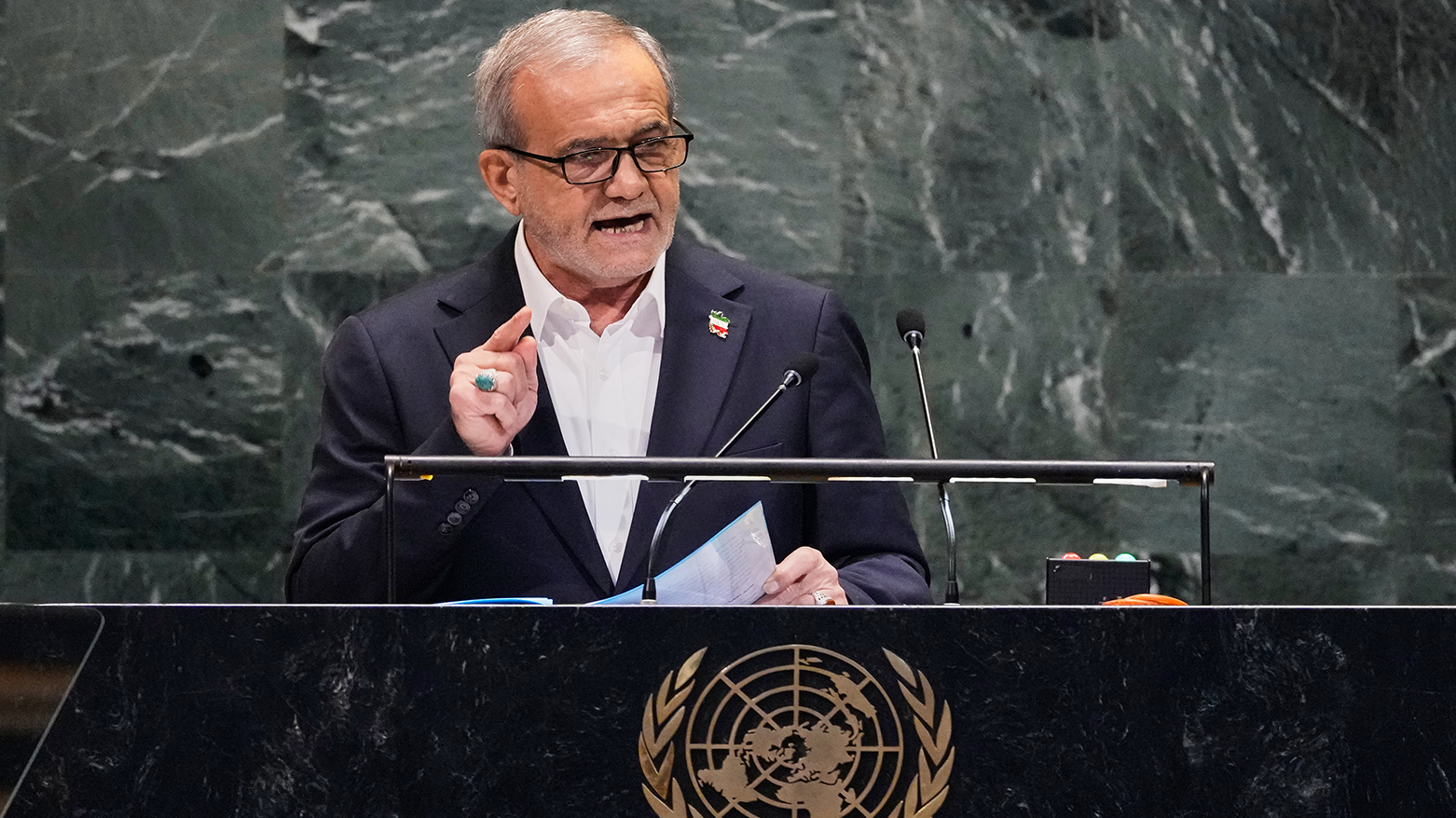
ERBIL (Kurdistan24) - A stark warning from Iran’s president has cast a new shadow over an already intensifying regional conflict, as Tehran signals growing alarm over recent developments involving Israel and the United States.
On Friday, Iranian President Masoud Pezeshkian said that the killing of Iranian leadership figures marks the beginning of a “dangerous precedent” in international relations, warning that global inaction could lead to far-reaching consequences.
In a post on X, Pezeshkian wrote: “The nature of the Zionist regime is state terrorism. Yet US aggression against Iran and the assassination of the martyred Leader sets a new precedent in international disputes that will destroy global legal norms. If the world fails to stand firm, its flames will burn many.”
His remarks come amid a rapidly escalating conflict, as Israeli Prime Minister Benjamin Netanyahu declared that Israel and the United States are “winning” the war against Iran, portraying Tehran as significantly weakened.
Speaking during an English-language press conference on Thursday, Netanyahu said, “We are winning and Iran is being decimated.” He added, “We are taking action to destroy the industries that make it possible to build missiles. Iran no longer has the capacity to enrich uranium and manufacture ballistic missiles.”
Netanyahu also emphasized close coordination with US President Donald Trump, stating: “Does anyone really think that someone can tell President Trump what to do? He didn't need any convincing.”
He further said, “I don't think any two leaders have been as coordinated as President Trump and I. He's the leader. I'm, you know, his ally,” while confirming that Israel had acted alone in striking Iran’s South Pars gas field, noting that Trump had requested a halt to similar attacks.
“President Trump asked us to hold off on future attacks and we're holding off,” Netanyahu stated, adding that Trump had earlier said, “We’re not doing that anymore.”
The Israeli premier also pointed to what he described as internal divisions within Iran’s leadership, saying, “We're seeing cracks, and we're trying to propagate them as fast as we can. Not only in the top command -- we're seeing cracks in the field.” He added uncertainty over Iran’s leadership, stating: “I'm not sure who's running Iran right now.”
Despite ongoing escalation, Netanyahu suggested the conflict could end sooner than expected. “There’s still more work to do, and we're gonna do it,” he said, adding, “I also see this war ending a lot faster than people think.”
The war, launched on Feb. 28, 2026, by the United States and Israel, has now entered its fourth week, marked by continued military exchanges across the region.
Iran has maintained retaliatory attacks, including strikes on energy infrastructure across multiple countries, impacting global markets. Iranian missiles struck Qatar’s Ras Laffan gas complex, while a drone hit the Samref refinery in Saudi Arabia’s Yanbu port. Additional drone attacks sparked fires at Kuwait’s Mina Abdullah and Mina Al-Ahmadi refineries.
In Israel, an oil refinery in the port of Haifa was also struck, with media showing black smoke rising from the site. Iran has also restricted traffic through the Strait of Hormuz, further affecting global energy flows.
Iranian military officials have warned of further escalation, stating they would pursue the “complete destruction” of Gulf energy infrastructure if attacks are repeated. Iranian Foreign Minister Abbas Araghchi said there would be “ZERO restraint” if Iran’s infrastructure is targeted again.
Meanwhile, several countries, including Britain, France, Germany, Italy, Japan, and the Netherlands, said they would contribute to efforts to ensure safe passage through the Strait of Hormuz.
US Defense Secretary Pete Hegseth said there is no set timeline for ending the war, adding that the decision would ultimately rest with President Trump. “It will be at the president's choosing, ultimately, where we say, ‘Hey, we've achieved what we need to,’” he stated.
As both sides intensify their rhetoric and military actions, the conflict continues to widen, with competing narratives emerging over its trajectory and outcome.
Pezeshkian’s warning underscores the growing stakes, signaling that without international intervention, the consequences may extend far beyond the immediate battlefield.