Ex-Governor’s Son Says Kirkuk Deal Poses 'Serious Threat' to Kurdistan
In the shadows of the Rasheed Hotel, a city’s fate was bartered away, at least according to the son of its late governor. Sirwan Najmiddin Karim views the recent handover of Kirkuk as a repetition of history, a cold transaction of sovereignty that echoes the bitter betrayals of 2017.
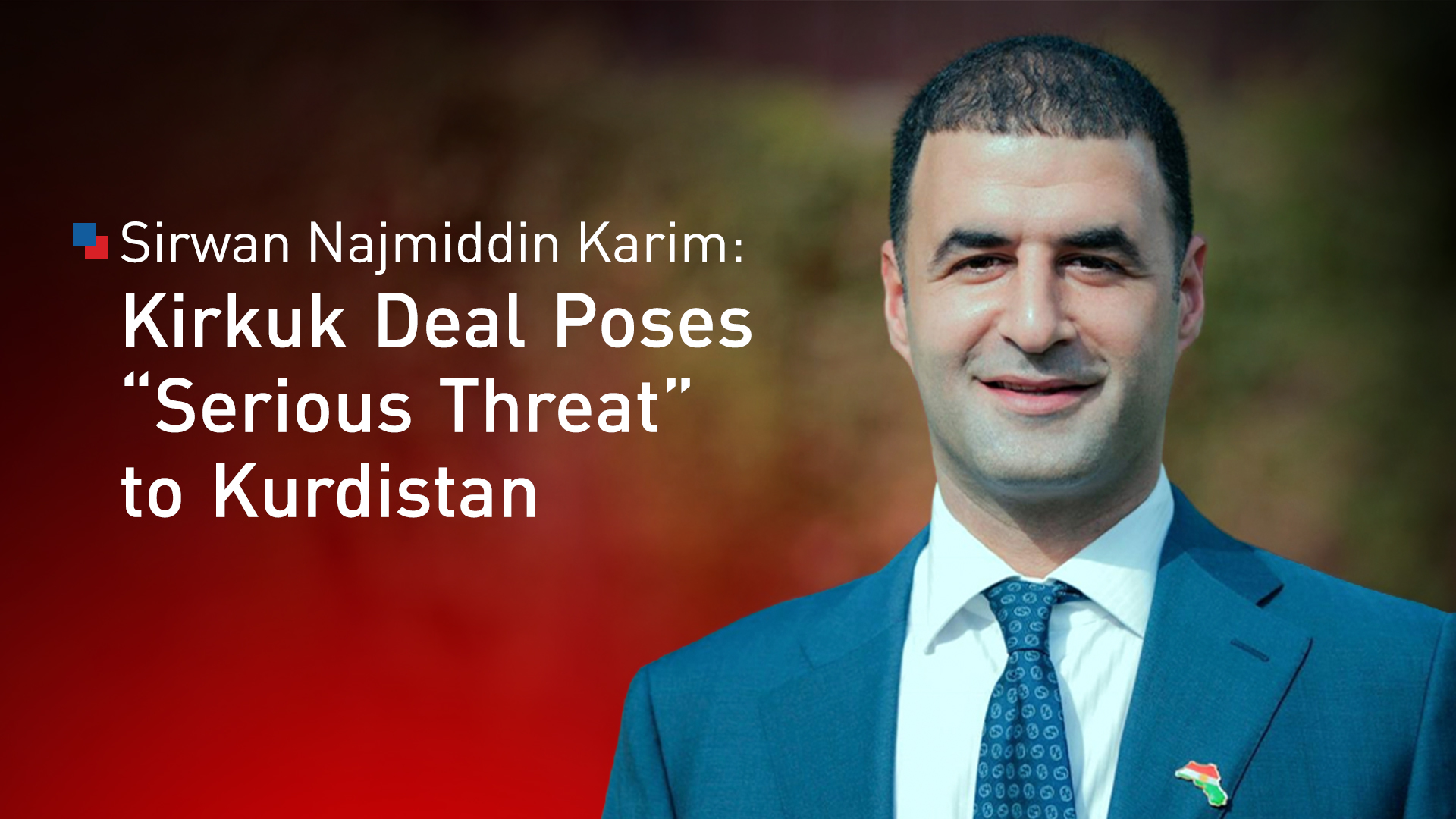
ERBIL (Kurdistan24) - Sirwan Najmiddin Karim, the son of the late Kirkuk Governor Najmiddin Karim, publicly condemned the recent transfer of the city’s governorship to a non-Kurdish administration, characterizing the geopolitical agreement that facilitated the handover as a severe threat to the Kurdistan Region that mirrors the loss of Kurdish control on October 16, 2017.
The statement follows a definitive administrative restructuring in the Kurdistani province, underscoring deep institutional fractures within Kurdish political representation.
Speaking to Kurdistan24 on Sunday, Karim stated that on Oct. 16, 2017, "Kirkuk was handed over to armed groups and militias" due to what he described as the 'betrayal' of a faction within the Patriotic Union of Kurdistan (PUK) leadership, specifically implicating figures associated with the Talabani family.
He recalled warning the people of Kirkuk at that time that such political concessions would yield severe, long-term consequences.
"Today," Karim argued, "the region is witnessing a parallel crisis." He stated that the people of Kurdistan are facing a 'new betrayal', asserting that the same political figures who previously compromised Kirkuk are currently orchestrating a scenario more dangerous than the events of Oct. 16.
He further warned that the administrative conspiracies formalized at Baghdad’s Rasheed Hotel pose a direct and profound danger to both the local population and the broader Kurdistan Region.
Describing an environment of ongoing oppression, the former governor’s son noted that the governing militias "have no mercy for anyone," emphasizing that the systemic marginalization of citizens and strict prohibitions against raising the Kurdistan flag in the city remain actively enforced.
Directly addressing those he accused of selling Kirkuk as "traitors," Karim pledged to stand against them with all available strength. He emphasized his commitment to a continued political struggle, driven by a strong will to return Kirkuk to the land of Kurdistan.
Karim's remarks are a direct response to a comprehensive administrative overhaul executed by the Kirkuk Provincial Council. On Thursday, following initial delays over quorum requirements, the council formally accepted the resignation of Governor Rebwar Taha, a member of the Patriotic Union of Kurdistan (PUK).
In a subsequent vote, 12 of the 14 attending council members elected Mohammed Samaan, head of the Iraqi Turkmen Front, as the new Governor of Kirkuk. Concurrently, Nashat Shawez was appointed as Deputy Chairman, finalizing the province's executive framework.
This administrative handover represents a fundamental restructuring of post-2003 political paradigms in Iraq, carrying profound implications for the Kurdistan Region’s constitutional standing.
By trading local executive control in a historically contested territory for sovereign federal appointments in Baghdad, political entities are decoupling Kirkuk’s governance from a unified Kurdish consensus.
This structural shift transforms historically Kurdistani jurisdictions into tradable political capital, potentially diminishing Erbil's negotiating leverage and rendering local Kurdish administration vulnerable to cross-sectarian parliamentary bartering.
The transition materializes a political pact originally negotiated in August 2024 at Baghdad's Rasheed Hotel.
The agreement—structured through an alliance between PUK President Bafel Talabani, Progress Party leader Mohammed al-Halbousi, Asa'ib Ahl al-Haq Secretary-General Qais al-Khazali, and Babylon Movement leader Rayan al-Kildani—instituted a rotational governance model.
According to the established timeline, Samaan and the Turkmen component will govern Kirkuk for an initial period of seven months. Following this term, the executive office is scheduled to transfer to a Sunni Arab representative, who will retain authority until the next provincial elections.
According to informed political sources, the rotation of the strategic provincial office was the cornerstone of a geopolitical exchange designed to secure external legislative backing for the PUK’s candidate in the Iraqi presidential election.
The core terms of the pact mandated that in exchange for legislative support from Turkmen and Arab factions to elect Nizar Amedi as the President of Iraq, the PUK would surrender the governorship.
In compensation, the PUK secured several local administrative positions, including the post of Deputy Governor, command of the Kirkuk Police Directorate, and the mayoralties of the Dibis and Daquq districts.
The Kurdistan Democratic Party (KDP) categorically rejected the agreement and boycotted Thursday’s council session, characterizing the process as an opaque political exchange that compromised Kurdistani identity for federal power. KDP Central Committee member Hiwa Gailani stated during a Kurdistan24 broadcast that an "under-the-table agreement was made at the expense of the rights of the people of Kurdistan."
Gailani explicitly rejected allegations that the KDP's political posture forced the PUK to surrender the provincial leadership to non-Kurdish factions. He highlighted the KDP's historical backing of PUK-affiliated governors, such as the late Najmiddin Karim, to maintain Kurdish administrative cohesion.
"It is not important to us who that person is; what is important to us is that all parties agree that Kirkuk's identity is Kurdistani," Gailani explained.
Ali Hussein, a KDP Politburo member and head of the Sulaimani-Halabja Organizing Office, detailed the party’s structural objections, clarifying that the opposition stems from political principles established after the fall of the Ba'ath regime in 2003.
Hussein explained that historically, each ethno-sectarian component internally designates its representative—with the Presidency of the Republic allocated to the Kurds, the Presidency of the Parliament to Sunni Arabs, and the Premiership to Shiite Arabs—before presenting the candidate to the broader legislature.
By bypassing this internal Kurdish consensus, Hussein argued, the PUK empowered federal Arab parties to extract the Kirkuk governorship as a necessary concession. "Each component designates its own representative itself," Hussein noted, stressing that relying on external alliances undermines the geopolitical standing of the Kurdistan Region.
Hussein further correlated the fragmentation of Kurdish unity with the deteriorating security environment in the Kurdistan Region, asserting that a consolidated front deters kinetic aggression from federal factions.
"Those who elected the President were the very same ones who were bombarding Kurdistan," he stated.
Responding to widespread reports regarding the physical absence of KDP representatives in the federal capital following the contested presidential vote, Hussein clarified that President Masoud Barzani had summoned parliamentary and governmental factions to Erbil strictly for strategic consultation, rather than a formal withdrawal from Baghdad.
Institutionally, KDP officials continue to advocate for governance rooted in electoral mandates. Reber Ahmed, a senior KDP official and member of its Central Committee, reiterated the party's demand for a lawful administration during a press conference on Thursday.
"Anything built based on the Rashid Hotel agreement—we will reject its outcomes, and we will not participate in any meetings organized on that basis," Ahmed said, asserting that the disputes between Erbil and Baghdad must be resolved through the implementation of Article 140 of the Iraqi Constitution.
Kirkuk remains one of Iraq's most heavily contested geopolitical flashpoints, serving as a focal point for competing Kurdish, Arab, and Turkmen demographic claims.
Following 2003, Kurdish leaders held the governorship for over a decade, anchoring the city’s administration to Erbil’s broader constitutional aspirations.
This administrative dominance shifted decisively on October 16, 2017, when federal Iraqi forces and the Popular Mobilization Forces (Hashd al-Shaabi) reasserted control over the province following a withdrawal of Peshmerga forces negotiated by select PUK officials.
With only two provincial elections held in nearly two decades—in 2005 and 2023—governance in Kirkuk is frequently characterized by interim, negotiated arrangements rather than continuous electoral mandates.
The 16-seat provincial council has historically struggled to achieve consensus, with the initial August 2024 Rasheed Hotel agreement passing with only nine votes, isolating the KDP and major Turkmen factions before the recent realignment.
The mechanics of the Rasheed Hotel agreement illuminate an evolving dynamic in Iraqi federal politics, wherein traditional ethno-sectarian blocs demonstrate a willingness to fragment their own communal unity to forge cross-sectarian, transactional alliances.
By decentralizing the Kurdish negotiating posture, federal actors can now leverage competing Kurdish interests against one another, effectively utilizing local administrative control in historically Kurdistani zones as tradable capital within Baghdad's broader parliamentary calculations.
The ultimate viability of Kirkuk’s newly established administrative structure remains untested as the Turkmen Front initiates its seven-month mandate before an anticipated transition to Arab leadership.
Concurrently, the KDP’s formal rejection of the process and its ongoing internal consultations in Erbil suggest a deliberate recalibration of its federal strategy, leaving the future architecture of Kurdish institutional participation in Baghdad deeply unresolved.