Erbil Potato Exports Expected to Peak Next Month as Daily Agricultural Shipments Reach 300 Trucks
He noted that potatoes from the region have already been exported to Gulf countries, including Qatar, the United Arab Emirates, Saudi Arabia, and Bahrain.
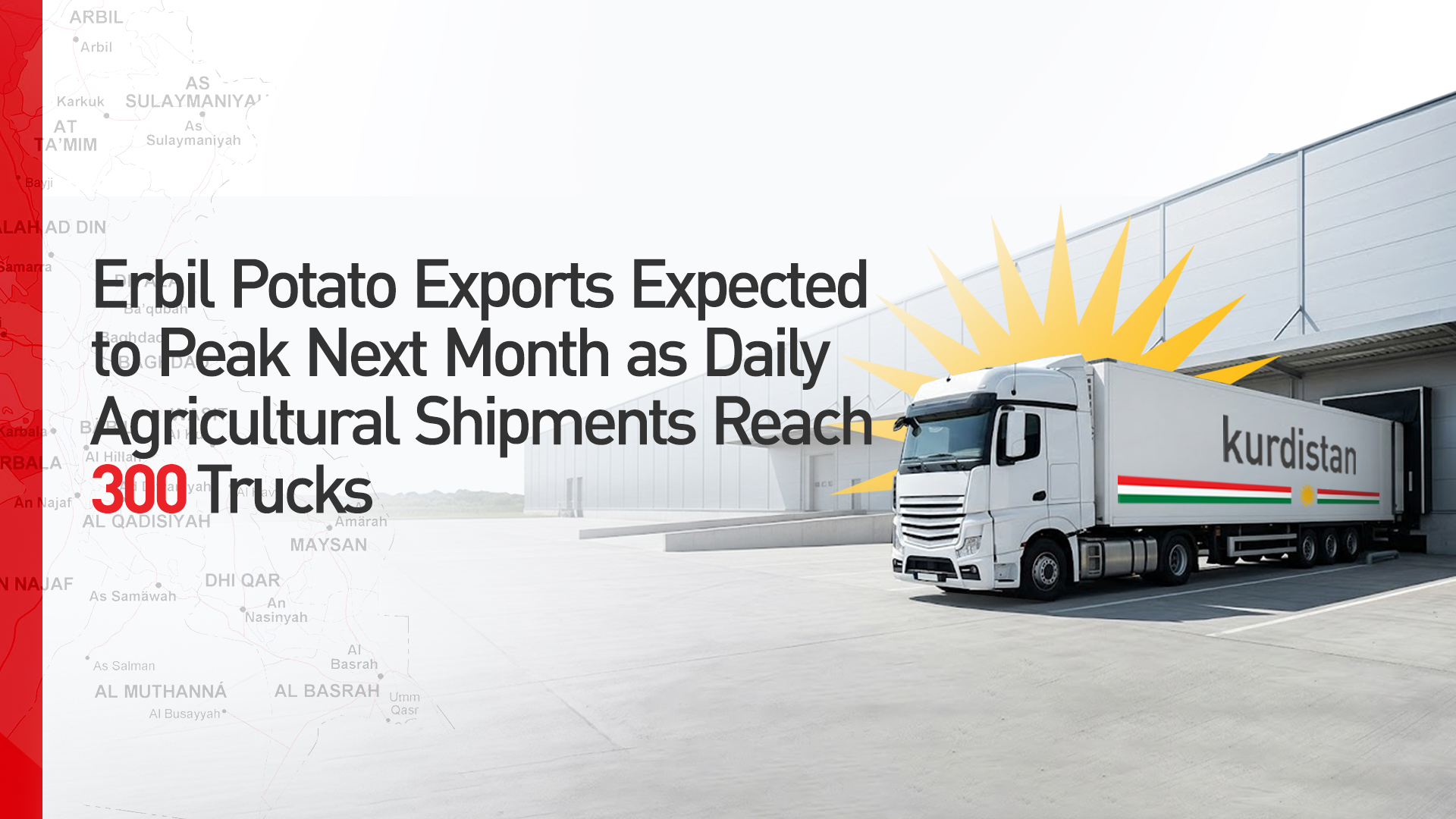
ERBIL (Kurdistan24) — The Director General of Agriculture in Erbil, Hemin Said Murad, announced on Wednesday that potato exports from Erbil are expected to reach their peak next month, as agricultural shipments from the Kurdistan Region continue to expand across both domestic and international markets.
Speaking to Kurdistan24, Murad said nearly 300 truckloads of locally produced agricultural goods are currently being transported daily from the Kurdistan Region to markets in central and southern Iraq. He said this reflects the Kurdistan Regional Government’s (KRG) broader strategy to strengthen the marketing and distribution of local agricultural products.
Murad explained that part of the region’s agricultural output is used to meet domestic demand, while the surplus is exported to international markets or supplied to other Iraqi provinces. He highlighted particularly strong demand for Kurdistan Region potatoes, citing their high quality and large production volumes.
He noted that potatoes from the region have already been exported to Gulf countries, including Qatar, the United Arab Emirates, Saudi Arabia, and Bahrain. Other agricultural products, such as Kurdistan honey, are also being exported to the Gulf states and Europe, while tomato paste produced in the region is reaching European markets.
Murad emphasized that the Kurdistan Region has become a key contributor to Iraq’s food supply, with an estimated 250 to 300 truckloads of agricultural products transported daily to federal Iraqi provinces, supporting broader national food security.
He also pointed to regulatory measures aimed at protecting local farmers during harvest seasons, including higher tariffs on imported agricultural goods or temporary import restrictions designed to prioritize domestic production.
According to Murad, agricultural trade is closely tied to seasonal demand in regional markets. He said countries such as Saudi Arabia prioritize domestic production during harvest periods, while import windows in markets like the UAE typically run from July through September — a period that aligns with peak export activity from the Kurdistan Region.
Murad added that while some potato shipments from Duhok have already been exported, Erbil’s exports are expected to increase significantly next month as the harvest reaches its peak.
He also highlighted recent progress in promoting Kurdish agricultural products abroad, noting that honey became the first regional product to enter European markets in 2022 and 2023, particularly in France, under the KRG’s Ninth Cabinet initiative.
Following honey exports, products such as Akre rice and Amedi tahini have also reached markets in Sweden, Germany, and the United Kingdom. Murad further clarified that while pomegranates are often seen as a flagship export, large-scale formal exports of pomegranates from Halabja and Zakho to Gulf countries — particularly the UAE and Qatar — preceded broader European shipments.