Sudani Coalition Claims Maliki Withdrawal Amid Fractured Shiite Bloc Negotiations in Baghdad
In Baghdad’s corridors of power, the Construction and Development Coalition told Kurdistan24 that Mohammed Shia al-Sudani is the frontrunner for Prime Minister as Nouri al-Maliki withdraws. Yet, as global envoys arrive, denials from Maliki’s camp suggest a leadership race that is far from settled.
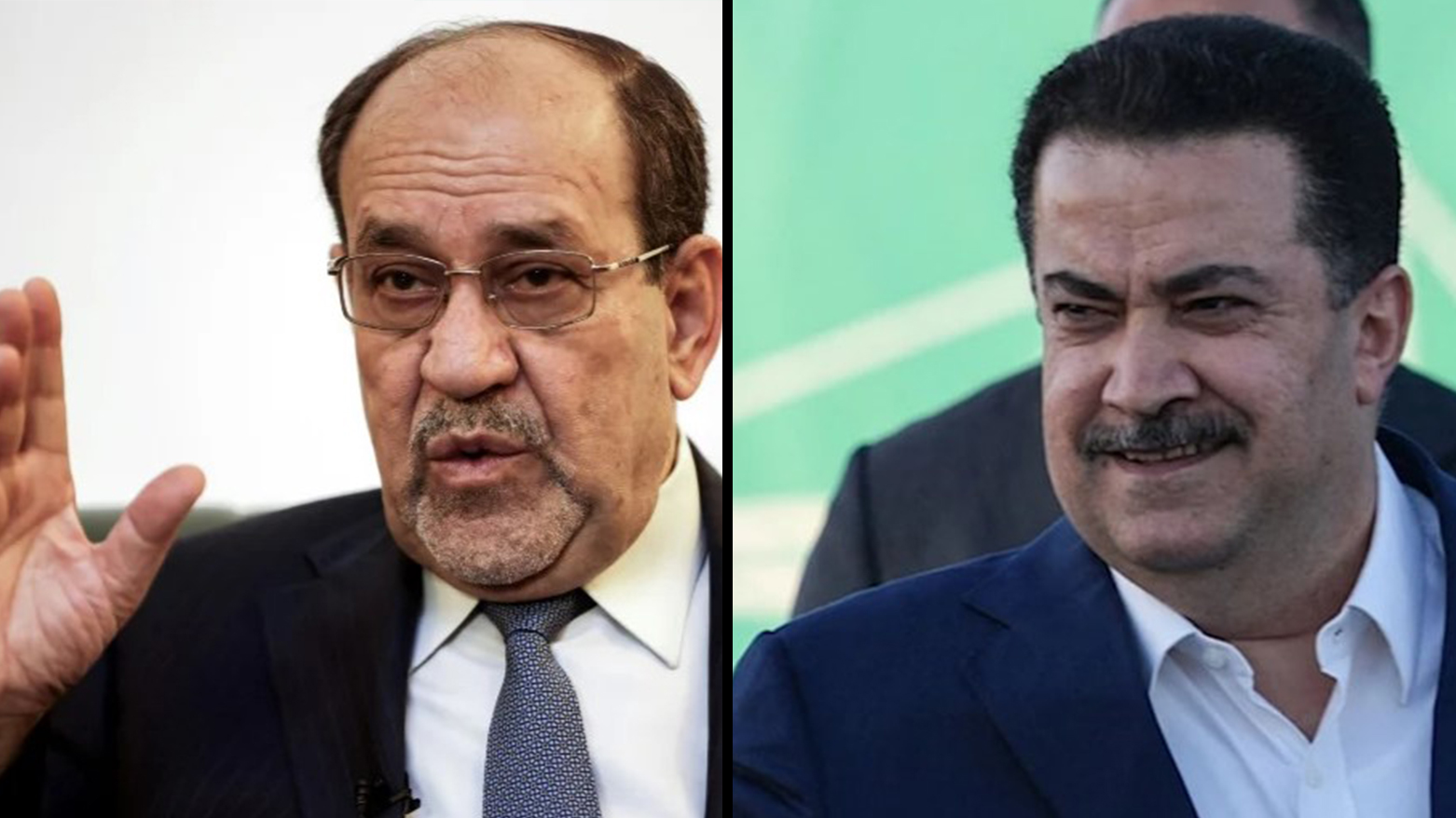
ERBIL (Kurdistan24) - The spokesperson for the Construction and Development Coalition, Faisal Maslamawi, stated on Sunday that incumbent Mohammed Shia al-Sudani maintains the highest probability of securing the Iraqi premiership following the reported withdrawal of Nouri al-Maliki from the race. The claim, however, has triggered an immediate and sharp rebuttal from Maliki’s camp, exposing a profound rift within the Shiite Coordination Framework as constitutional deadlines for government formation approach.
The arrival of high-level international envoys in Baghdad on Sunday underscored the geopolitical stakes of the impasse.
According to Kurdistan24 information, Esmail Qaani, commander of the Iranian Quds Force, and Tom Barrack, the United States President’s envoy for Syrian affairs, conducted simultaneous visits to the Iraqi capital to mediate the selection of the Coordination Framework’s nominee.
Their presence in the "Green Zone" reflects a rare and precarious convergence of rival regional interests, each seeking to stabilize a political process that remains paralyzed by internal Shiite competition and external economic pressures.
The selection of a prime minister is the final, most volatile hurdle in Iraq’s 2026 government formation process.
With the contentious 'selection' of a new President on April 13, the constitutional clock has been set to a strict 15-day mandate, requiring the presidency to task the largest parliamentary bloc's candidate with forming a cabinet by late April.
The current deadlock within the Coordination Framework—the umbrella group of Shiite parties—matters because it threatens to derail this legal timeline, potentially triggering a vacuum of authority at a moment when the United States is intensifying sanctions on Iraq’s security infrastructure.
The outcome will ultimately decide whether Baghdad remains a bridge between Tehran and Washington or becomes a theater of renewed institutional collapse.
Faisal Maslamawi, representing the coalition led by Prime Minister Sudani, told Kurdistan24 on Sunday that the political landscape had shifted decisively.
"Nouri al-Maliki has withdrawn from the race for the post of Prime Minister because there were several reservations regarding him," Maslamawi said.
He asserted that Sudani, who has held the office since 2022, has been the coalition's consistent candidate. "After Maliki's withdrawal, Sudani has the highest chance to become the Prime Minister of Iraq for a second term," he added, citing what he characterized as broad support within the Coordination Framework as well as at the regional and international levels.
However, the State of Law Coalition, led by Maliki, has moved aggressively to categorize these claims as misinformation.
Hisham Rukabi, head of Maliki’s media office, issued a statement on the social media platform X on Sunday rejecting "all rumors" of Maliki’s exclusion. Rukabi emphasized that Maliki remains the officially recognized candidate of the Coordination Framework.
This public contradiction is rooted in a series of heated, behind-the-scenes confrontations. Multiple sources within the Shiite coalition informed Kurdistan24 that internal disputes have made a consensus "extremely difficult."
Tensions reportedly reached a breaking point following a phone call in which Maliki was approached regarding a withdrawal in favor of an alternative candidate, reportedly Basim al-Badri.
According to senior sources, Maliki rejected the proposal with visible anger and has subsequently boycotted recent meetings of the Coordination Framework leadership, leading to the postponement of a critical session now rescheduled for Monday.
The institutional framework of Iraqi politics relies on the "largest parliamentary bloc" (al-kutla al-akbar) to nominate the premier.
While the Coordination Framework currently holds this status, its internal fragmentation reflects a deeper struggle over the future of the Iraqi state’s security policy. Maslamawi emphasized that Sudani remains "committed to the unity of the Coordination Framework" and would not attempt to form a government via a simple parliamentary majority outside of the Shiite umbrella.
This commitment highlights the "consensus" model of governance that has defined post-2003 Iraq, yet it is precisely this model that is being strained by the personal and ideological rivalries between Sudani and Maliki.
The deadlock is further complicated by a sweeping sanctions package recently imposed by the United States Department of the Treasury.
Under Executive Order 13224, the US has targeted commanders within several SCF-aligned groups, including Kata'ib Hezbollah and Asa'ib Ahl al-Haqq. US Treasury Secretary Scott Bessent stated that these measures are intended to isolate Iran-backed militias from the global financial system.
According to sources familiar with the discussions, Washington’s position has been relayed to Baghdad with "clear and explicit" warnings: the return of Nouri al-Maliki to the premiership would be viewed as a red line.
Analysts suggest that the Trump administration has signaled a potential cessation of US financial and security support to Iraq should a figure closely aligned with sanctioned armed groups take the helm.
In contrast, US officials have reportedly expressed a preference for a candidate who can maintain the neutrality of state institutions and protect diplomatic facilities from recurring attacks.
The Iranian position, mediated by Qaani, appears focused on damage control. Sources indicate that Tehran has not publicly favored a specific individual but is prioritizing the structural integrity of the Coordination Framework.
Iran’s strategic interest lies in a prime minister capable of preserving Shiite political dominance while maintaining a functional relationship with the West to avoid Iraq's total economic isolation.
Despite the friction, some members of the bloc maintain a public veneer of optimism.
Humam Hamoudi, head of the Supreme Islamic Council, stated on Sunday that the bloc is "very close" to finalizing its nominee. Yet, the State of Law Coalition’s official statement on Sunday issued a stern warning against further delays: "Whoever seeks to form a government within constitutional timelines must act decisively, not delay or shift responsibility onto others."
The statement insisted that any replacement of a candidate must follow the same majority-based mechanism used during the initial nomination, a move interpreted as a challenge to Sudani’s camp.
The involvement of the militia landscape adds a layer of kinetic uncertainty to the political bargaining. Kata'ib Hezbollah issued a statement late Saturday suggesting that the choice should be limited to Maliki or Sudani, warning against the "monopolization" of state offices by any single faction.
This indicates that while the armed wings of the SCF are divided on the person, they are unified in their demand that the premiership remains within the current power-sharing arrangement.
The current impasse demonstrates the persistent structural fragility of the Iraqi premiership, which functions less as an executive mandate and more as a negotiated settlement between competing domestic blocs and their respective regional patrons.
By relying on immediate mediation from Tehran and Washington to resolve internal disagreements, the Coordination Framework has highlighted a persistent inability to insulate Iraqi sovereign decision-making from broader Middle Eastern security dynamics.
As the Monday meeting of the Coordination Framework approaches, the coalition faces an unresolved institutional dilemma. Faisal Maslamawi’s assertion of Sudani’s "highest chance" rests on the assumption that Maliki’s candidacy is no longer viable in the face of international pressure.
Conversely, Maliki’s refusal to withdraw suggests that the State of Law Coalition is prepared to test the limits of the SCF’s unity. With only a few days remaining before the constitutional deadline, the prospect of an agreed-upon government remains secondary to the immediate struggle for dominance within Iraq’s Shiite political hierarchy.