U.S. War Secretary Hegseth Pledges Support for Kurdistan Region
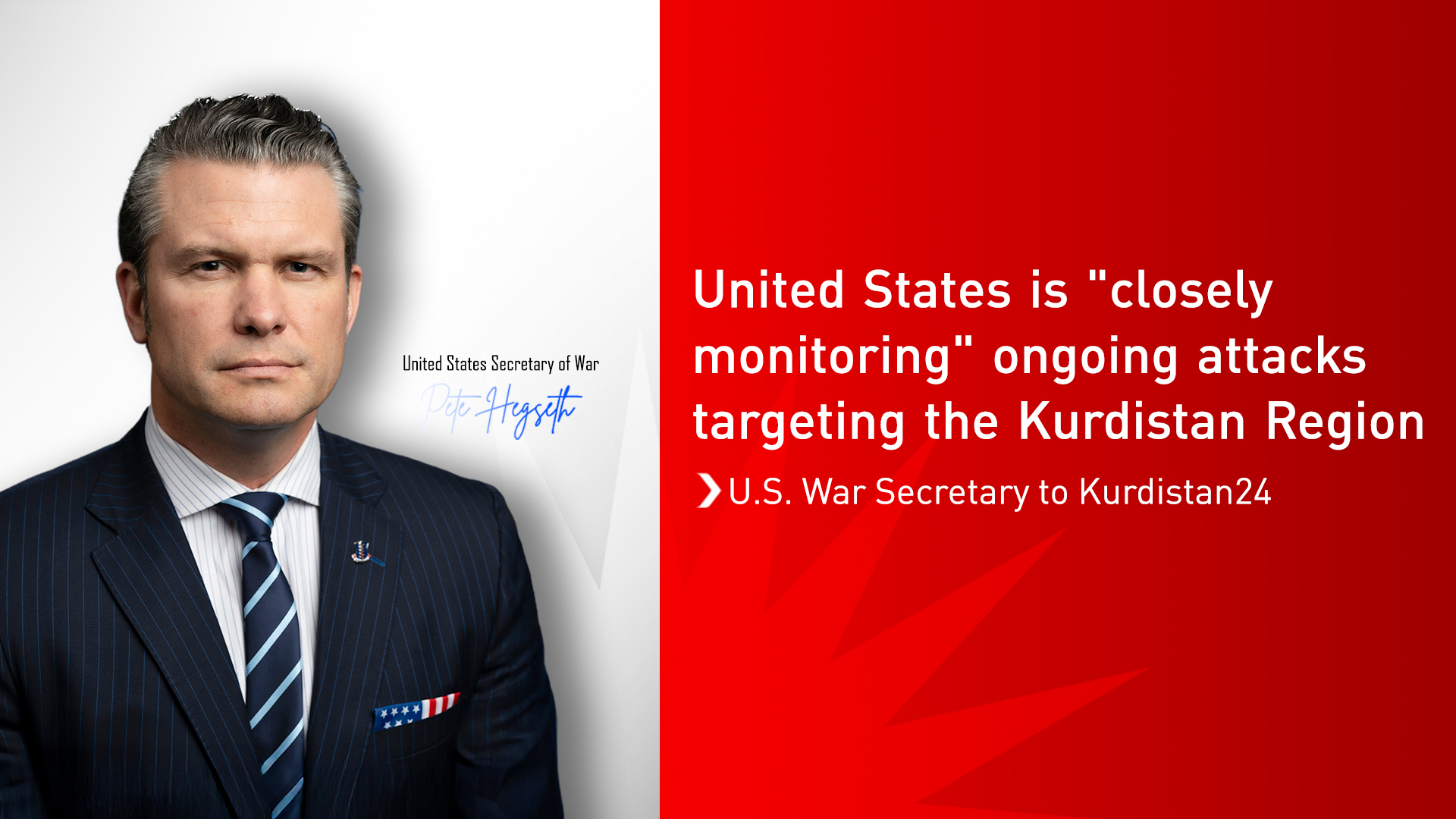
Speaking to Kurdistan24’s Washington bureau chief Rahim Rashidi, Hegseth stated that the United States is "closely monitoring" ongoing attacks targeting the Kurdistan Region.
ERBIL (Kurdistan24) - U.S. Secretary of War Pete Hegseth on Friday reaffirmed Washington’s commitment to monitoring security threats against the Kurdistan Region, emphasizing a strategic priority to prevent Iran from acquiring nuclear weapons.
Speaking to Kurdistan24’s Washington bureau chief Rahim Rashidi, Hegseth stated that the United States is "closely monitoring" ongoing attacks targeting the Kurdistan Region. The remarks come amid a period of heightened regional tension and sporadic drone and missile strikes directed at Erbil.
The Secretary further underscored the administration’s focus on Tehran’s nuclear ambitions, stating that ensuring Iran does not obtain nuclear weapons remains a critical objective. He noted that reaching a "good agreement" is a primary focus for US policy, though he did not elaborate on the specific parameters of such a deal.
The statements reflect a continuation of the strategic partnership between Washington and Erbil. The Kurdistan Region remains a central pillar of US security architecture in the Middle East, serving as a key hub for counter-terrorism operations and regional stability efforts.
Security analysts suggest Hegseth’s comments signal a firm stance against regional escalation and a push for a more robust diplomatic or deterrent framework regarding Iran’s nuclear program.
The comments by the Secretary of War came amid a briefing at the Pentagon, where Hegseth and Chairman of the Joint Chiefs of Staff Gen. Dan Caine confirmed that U.S. military operations have transitioned from active combat into a "global" interdiction phase.
This new posture is designed to exert "ironclad" pressure on Iranian commercial transit and nuclear ambitions under an indefinite ceasefire.
"We are very clear about our authority and the necessity of these actions to achieve the administration’s strategic objectives," Hegseth told reporters, noting that the blockade is expanding in scope and reach.
Gen. Caine confirmed that the U.S. military is currently enforcing restrictions on all vessels moving to or from Iranian ports. In recent days, American forces intercepted 34 ships, including the seizure of the M/V Touska and two "dark fleet" tankers in the Indian Ocean.
A second U.S. aircraft carrier is expected to join the blockade shortly to solidify control over Iranian maritime assets.
The situation in the Strait of Hormuz remains volatile. Following a directive from President Donald Trump, U.S. commanders have received orders to "shoot to destroy" any Iranian assets attempting to mine the waterway or threaten commercial shipping.
Despite these tensions, the U.S. Department of War reported that 34 non-Iranian vessels were permitted to transit the strait as of Friday morning.
The shift to a maritime blockade comes amid a fractured Iranian leadership and an extension of the ceasefire between Israel and Lebanon. President Trump has indicated he is in "no hurry" to finalize a diplomatic settlement, opting instead to maintain the blockade to maximize leverage.
For the Kurdistan Region, Hegseth’s pledge of continued monitoring arrives at a critical juncture. Erbil has frequently been the target of missile and drone strikes by Iranian-aligned groups, prompting the Kurdistan Regional Government (KRG) to call for enhanced air defense capabilities and sustained U.S. security guarantees.
The Pentagon has called on international allies to assist in mine-clearing efforts and maritime security. While the blockade remains in effect, the U.S. maintains "total control" over the strategic chokepoint of the Strait of Hormuz, through which one-fifth of the world’s oil supply typically flows.
This article was updated on Friday, Apr. 24, 2026, at 04:12pm.