French Envoy in Erbil Highlights Enduring France-Kurdistan Ties at Annual Music Festival
Consul General Yann Braem says cultural celebration sends a message of hope, resilience, and friendship after years of regional turmoil
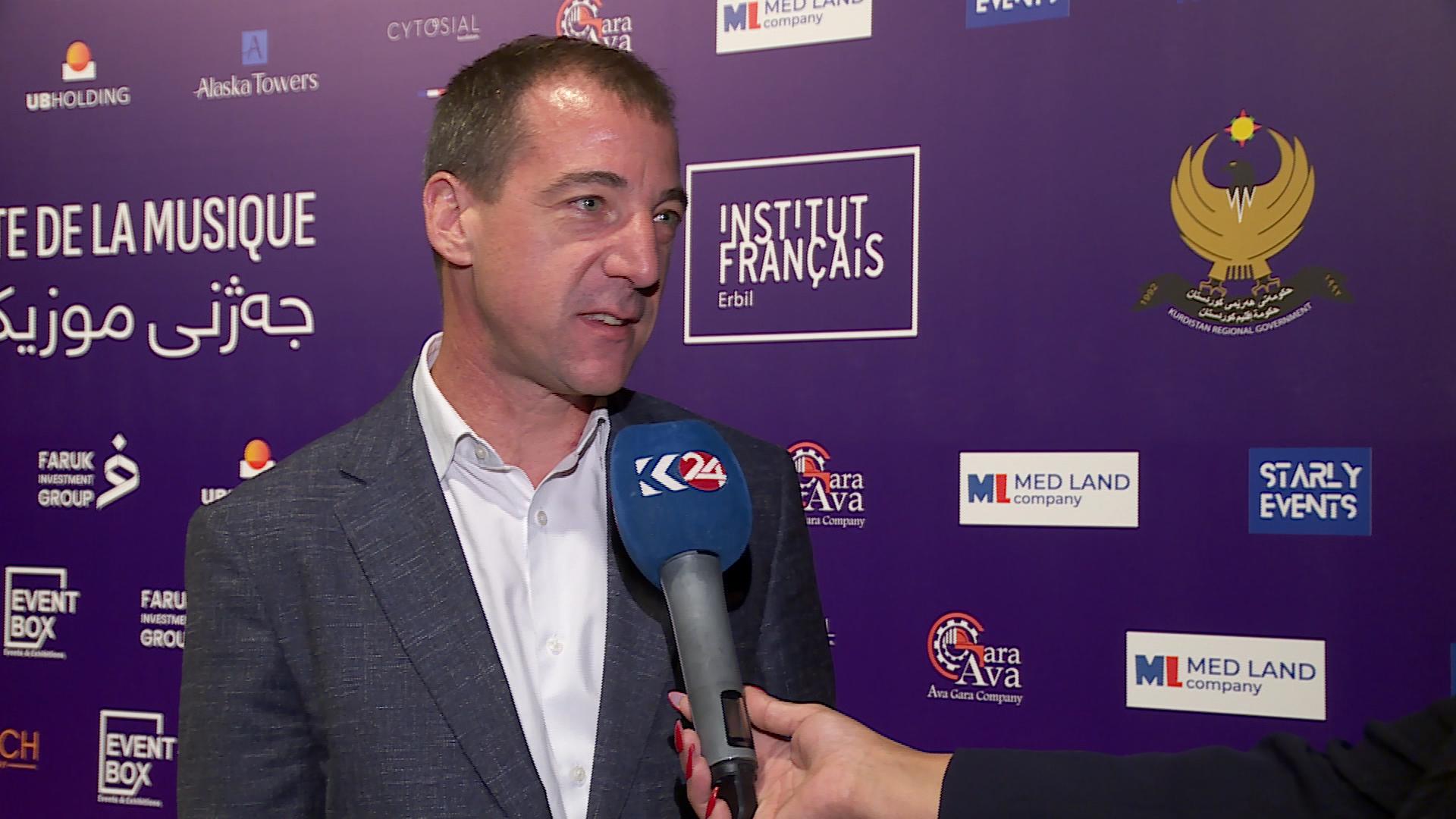
ERBIL (Kurdistan24) — France's Consul General in Erbil, Yann Braem, on Saturday underscored the deep and historic friendship between France and the Kurdistan Region, saying cultural events such as the annual French Music Festival serve as a powerful reminder of resilience, hope, and the enduring bonds between peoples.
Speaking to Kurdistan24 during celebrations marking France's annual music festival, known internationally as the "Fête de la Musique," Braem said the event has become a longstanding tradition since its launch in 1982 and is now celebrated in more than 120 countries worldwide.
"We have organized this event every year since 1982. France celebrates music, and we celebrate music in more than 120 countries," Braem said. "It's a tradition to let people enjoy music and play music for free in a popular gathering that brings together everyone, from the highest levels of society to ordinary citizens."
The French diplomat noted that this year's event carries special significance after last year's festival was canceled due to the outbreak of war and heightened regional tensions.
"Since the situation has calmed down, we are able to organize this event," he said. "For us, it is an opportunity to send the message that life continues after all the difficult situations we have suffered. It is a message of hope and a return to normal life."
Braem said the celebration reflects a shared desire to restore everyday life through culture, music, theater, and artistic expression after years marked by conflict and economic hardship.
The festival is being held across multiple cities in the Kurdistan Region, including Erbil, Duhok, and Sulaimani, highlighting France's continued cultural engagement throughout the region.
Beyond cultural cooperation, Braem emphasized the broad and growing partnership between France and the Kurdistan Region, describing the relationship as one rooted in friendship, shared values, and decades of cooperation.
"We have very close relations between our political leaders and very close relations between our security services, whether military forces or police forces," he said.
He noted that cooperation has expanded in areas including security, policing, migration management, education, and business development.
In the field of education, Braem pointed to the International French Schools Danielle Mitterrand in Erbil and Sulaimani as examples of France's long-term investment in Kurdistan's future.
According to the consul general, the schools have evolved into increasingly international institutions, offering multilingual education in French, English, Kurdish, and Arabic while preparing students for higher education opportunities abroad.
"A lot of them will go and study in France," Braem said of the students. "They speak French, perfect English, Kurdish, and Arabic. In the future, they will be the living link between French and Kurdish people."
The diplomat also highlighted growing economic cooperation and efforts to further strengthen commercial ties between French institutions and the Kurdistan Region.
Reflecting on the foundations of the relationship, Braem credited the late Danielle Mitterrand—widely known among Kurds as the "Mother of the Kurds"—with helping establish a lasting bond between the French and Kurdish peoples.
"You remember the role of Danielle Mitterrand," he said. "She planted the seeds of a very strong friendship between the people."
France has long been regarded as one of the Kurdistan Region's closest European partners. Successive French governments have maintained strong political engagement with Kurdish leaders and have consistently supported the Kurdistan Region during critical periods of its modern history.
French support became particularly visible following the 1991 Kurdish uprising against dictator Saddam Hussein's regime, when Paris advocated internationally for the protection of Kurdish civilians.
The relationship deepened further after the rise of ISIS in 2014, when France joined the international coalition supporting Iraqi and Kurdish forces in the fight against the extremist group.
French military advisers and special forces worked alongside Peshmerga forces throughout the anti-ISIS campaign, while France provided military assistance, training, humanitarian aid, and diplomatic support.
The shared struggle against ISIS strengthened strategic ties between Paris and Erbil and forged what many officials on both sides describe as a partnership built on mutual sacrifice and trust.
"French blood and Kurdish blood have been intertwined here," Braem said, recalling the joint fight against ISIS.
Today, relations between France and the Kurdistan Region extend far beyond security cooperation, encompassing diplomacy, culture, education, economic development, and people-to-people exchanges.
French leaders regularly receive senior Kurdish officials in Paris, while French diplomatic missions remain actively engaged in supporting development initiatives across the Kurdistan Region.
Braem said France intends to continue expanding those partnerships, emphasizing that the country's commitment to Kurdistan remains strong because of the historical friendship between the two peoples.