U.S. Department of War Expands Blockade of Iran Globally
The U.S. Department of War confirmed Friday that Operation Epic Fury has achieved its military objectives, leading to the establishment of a global maritime blockade to maintain pressure on Iran.
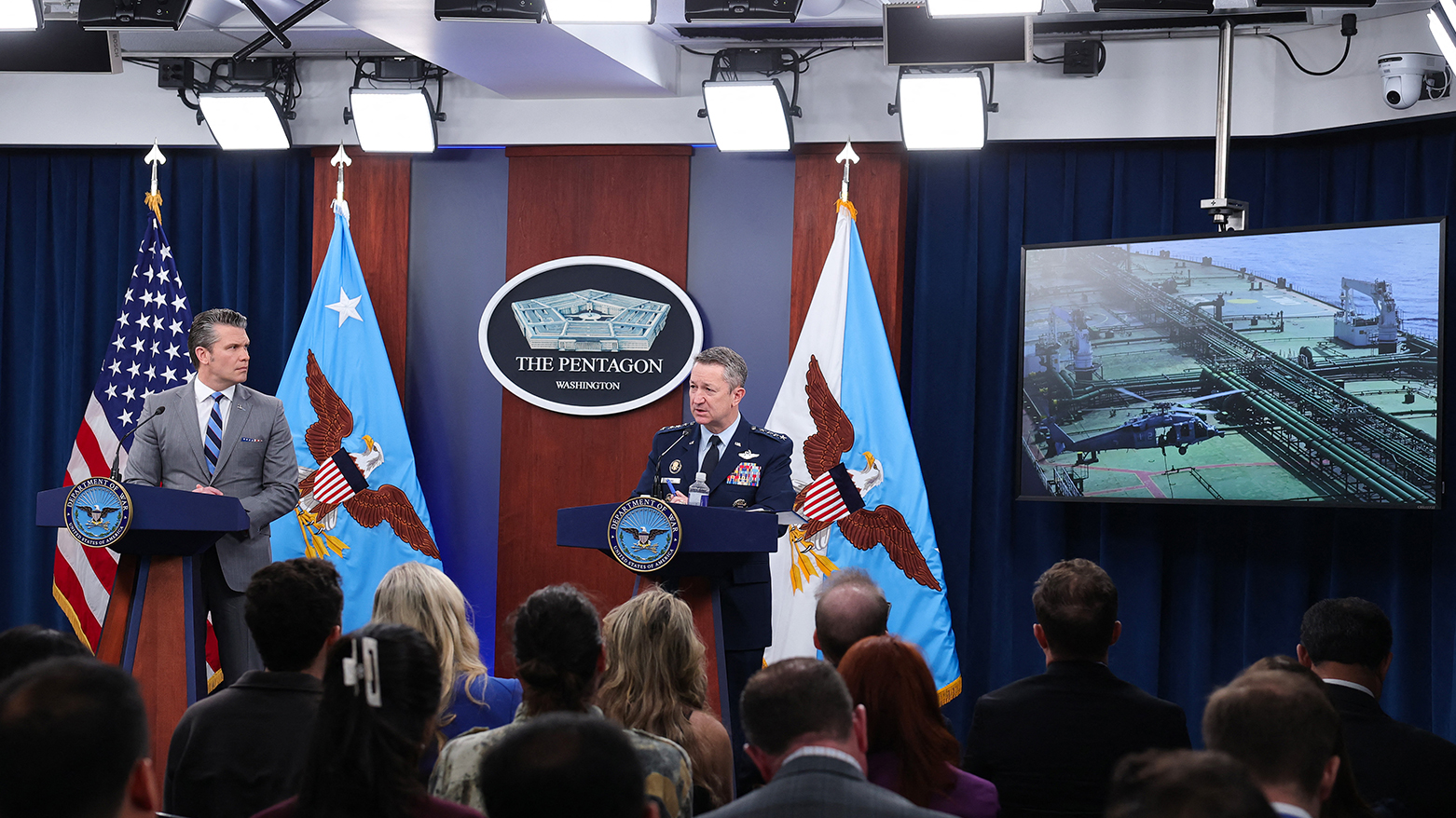
ERBIL (Kurdistan24) - Secretary of War Pete Hegseth and the Chairman of the Joint Chiefs of Staff, Gen. Dan Caine, announced Friday that the United States has transitioned its military campaign against Iran into a "global" maritime blockade.
In a report published Friday morning by CBS News, officials from the U.S. Department of War detailed that Operation Epic Fury has achieved a "decisive military result" over the past several weeks, shifting the mission’s priority toward a comprehensive interdiction strategy designed to prevent Tehran from advancing its nuclear capabilities.
According to the update provided by the U.S. Department of War, the campaign has moved into a new phase that combines continued economic pressure with a pause in active hostilities under an indefinite ceasefire.
During a joint briefing, Secretary Hegseth stated that the Iranian leadership now faces the opportunity to negotiate what he termed a "wise deal" with the administration.
The CBS News dispatch noted that while the ceasefire remains in place, the U.S. military has significantly expanded the scope of its naval operations, ensuring that the blockade of Iranian ports and maritime assets is now "ironclad" and increasingly international in reach.
In details documented by CBS News correspondents Melissa Quinn and Joe Walsh, the U.S. Department of War confirmed that a second aircraft carrier is scheduled to join the blockade in the coming days.
The military’s current posture, which Secretary Hegseth described as "growing and going global," is aimed at total control over Iranian commercial transit. Despite the overarching restrictions, the Department of War clarified that certain international traffic is being permitted through the Strait of Hormuz.
As of Friday morning, the report indicated that 34 non-Iranian vessels have been allowed to transit the waterway, including during overnight hours, though the total volume of shipping remains substantially lower than historical averages.
The mechanics of the blockade were further detailed by Gen. Dan Caine, who informed reporters that the U.S. military is currently enforcing restrictions on any vessel attempting to move to or from an Iranian port.
According to figures released by the U.S. Department of War, 34 ships have been intercepted and forced to turn around after meeting the blockade. However, the military has utilized more direct measures in specific instances.
Gen. Caine confirmed that one vessel, the M/V Touska, was seized by American forces. Two additional ships categorized as "stateless" but linked to the Iranian "dark fleet"—the M/T Tifani and the M/T Majestic X—were also interdicted.
The U.S. Department of War noted that these interdictions took place within the Indo-Pacific Command's area of responsibility, specifically in the Indian Ocean. According to Gen. Caine, the crews of these vessels remain in U.S. custody.
The report emphasized that the military will continue to conduct maritime interdiction activities in the Pacific and Indian Oceans to ensure no Iranian-linked cargo bypasses the primary blockade.
Secretary Hegseth told the press that the U.S. is "very clear" about its authority and the necessity of these actions to achieve the administration’s strategic objectives.
The volatility of the maritime environment was underscored by recent Iranian counter-actions in the Strait of Hormuz. The CBS News report detailed that Iran has attacked and allegedly boarded at least two cargo ships in the waterway.
Iranian Revolutionary Guards released an edited video on Thursday showing masked commandos using speedboats to board commercial vessels.
Secretary Hegseth characterized these Iranian targets as "random ships" that had been subjected to gunfire. Amid these tensions, the Philippine government confirmed that 15 Filipino seafarers aboard vessels seized by Iran are "safe and unharmed," according to the latest information available to the U.S. Department of War.
Operational rules of engagement have also been clarified following a directive from President Donald Trump. On Thursday, the president ordered the U.S. Navy to "shoot and kill" any Iranian boat attempting to place mines in the Strait of Hormuz.
Secretary Hegseth confirmed Friday that commanders at the Department of War have received explicit instructions to "shoot to destroy" any Iranian assets found to be mining the water or threatening American commercial shipping.
While the military is actively engaged in mine-clearing efforts, Hegseth declined to provide a specific timeline for completion, instead calling on international allies to contribute to the security of the waterway.
On the diplomatic front, the U.S. Department of War is operating under an indefinite extension of the ceasefire with Iran.
President Trump informed reporters at the White House that he is in no hurry to finalize a deal, stating that the current pause in bombing allows for more leverage over a "severely fractured" Iranian leadership.
According to the CBS News report, the president has warned that he will resume military strikes if Tehran fails to engage in meaningful negotiations, though he remains focused on securing what he calls the "best deal."
This pause in the Iran conflict coincides with a three-week extension of the ceasefire between Israel and Lebanon, a development that officials believe could influence Tehran’s decision-making due to its support for Hezbollah.
Internal shifts within the U.S. Department of War have also marked the current week.
Navy Secretary John Phelan departed his post at the direction of both the president and Secretary Hegseth. In an Oval Office exchange captured in the background reports, the president described Phelan as a "wonderful guy" but noted that he had difficulty maintaining professional relationships with other senior officials.
President Trump emphasized that internal cohesion within the military hierarchy is essential, particularly during the enforcement of a global blockade.
The conduct of the war has also drawn international scrutiny, specifically from the Vatican. Secretary Hegseth addressed recent criticisms from Pope Leo, who questioned the morality of the campaign against Iran.
The Secretary of War defended the mission, telling the press that the Department of War is confident in its mandate and its specific goal of regional denuclearization. This institutional detachment from international criticism remains a hallmark of the current administration’s approach to the conflict.
According to the latest status report from U.S. Central Command, the U.S. maintains "total control" over the Strait of Hormuz, despite Iran's claims on Thursday that it had begun collecting toll revenue from the waterway. The Department of War continues to monitor the "tit-for-tat" nature of maritime interdictions, as both nations compete for dominance over the strategic chokepoint.
With one-fifth of the world’s oil supply typically transiting the strait, the economic implications of the continued blockade remain a focal point for global markets and international shipping associations.
As Operation Epic Fury concludes its primary combat phase, the U.S. Department of War remains positioned for long-term enforcement.
Secretary Hegseth and Gen. Caine have jointly addressed the press multiple times since the conflict began in late February, reinforcing a unified front between the civilian and military leadership of the War Department.
The transition to a global blockade represents the administration’s stated preference for maritime and economic containment as a precursor to any potential diplomatic settlement with the Iranian government.