Erbil Launches Scientific Data Center for Resource Management
New facility digitalizes water and soil monitoring to enhance Kurdistan’s climate resilience.
ERBIL (Kurdistan24) - The Director of Erbil Irrigation, Engineer Rebwar Hassan on Tuesday confirmed the establishment of a specialized scientific center dedicated to the collection and analysis of water and soil data. This institutional development is part of a strategic initiative by the Kurdistan Regional Government (KRG) to modernize natural resource management and provide a technical foundation for addressing the evolving challenges of climate change within the region.
A scientific and data center for water and soil resources officially opened in Erbil on Monday.
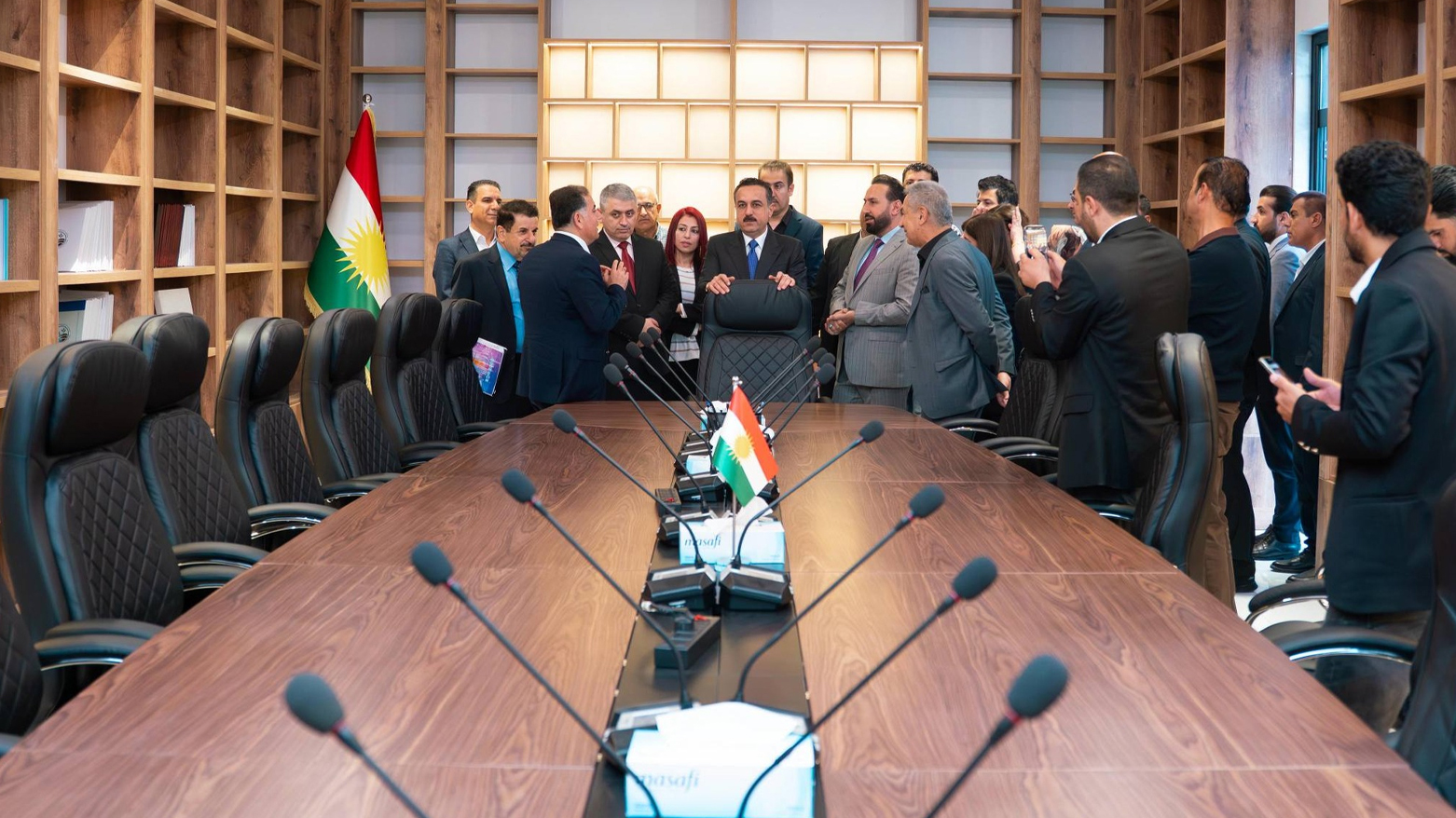
The facility, located within the Erbil Irrigation Directorate's headquarters, was inaugurated by the Governor of Erbil, Omed Khoshnaw, during an official visit intended to promote the integration of scientific principles into the irrigation sector.
The center is designed to serve as a repository for academic research and a hub for expert consultation on the management of natural resources across Erbil Province.
The establishment of this center aligns with the overarching objectives of the "Local Climate Change Adaptation Plan for Kurdistan Region - Iraq" (LAP).
Formulated in coordination with the United Nations Development Programme (UNDP), the LAP serves as the region's comprehensive policy framework for enhancing adaptive capacity and building resilience against environmental stressors.
By centralizing water and soil data, the KRG aims to fulfill the LAP's mandate for data-driven environmental governance and regional resilience.
What the "Water and Soil Resources Scientific Center" signifies is a transition toward the digitalization of environmental monitoring in the Kurdistan Region.
Why water and soil data are critical for environmental management is rooted in the region's increasing vulnerability to water scarcity, soil degradation, and temperature extremes.
How this reflects broader climate adaptation efforts is through the creation of a "robust information base" that enables policymakers to move from reactive measures to scientific decision-making, particularly in the agricultural and irrigation sectors.
Institutional Integration of Scientific Data Systems
The new center functions as a critical component of the KRG's strategic plan to confront climate change.
According to Rebwar Hassan, the facility is "one of the most important scientific bases" tasked with the responsibility of ensuring the precision of data related to the region's foundational natural resources.
The center will utilize digital mapping for soil and water, providing researchers and decision-makers with the tools necessary to limit the waste of resources in a "scientific and modern manner."
This development directly supports the "Local Climate Change Adaptation Plan," which was officially launched by the Environmental Protection and Improvement Board (EPIB) to reduce vulnerability to the impacts of changing weather patterns.
The LAP identifies the lack of precise data as a potential institutional gap. By establishing the Erbil center, the KRG is implementing the plan's strategic focus on "identifying and understanding historical and projected climate risks at the regional level."
During the inauguration, Governor Omed Khoshnaw emphasized that the province will provide sustained support for initiatives that serve the protection of water and soil resources. The center is expected to provide the expert consultation required to optimize irrigation projects, which are vital for Erbil's agricultural stability.
This aligns with the LAP's identification of the water sector as the second most vulnerable sector in the region, primarily due to a heavy reliance on limited supplies and susceptibility to shifting precipitation patterns.
Technical Functions: Monitoring and Mapping
The operational mandate of the center includes the collection of "all precise data and information" related to the Kurdistan Region's soil and water. This includes digital mapping of soil types and groundwater levels, which is essential for confronting the "risks of water scarcity and rapid climate change."
The center serves as a new scientific institution where academic research is collated to provide a reliable source for evidence-based governance.
According to the policy document, "Local Climate Change Adaptation Plan for Kurdistan Region - Iraq," the region faces unique climate challenges that differ from the southern parts of Iraq.
The LAP notes that while mean and minimum temperatures show a distinct increasing trend in Erbil, there has been a corresponding slight decrease in annual mean precipitation.
Specifically, future projections for Erbil suggest a temperature increase of 1.0 to 5.0 °C compared to the 1995–2014 reference period.
The data center's role in digital mapping is particularly relevant given the LAP's projection that the number of "hot days" (temperatures exceeding 40°C) in Erbil is expected to increase by 15 to 54 days.
Such data is necessary for the center to provide "expert consultation" on agricultural planning and irrigation schedules, helping to mitigate the "oven-like" summer heat and its impact on crop yields and groundwater recharge.
Climate Adaptation Framework and Regional Resilience
The establishment of the Erbil center is situated within a broader environmentalism framework characterized by the 2024 LAP.
The plan was developed using a participatory approach involving a Technical Working Group (TWG) composed of local sectoral experts. The center embodies the "MRL Data Platform" (Monitoring, Review and Learning) identified in the LAP's institutional arrangements for adaptation.
The LAP's Strategic Framework sets out six primary objectives, with the Erbil center contributing significantly to three:
- Providing a functional coordinating framework to guide national stakeholders through climate-resilient decision-making.
- Establishing a baseline for a robust monitoring, review, and learning framework.
- Supporting the Government of Iraq in achieving its national priorities provided in its Nationally Determined Contributions (NDCs) and the Sustainable Development Goals (SDGs).
Policy analysis of these goals suggests that the creation of the center is a move to "mainstream" the LAP into local administrative functions.
By housing the center within the Erbil Irrigation Directorate, the KRG ensures that scientific data is seamlessly incorporated into the "sectoral planning and budgeting systems," as called for by the LAP.
Environmental Significance: Water and Soil Management
Erbil Province faces significant environmental pressures, including groundwater decline and biodiversity loss.
Table 2 of the LAP report identifies "Extreme heat, Water scarcity (Groundwater decline, Water loss, precipitation decline), and Biodiversity loss" as the prominent climate hazards for Erbil.
The province has an overall vulnerability score of 4.80, with its water sector sensitivity rated at 3.2 out of 5.
The "Water and Soil Resources Scientific Center" is designed to address these specific vulnerabilities.
By tracking groundwater decline and soil fertility through digital mapping, the center facilitates the "Implementation of water conservation practices" and the "Development of water infrastructure," which are priority programs under the LAP's Adaptation Action Plan.
Furthermore, the center supports the LAP's agriculture and food security goals.
In Erbil, agriculture is a vital sector that remains susceptible to "changing growing seasons" and "water quality issues."
The expert consultation provided by the new center will help local farmers adopt "climate-smart agricultural techniques," including crop diversification and efficient irrigation, which are essential for long-term food security in a semi-arid continental climate.
Infrastructure Expansion and Climate Variability
The inauguration of the Erbil center coincides with the KRG's broader infrastructure policy aimed at securing water resources.
Over the past four years, the KRG's ninth cabinet has expanded the region's water storage capacity to 10 billion cubic meters through the completion of 120 ponds and eight major dams, including strategic projects like the Gomespan, Dwin, and Khans dams.
The newly established scientific center is positioned to support this expanded infrastructure by providing the hydrological data necessary to optimize reservoir management and agricultural allocation.
The necessity for precise data management has been heavily underscored by recent climate anomalies.
During the 2025–2026 winter season, the Kurdistan Region witnessed a marked increase in rainfall and snowfall, presenting a sharp contrast to preceding years of severe drought.
Meteorological records documented intense precipitation, with sub-districts such as Hiran receiving 104 millimeters of rain in a 24-hour period, and areas like Kani Masi recording 34 centimeters of snow.
This influx caused the Dukan Dam's water level to surge by 4.39 meters and led to the maximum-capacity overflow of both the Smaquli and Khans dams.
The scientific center will be crucial in modeling these dramatic hydrological shifts, from mitigating flood risks during sudden precipitation spikes to efficiently banking water for subsequent dry seasons.
Furthermore, this institutional development reflects a formalization of long-standing regional environmentalism.
The modern policy framework parallels a century-old legacy of indigenous ecological stewardship in the Zagros Mountains, where early 20th-century leaders such as Sheikh Ahmed Barzani issued strict decrees protecting forests, wildlife, and natural waterways in the Barzan and Sherwan territories.
Today, the KRG is transitioning that historical, cultural commitment to environmental protection into a formalized, data-driven governance structure.
Policy Analysis: Institutional Capacity-Building
What appears as a technical initiative is, in effect, part of a broader effort to institutionalize environmental data systems in response to climate pressures.
The inauguration of the Erbil center reflects a growing recognition within the KRG that "adaptation is not merely an option; it is a necessity," as stated by Abdulrahman Sedeeq, Head of the EPIB.
The center represents a shift toward a more robust "Adaptive Capacity."
The LAP defines adaptive capacity through indicators such as "Infrastructure availability," "Technology and innovation," and "Institutional capacity."
By creating a dedicated facility for scientific consultation, Erbil is enhancing its ability to "withstand and recover from climate-related events such as droughts, floods, or extreme temperatures."
This institutional response is also a step toward securing international cooperation.
The LAP notes that a local adaptation plan facilitates "access to climate finance" by aligning with national and international climate goals.
The existence of a "scientific and data institution" provides the "precise data" required for international grants and partnerships with organizations like the UNDP and GCF (Green Climate Fund), enhancing the region's credibility in global climate forums.
The opening of the Water and Soil Resources Scientific Center in Erbil marks a significant milestone in the Kurdistan Regional Government's institutional response to climate change.
By integrating precise data collection with the strategic goals of the Local Climate Change Adaptation Plan, the KRG is building the necessary infrastructure for scientific resource management.
This initiative not only addresses immediate concerns regarding water scarcity but also establishes a long-term foundation for regional environmental resilience and sustainable development.