Iraq’s New Premier Faces a Kurdish Parliament Boycott: What to Know About the Political Atmosphere in Iraq
Ali al-Zaidi will meet President Masoud Barzani to resolve longstanding Erbil-Baghdad disputes, while emerging cabinet distribution details reveal Kurds in line for three to four ministries
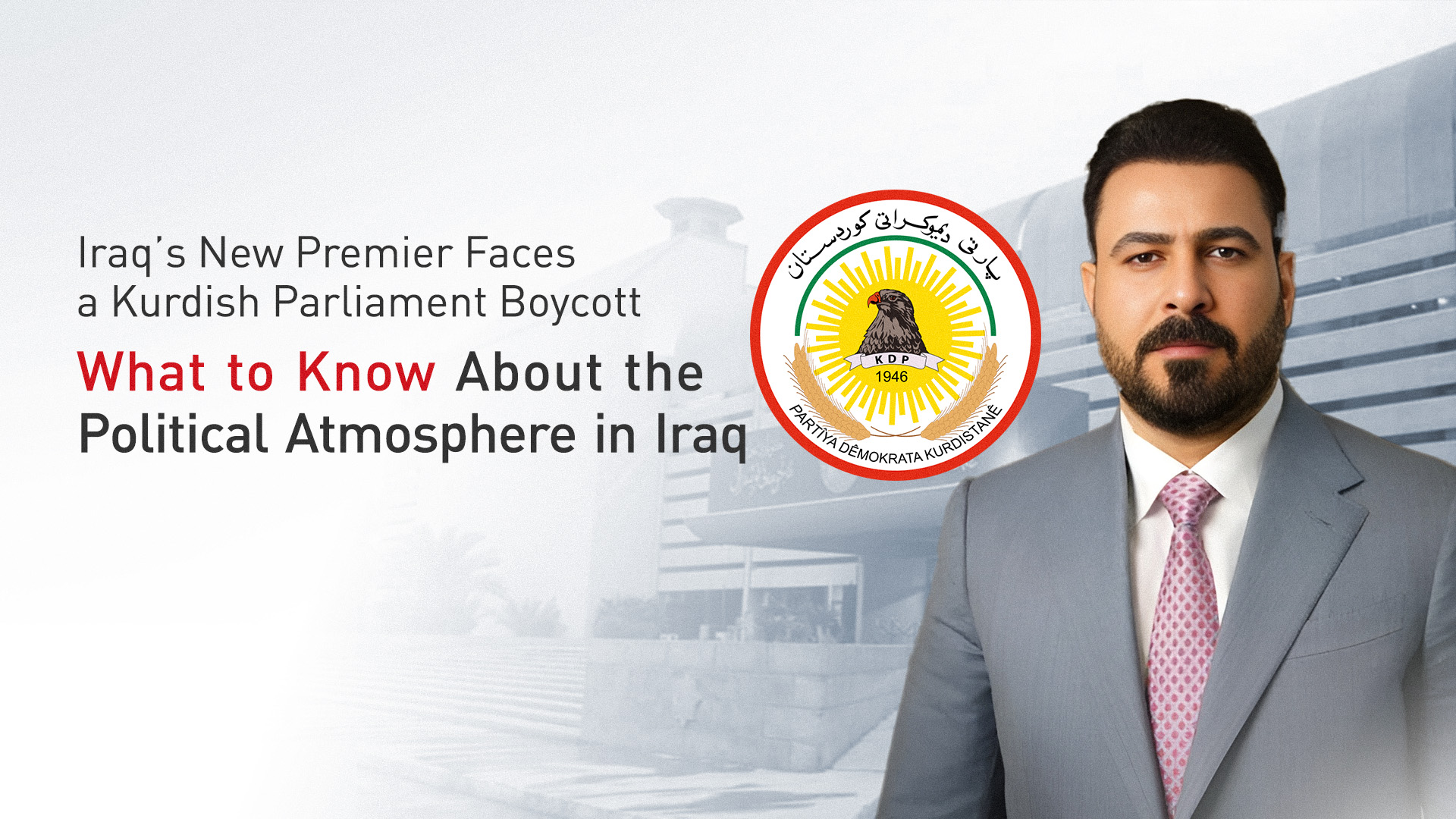
ERBIL (Kurdistan24) - Iraq's prime minister-designate Ali Al-Zaidi will visit the Kurdistan Region next week for a meeting with President Masoud Barzani, a senior figure in the Coordination Framework's State of Law alliance confirmed on Wednesday, — a visit framed from the outset as an attempt to resolve the disputes between Erbil and Baghdad.
Abdulrahman al-Jazairi, a State of Law alliance leader, told Kurdistan24 that the visit's primary agenda will center on the salary crisis and Article 140 — two of the most persistently unresolved issues in the Erbil-Baghdad relationship.
He added that Al-Zaidi brings with him a new strategy for addressing these stalled disputes, and that he assigns particular importance to figures who played a constructive role in building Iraq's modern political process — among them President Barzani.
The visit comes two days after Barzani spoke with Al-Zaidi by telephone on Tuesday, congratulating him on his designation and describing the appointment as an opportunity to correct the course of Iraq's political process.
Kurdistan Region Prime Minister Masrour Barzani also extended congratulations, reaffirming Erbil's readiness to resolve outstanding disputes with Baghdad on a constitutional basis and expressing hope that Iraq would enter a new era of security, stability, and peace.
Al-Zaidi was formally announced as the Coordination Framework's candidate for prime minister on Monday evening, following an agreement between outgoing Prime Minister Mohammed Shia al-Sudani and State of Law leader Nouri al-Maliki.
KDP: This is a boycott, not a withdrawal
Al-Zaidi's Erbil visit arrives against the backdrop of a Kurdistan Democratic Party (KDP) parliamentary boycott that has added a layer of tension to the government formation process.
Ashwaq Jaf, a member of the KDP Central Committee and parliamentary bloc member, addressed the issue directly in Kurdistan24's midday news program on Wednesday, drawing a clear distinction between a boycott and a withdrawal.
"What the party has done is a boycott," she said, "and it does not mean withdrawal.
This is a democratic practice and an expression of a position against the constitutional and legal violations being committed, as well as violations of parliament's internal procedures."
Jaf said the boycott is rooted in the defense of the constitutional rights of the people of Kurdistan and a rejection of the erosion of the foundational principles on which post-2003 Iraq was built — partnership, balance, and consensus among its three main components.
She also addressed the conditions under which the KDP would return to Baghdad.
The party has formed a committee to assess the situation and prepare a detailed report documenting all violations committed.
Once complete, the party intends to enter dialogue with Iraq's political forces over those specific points.
"Our return to parliament is contingent on the outcome of those discussions and on guarantees that the constitutional rights of the components will be protected and the political process corrected," she said.
Jaf added that while a committee of parliamentary bloc leaders had already requested the KDP's return, the party's preference was for senior political leaders to come directly to the KDP leadership — rather than operating through intermediaries.
'Our issue is bigger than a post'
On the question of the Kurdish presidency — and persistent reports that the KDP boycott was driven by dissatisfaction over that post — Jaf was emphatic.
"We have no problem with who becomes president or which party they come from," she said. "Our objection was to the manner of the selection."
She explained that while the Shia house selected its own prime minister candidate and the Sunni house selected its own parliamentary speaker candidate, Kurds were not afforded the same right to independently determine their candidate for deputy parliamentary speaker. "Other parties should not interfere in that," she said.
"They were able to return Iraq from a period of isolation to a phase of diplomatic openness and initiative," she said, adding that this positive Kurdish and KDP role had been acknowledged and praised by Iraq's other political forces.
Of the Kurdish allocation, she confirmed that two ministries will definitively go to the KDP, one of which will be a sovereign ministry.
Cabinet distribution: who gets what
Details of the broader cabinet distribution leaked Wednesday from within the Coordination Framework, offering the clearest picture yet of how Iraq's new government under Al-Zaidi is being assembled.
Ministries are allocated through a points-based system, with posts ranked by political and financial weight into three tiers: sovereign ministries — Foreign Affairs, Interior, Defense, Finance, and Oil — carry the highest point value; service ministries including Health, Education, Higher Education, and Electricity carry medium value; and state minister positions carry the lowest.
The Shia component will receive the largest share, between 12 and 13 ministries, with Interior, Oil, Electricity, Finance, Health, and Transport among those already allocated to Shia factions.
Within that bloc, al-Sudani's alliance is set to receive five to six ministries, possibly including one sovereign post. State of Law under al-Maliki receives three.
Asaib Ahl al-Haq under Qais al-Khazali receives two — having already secured the deputy parliamentary speakership — though Khazali is reportedly pushing to acquire the Education Ministry from the Sunni component in exchange for relinquishing Higher Education.
Badr Organization under Hadi al-Amiri receives one.
Sunni factions are set to receive five to six ministries, including Defense, Planning, Education, Industry, and Commerce, though the Education Ministry remains contested.
Smaller components including Christians, Turkmen, and independent parliamentarians are generally allocated minor service ministries or state minister positions, such as the Migration and Displacement Ministry.
Intense competition persists over the sovereign ministries, with each faction aware that control of Oil, Finance, or Interior translates directly into budgetary and security leverage for years to come.
The visit to Erbil next week will be among Al-Zaidi's first significant political acts as premier-designate, and its framing — resolving the salary dispute and advancing Article 140 — signals an awareness in Baghdad that no government can be durably functional without Kurdish participation and goodwill.
Whether Al-Zaidi's "new strategy" for resolving Erbil-Baghdad disputes amounts to a genuine shift, or another iteration of promises made at the formation stage and forgotten after cabinet seats are filled, is a question the KDP, and the Kurdistan Region's population, have learned to treat with measured skepticism.
For now, the meeting is scheduled, the conditions have been stated, and the negotiation is underway.